
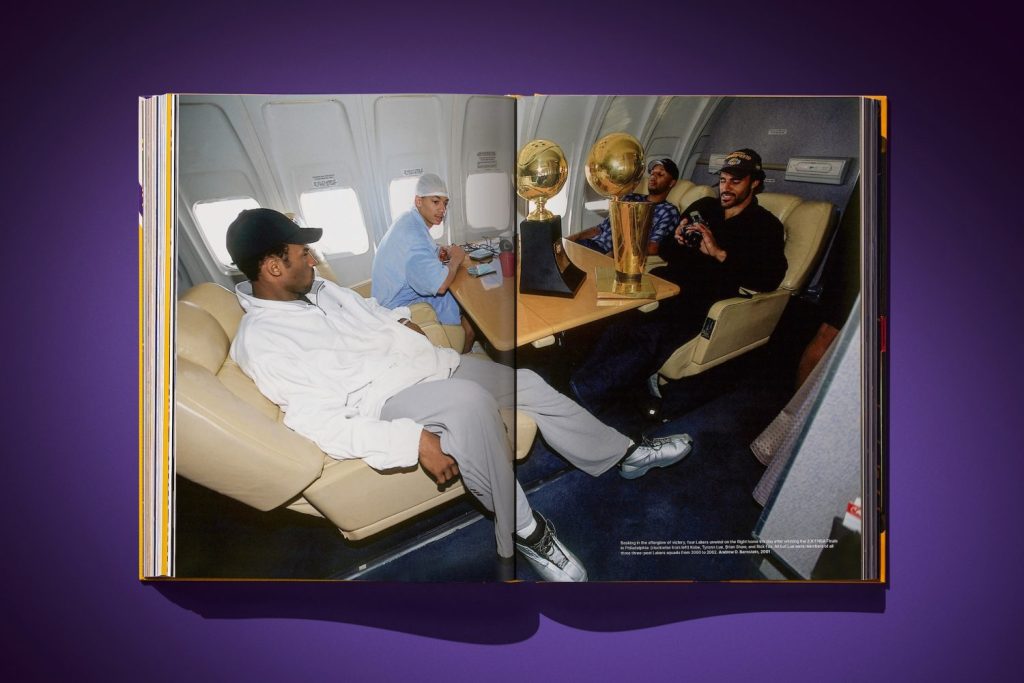
On 15 June 2001, in the locker room at Philadelphia’s First Union Center, the Los Angeles Lakers are celebrating their second consecutive NBA title, won against Allen Iverson’s Philadelphia 76ers. Somewhere between the showers and the lockers, in a corner of the room suspended in time, Kobe Bryant sits alone, staring into space, the Larry O’Brien Trophy in his arms. He is wearing a celebratory jacket by fashion designer Jeff Hamilton. Jesse D. Garrabrant raises his camera and takes a photograph that will become an emblem of early-2000s style, capturing what it means to be a Laker. Or, more than that, to be the Lakers, on and off the court.
“That photograph contains everything: winning, discipline, pain, glory. To me, it’s the Mona Lisa of sport. You can’t immediately grasp everything it makes you feel, and you can’t claim to know the whole story behind it, yet the image speaks for itself. It has become legendary in the Lakers’ imagination,” Vikki Tobak tells Undici. Born in Kazakhstan and raised in Detroit, Tobak knows how much an image can reveal without showing everything. This has become the hallmark of her work as a journalist and author, the signature of a distinctive approach to storytelling that begins with a single photograph, seemingly detached from its context, and gradually opens onto a much wider world. She has spent years doing this with the history of hip-hop. Now she has done it with Lakers. An Official History of the Purple and Gold, published by TASCHEN in collaboration with what the book describes as “the most glamorous franchise in sports”.
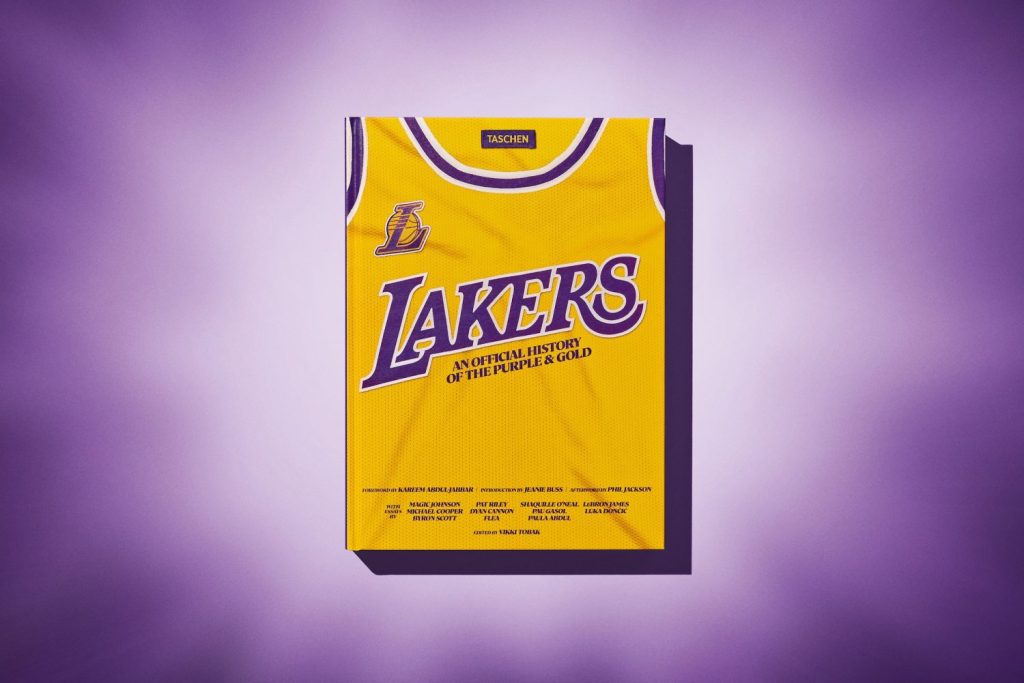
© Lakers. An Official History of the Purple & Gold, published by TASCHEN
The first thing I wanted to ask her was to pick one photograph, from the many she had selected, that could represent the Lakers across their first 80 years. It was hardly a straightforward task. “This book celebrates continuity, so I don’t think there’s a single photograph that can capture all of it. That was one of the big challenges when it came to choosing the cover. If I’d put one person on it rather than another, we might have ended up talking about just one era, or one particular period. This is about the Lakers, their glamour, the spectacle, the great personalities.”
So there is Kobe, the Mona Lisa, but also Magic Johnson and Kareem Abdul-Jabbar, George Mikan and Jerry West. “I was genuinely surprised by how many people didn’t know that Jerry West was the player in the NBA logo.”
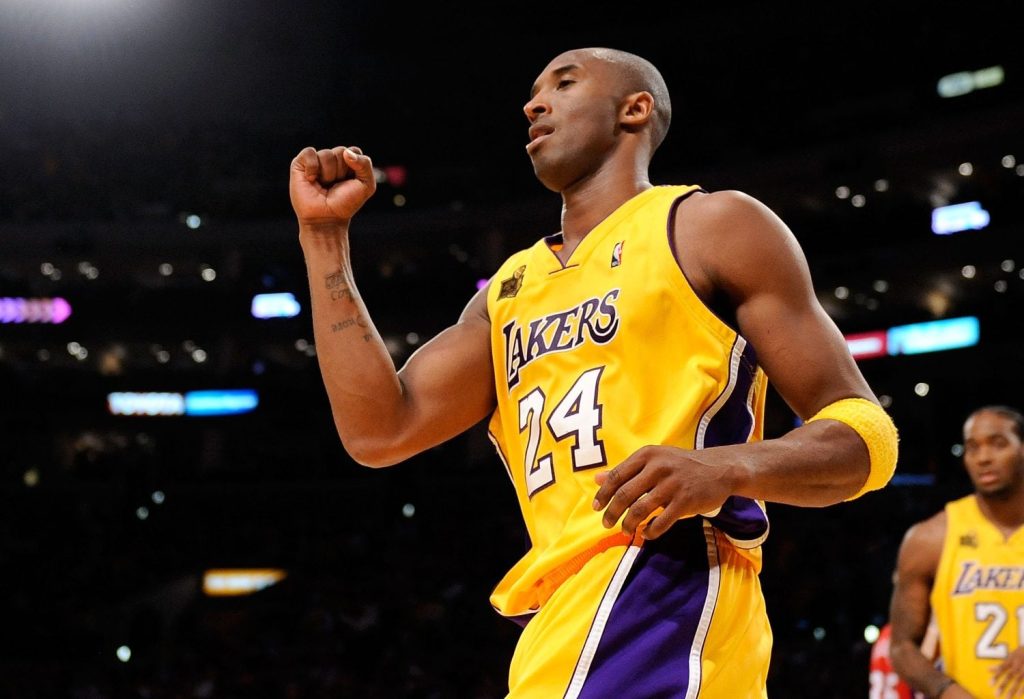
Then Jerry Buss and Jack Kent Cooke, Pat Riley and Phil Jackson, Wilt Chamberlain and Shaquille O’Neal, LeBron James and Luka Doncic. But if she had to choose just one image to explain the Lakers and their legacy to someone who knew nothing about them? “That’s difficult, but I think the photograph of Kobe making a behind-the-back pass to Shaq captures the spirit of the Lakers.”
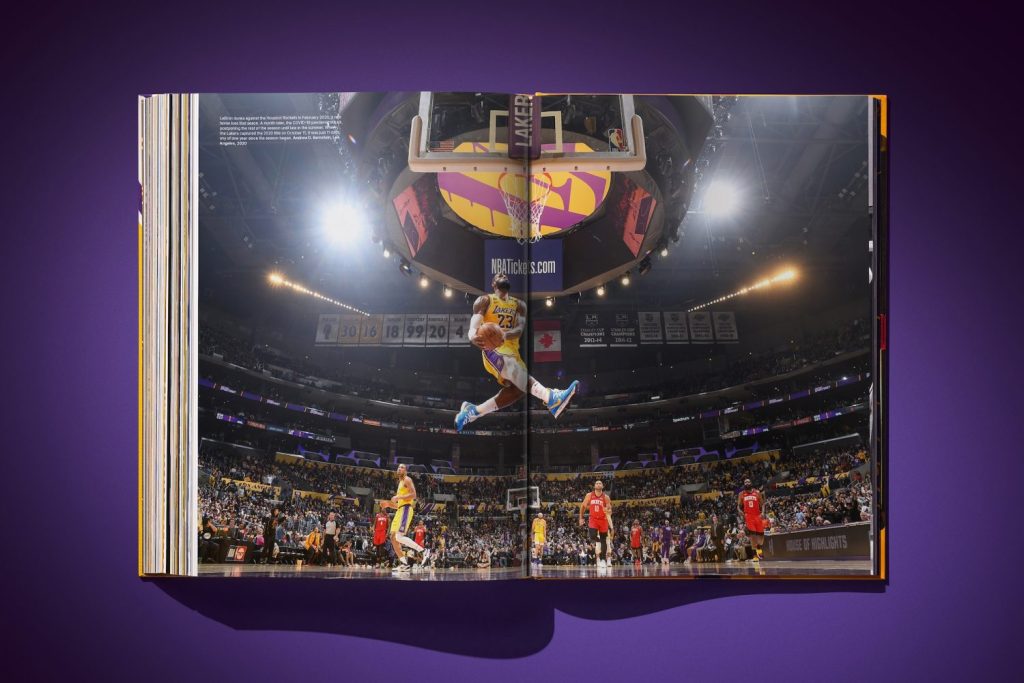
The Lakers are more than a brand whose association with Hollywood grows ever closer. They have become an extension of one of the world’s most recognisable cities, carrying the Los Angeles way of life far beyond its borders. Even those who have never made the pilgrimage to Inglewood to see the Fabulous Forum moments after stepping off a plane at LAX know something of what the Lakers represent. “To me, they’re a one-off, a kind of unicorn. Wherever you go in the world, you’ll find people wearing Lakers gear. In a way, the Lakers have become much bigger than Los Angeles itself, turning into a pop-culture icon. I think a lot of that comes from the image of Los Angeles: the glamour, the entertainment, the ability to become part of the spirit of different eras. And then, of course, there are the 17 titles, the Showtime years and the Kobe Bryant era. That winning culture, combined with Hollywood’s instinct for big ideas, has made the Lakers a phenomenon unlike any other in the eyes of the world. Over the years, even people who know very little about basketball have fallen in love with the Lakers. They recognise the logo, the palm trees, the spirit the team embodies, the winning mentality. It resonates everywhere, and the Lakers have become synonymous with it.”
People often say that something could only happen here. With the Lakers, the phrase feels particularly apt. In the early 1980s, only in Los Angeles could Jerry Buss have found the people capable of bringing his vision of sports entertainment to life. Not just the players and coaches who would earn their places in the Hall of Fame, but the many people who, at some point in their lives, embraced an idea that would transform not just a team but an entire league. Chief among them was Claire Rothman, the legendary power broker at the Forum and the driving force behind the idea of the Lakers as a family business. In light of the news that the Buss siblings are now at the centre of a bitter legal dispute over the sale of the family’s remaining stake in the franchise to Josh Kushner and Bob Iger, that idea feels almost anachronistic.
And yet the Lakers became the Lakers precisely because they have always been a family affair. “When I started working on the book a few years ago, I realised that, despite the enormous scale of the whole thing, there was still a family atmosphere,” Tobak says. “You step into their world and quickly understand how things work. It really is like a family, though I don’t necessarily mean people related by blood. There are people who have been around the Lakers for years and play crucial roles. Lisa Estrada, the chief operating officer, was a Laker Girl in the 1980s. Octavia Ellison, who was a Laker Girl during the Kobe and Shaq years, works closely with Jeanie Buss and Linda Rambis, who started working for the Buss family when Jeanie was still a teenager. Then there’s Lon Rosen, Magic Johnson’s longtime manager, who went on to work for the Dodgers before returning to take on a senior role. Spend time around the organisation and you realise how many people have been there all along. Even celebrities such as Dyan Cannon and Lou Adler are now considered part of the family.”
Small stories within the larger story, brought back to life through the memories and anecdotes of those who were there. Michael Cooper, in particular, has plenty to tell. “His love for the Lakers runs incredibly deep, and his memory is extraordinary. He has an anecdote about practically everything. We talked about the 1985 title against the Celtics, which he considers the most important in the team’s history. He’s also very funny. When he found out I was from Detroit, every time we spoke he would tell me I had to forget about the city, that I was a member of the Lakers family now. I can easily imagine him at practice, teasing all his teammates. He must have been great company,” Tobak says.
She has a clear idea of the ideal Laker, too. “Pat Riley. He played for the Lakers before becoming their coach, but as a coach he embodied the Showtime mentality perfectly. His discipline, his approach to coaching, his vision of basketball, the Armani suits he wore on the sidelines: all of it attracted attention. But when I spoke to him for the book, he explained that it was all in service of what he wanted to communicate as a leader and a coach, while showing respect for the players he worked with. I found it fascinating to see how all those elements came together in the image he projected throughout his career.” Perhaps that constant attention to the image one projects is part of what makes the Lakers what they are, even in seasons when results offer little to justify the ambition. If so, Tobak has it right, about Pat Riley and the Lakers alike. And no one could have told the story of the most glamorous franchise in sports quite like her.