
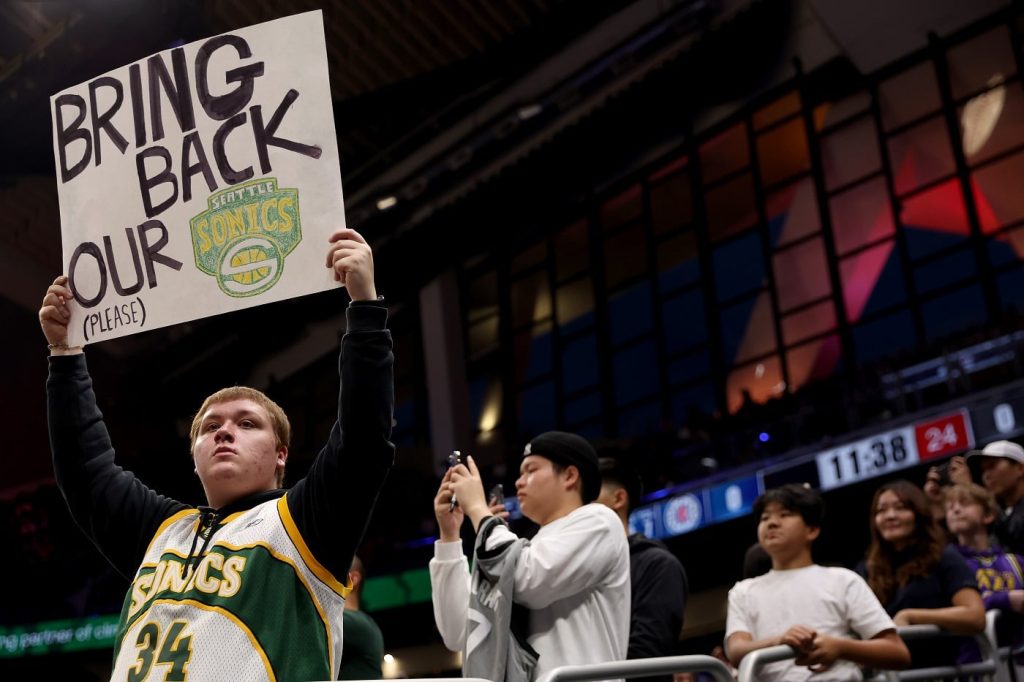
Seattle and the NBA are beginning to look like parallel lines, destined never to meet again. The return of the SuperSonics to the Emerald City once seemed inevitable; now, even their return is far from assured. According to ESPN, Adam Silver suggested at a recent meeting of the NBA’s Board of Governors that Seattle was no longer guaranteed a franchise. Mexico City has re-entered the picture, with a group of Mexican investors approaching PJT Partners, the investment bank advising the league on expansion, with a proposal for a franchise and a surrounding arena district. The approach has reportedly attracted the NBA’s interest, complicating what had appeared to be a straightforward choice between Las Vegas and Seattle.
The league has announced plans to explore expansion in both cities, but Silver has never promised that either would necessarily receive a franchise, let alone that both would. The NBA has expanded in pairs before, admitting Charlotte and Miami in 1988, Minnesota and Orlando in 1989, and Toronto and Vancouver in 1995. This time, however, the process could unfold in stages, with one city admitted before the other, or the league could decide that only one of the two American markets merits a team. Las Vegas appears to be Silver’s priority, while the offers for Seattle have so far fallen short of the league’s expectations. A preferred bidder for Las Vegas could emerge within weeks, with three groups competing in a process in which the franchise and its associated arena development are together expected to be valued at more than $10 billion. Seattle remains in contention, but the gap between the sums being discussed in the two markets is becoming increasingly difficult to overlook.
Two groups are known to be bidding for a Seattle franchise. The presumed frontrunner is led by Samantha Holloway, owner of the NHL’s Seattle Kraken and operator of Climate Pledge Arena. Yet the offers remain well below the figures emerging from Las Vegas, giving the NBA every incentive to keep Seattle bidding against the alternatives. The question is no longer whether Seattle merits a franchise, but how much the league believes it can extract from the city. Silver’s priority is to maximise the value of expansion. Running the Las Vegas process separately, encouraging unsuccessful bidders to turn their attention to Seattle and making clear that a second franchise is not guaranteed all strengthen the league’s hand. The prospect of Mexico City serves a similar purpose, introducing another potential destination just as Seattle might otherwise have assumed its place was secure.
Keeping the city waiting could also give the NBA leverage in its dealings with existing franchises seeking public money for arena projects, including the Portland Trail Blazers, even as Silver maintains that relocation is not under consideration. For all the financial manoeuvring, Seattle remains an obvious candidate. The SuperSonics played in the city from 1967 until their move to Oklahoma City in 2008, and their return would restore an NBA presence to a major American market with an established following and a modern arena. Overlooking such a market would be difficult to justify, particularly after the league itself identified Seattle as a potential expansion destination. The financial case may still be unresolved, but the case for bringing the team back has changed little.
A 31-team league would create complications of its own. The NBA operated with an odd number of franchises between 1980 and 2004, but the current NBA Cup format is built around an even number of teams, making a single addition less straightforward than it might seem. Mexico City, meanwhile, is hardly a ready-made alternative, however well-funded its prospective backers. The commercial opportunity may be considerable, but establishing a franchise there would bring practical and logistical challenges of its own.
Then there is the money existing owners expect to receive. Expansion fees are projected to deliver between $500 million and $600 million to each team, with one source citing financial plans based on a payout of $533 million. Owners have already factored that money into budgets for player salaries, arena improvements and debt repayments. A single expansion franchise would therefore deliver a considerably smaller windfall than two, with consequences extending well beyond the cities seeking admission: the owners who must approve the deal have their own financial interests at stake. The SuperSonics’ return remains entirely plausible, but what once seemed a formality has become a negotiation. For Seattle, the long-awaited homecoming now depends on what price the NBA is prepared to accept — and how long the city is prepared to wait.