
Basketball inspires extraordinary devotion across the globe, boasting an estimated 3.3 billion fans and 610 million players worldwide. But few nations have embraced the sport quite like China, where more than 200 million people hit the courts regularly, NBA superstars are household names, and the country’s greatest-ever player, Yao Ming, has transcended basketball to become a national icon. But the country’s relationship with basketball began long before Yao, Kobe Bryant or even Michael Jordan, stretching back almost as far as the sport itself. Introduced to China in the mid-1890s, barely five years after the game’s invention, basketball quickly took root, becoming an established part of the country’s sporting culture.
The NBA’s own relationship with China began in 1979, when the Washington Bullets became the first team from the league to visit the country. Its popularity exploded after NBA games began appearing on national broadcaster CCTV in the late 1980s, giving the league extraordinary reach and introducing millions of Chinese viewers to stars such as Magic Johnson and Michael Jordan. Then came Yao Ming. Drafted first overall by the Houston Rockets in 2002, the Shanghai-born centre became both superstar and catalyst, propelling the NBA’s popularity in China to new heights. Two years later, the league staged its first China Games, with Yao’s Rockets facing the Sacramento Kings in Shanghai and Beijing, while television coverage, sponsorship deals and regular visits from the sport’s biggest stars helped deepen the NBA’s presence.
But a controversial social media post in October 2019 by then-Houston Rockets general manager Daryl Morey threatened to derail one of the NBA’s most important international relationships. The fallout was immediate, with Chinese state television network CCTV suspending NBA broadcasts and several Chinese sponsors stepping back from the league. “The losses have already been substantial,” NBA commissioner Adam Silver said later that month. “I don’t know where we go from here.” He would later estimate the financial impact in the hundreds of millions of dollars.
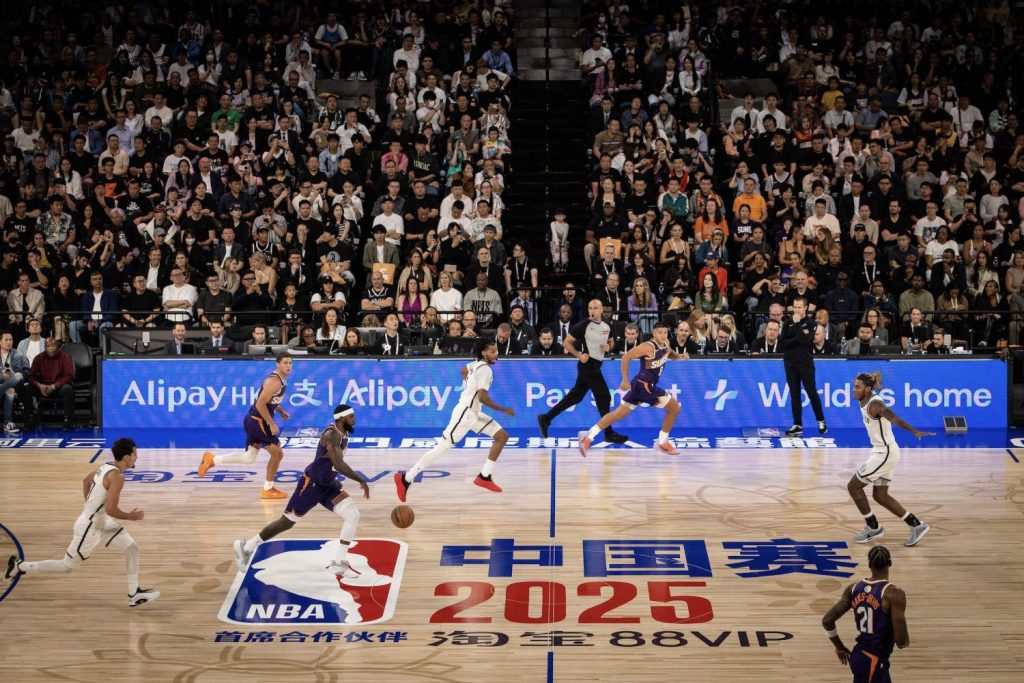
Seven years later, however, the picture looks very different. Live NBA games have returned to CCTV, the league’s biggest stars are drawing huge crowds on visits to China, and homegrown brands like Li-Ning and ANTA are signing some of basketball’s biggest names. The NBA China Games are back too, with the Houston Rockets and Dallas Mavericks set to face off in Macau on October 9 and 11, following last year’s double-header between the Brooklyn Nets and Phoenix Suns in the city.
Emil Cheung had a courtside view of that return. A Hong Kong-based basketball commentator and presenter, he witnessed first-hand the enthusiasm that greeted the NBA China Games’ Macau debut in 2025. For Cheung, the response was hardly surprising. “For Chinese fans, the NBA players are superstars. They’re heroes to them. They’re like the Avengers.” That connection stretches far beyond the game itself. In June, Stephen Curry signed a long-term partnership with Chinese sportswear giant Li-Ning and brought Curry Brand with him, a deal reportedly worth more than US$400 million over 10 years. Curry is the latest in a long line of NBA stars to work with Li-Ning, following the likes of Dwyane Wade, Shaquille O’Neal and Jimmy Butler.
In September, he put that new relationship on display with his first Curry Brand tour of China, travelling through Beijing, Dongguan and Shenzhen before finishing in Hong Kong. For Cheung, relationships like these reflect something deeper than commercial opportunity. “The NBA is more than just basketball, it’s more like a culture,” he says. That broader cultural appeal is evident in Macau, the China Games’ home until 2029, where the NBA has entered into a five-year partnership with resort operator Sands China. As well as two annual preseason games, the league has established a year-round presence across Sands’ Macau properties through the NBA Macao Flagship Store and NBA Atelier, a lifestyle brand bringing together basketball, fashion, art and technology.
For NBA deputy commissioner Mark Tatum, the appeal is straightforward. Macau has a “passionate fan base for the NBA and we have a partner in Sands China that is investing in sports, so that is why we are bringing the games back”, he said when the partnership was announced in 2024. Tatum has also described the city as “one of the world’s emerging hubs for sports”. It probably helps that Sands China is majority owned by Las Vegas Sands, whose chairman and CEO Patrick Dumont is also governor and part of the controlling ownership group of the Dallas Mavericks. Dumont described last year’s China Games as a “very strong success”.
Macau itself also seems unusually well suited to the arrangement. “Being a host in Macau is fun because of their hospitality,” says Cheung. “And Macau is so concentrated compared to Hong Kong and China.” That compactness is backed by extensive tourism and entertainment infrastructure, bringing accommodation, restaurants, retail, fan events and the games themselves together within the Sands resort ecosystem. This year’s China Games bring together two teams with particularly strong connections to the country. The Mavericks have their own place in Chinese basketball history through Wang Zhizhi; drafted by Dallas in 1999, he became the first Chinese player to appear in an NBA game two years later. Few franchises, however, have a deeper relationship with China than the Houston Rockets. “Since drafting Hall of Famer Yao Ming first overall in 2002, we have received overwhelming love from the passionate basketball fans of China,” Rockets alternate governor Patrick Fertitta said when the matchup was announced.
The current rosters offer plenty of reasons for excitement too. Houston are led by two-time NBA champion and former MVP Kevin Durant, alongside Turkish All-Star Alperen Şengün and rising star Amen Thompson, while Dallas boast 2025 number-one draft pick Cooper Flagg and nine-time All-Star Kyrie Irving, who is working his way back to fitness after missing last season due to a torn ACL. But the two games are only part of the experience surrounding the China Games in Macau. This year’s programme includes interactive fan events including NBA House and NBA Fan Day, youth basketball clinics, and a Community Impact Week hosted by NBA Cares and Sands Cares, focused on health, wellness and sustainability. Music is part of the mix too, with South Korean group KiiiKiii performing at halftime, while Hong Kong singer-actor Keung To and K-pop star EVAN will perform at NBA Fan Day, hosted by rapper and actor MC Jin.
But the relationship is no longer simply about bringing American basketball stars to China. In 2025, Yang Hansen became the ninth Chinese player selected in the NBA Draft, but only the third to go in the first round, taken 16th overall before joining the Portland Trail Blazers. While his rookie season was relatively quiet, the 21-year-old has emerged as one of the country’s most closely watched players since Yao Ming. For Cheung, Yang’s emergence is part of a broader shift. “I’m seeing a lot of Chinese potential players who are going to go to the US for high school earlier, for college earlier,” he says. “I think that’s going to be a must for Chinese players if they want to play in the NBA.” There is infrastructure supporting that development too. The NBA has worked with the Chinese Basketball Association (CBA) for years on player and coach development, while also establishing training programmes in China designed to give promising young players access to NBA-level coaching, facilities and competition.
It is a long way from that first NBA visit in 1979. What began largely as the export of an American sport has developed into something far more reciprocal, with Chinese players heading west in pursuit of the NBA, while NBA stars have travelled in the opposite direction, from Stephon Marbury and Tracy McGrady playing in the CBA to today’s biggest names visiting China for games, brand tours and fan events. More than two decades after Yao Ming supercharged the NBA’s relationship with China, his influence still looms large, but the connection has long since grown beyond any single player. Successive generations of NBA stars have found enormous followings in the country, while Yang represents the possibility of a new generation of Chinese talent making its mark in the league. For all the brands, partnerships, stores, clinics and commercial machinery surrounding the NBA’s relationship with China, however, its enduring appeal remains remarkably simple: Chinese basketball fans want to see their heroes play. When the Rockets and Mavericks take the court in Macau in October, they’ll have that chance again.