
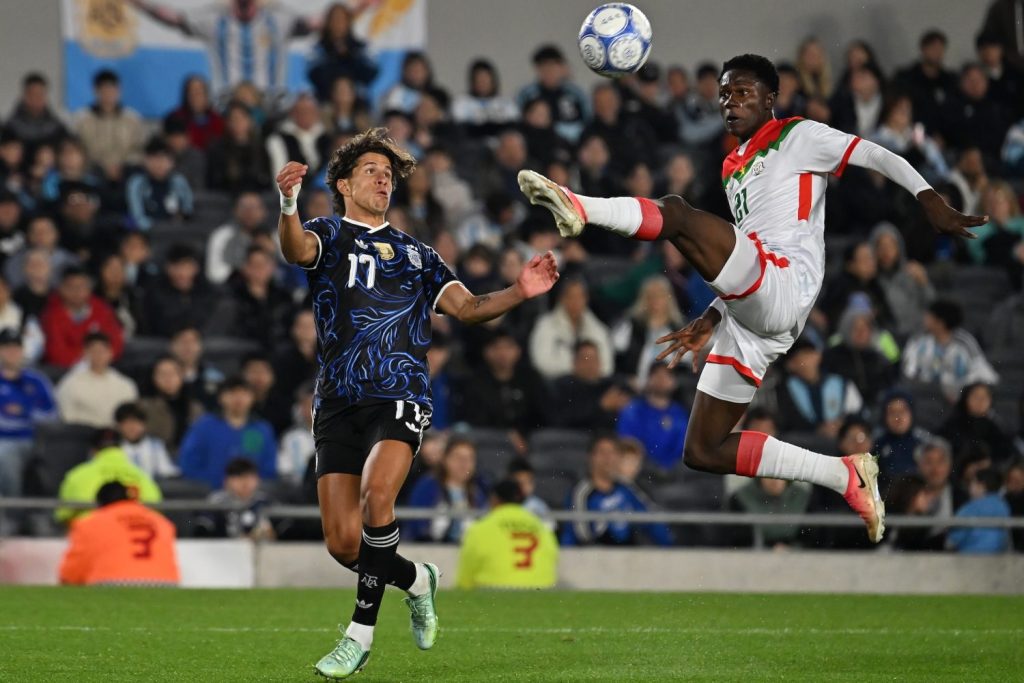
The fact that Argentina organise friendlies against African national teams that are hardly household names no longer surprises anyone. In fact, this practice has been going on for years and is part of a model that has allowed the AFA, Argentina’s football federation, to bring in enormous amounts of money, to the point that even Harvard has written about and studied the way the federation now operates. The matches organised during this international break against Burkina Faso and Benin, though, have taken things a little further. First because they coincide with Leo Messi’s farewell, scheduled for 6 October, when the Selección will face Benin at the Monumental. And then because the build-up to the matches has been, to put it mildly, controversial, not least among the players who have faced, or are due to face, Argentina. Pretty much every major newspaper has picked up the story: La Nación, L’Équipe, Diário As. And all the reports point in much the same direction: the AFA’s behaviour, well, leaves plenty to be desired.
For starters, the matches are organised by an external company, Eurodatasport, which handles all the logistics. The problem is that the teams invited by the AFA, and therefore dealing with Eurodatasport, do not receive a single cent for taking part in these friendlies. The Argentine federation covers travel and accommodation for the entire delegation, but there is no appearance fee. “And that is why,” La Nación writes, “mid-level African teams or those with limited resources are chosen: they accept certain conditions because it means playing against Argentina.” And against Messi, too, one might add. This system inevitably means that the AFA tries to keep costs down wherever it can. According to La Nación, the Mauritania national team, which played in Argentina during the spring 2026 international break, was offered — and ultimately reimbursed for — only a commercial flight, but the African federation decided instead to charter a private plane and covered the difference itself.
As for this autumn’s games against Burkina Faso and Benin, things, as mentioned, have gone even further. In the 7-0 win over Burkina Faso, L’Équipe reports that the logistical problems were enormous: the players originally called up did not make it to Buenos Aires, apart from Chec Bebel Doumbia and Jack Pantoulou Diarra, and even the senior national-team coach was absent. In their place came members of the Under-23 side, hastily called up and put on a plane after the senior team refused to travel to Argentina. The reason for the refusal? The conditions proposed by the AFA. The usual ones, one might say: a commercial flight that took 30 hours, including layovers, and no appearance fee. The African players eventually arrived in Buenos Aires less than six hours before kick-off. And the 7-0 result, in its own way, exposed the inexperience of what was, effectively, a youth side facing the World Cup runners-up. Not surprisingly, Argentina were already 3-0 up after ten minutes. After the match, Scaloni said that “Burkina Faso honoured football, did everything possible so that the match would not be cancelled.”
The problem is that the build-up to the game against Benin is following much the same pattern. If anything, it has been worse. According to Diário As, members of the African national team complained about the flight chosen to bring them to Argentina and about their reception at a hotel with no hot water, a gym with no equipment and a sauna that was out of order. The length of the flights and layovers, the Spanish newspaper reports, citing a Beninese outlet, also caused one of Gernot Rohr’s staff members to fall ill — a video analyst, to be precise. Nothing particularly strange, one might say, given what came before.