
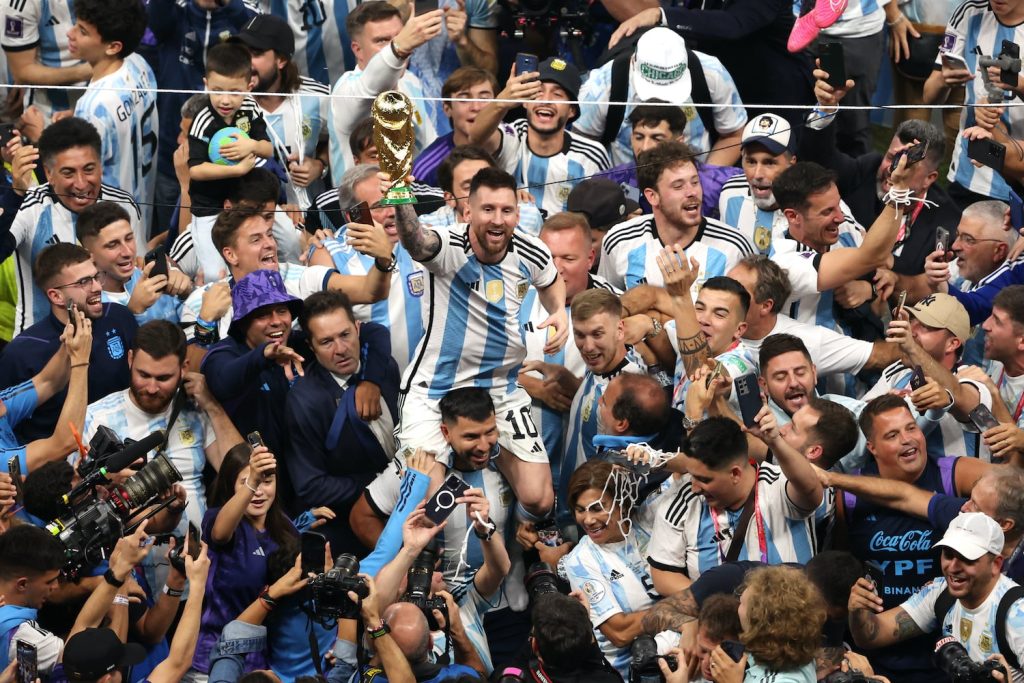
Being world champions is not enough for the Argentine Football Association (AFA), for whom Qatar 2022 functions less as a conclusion than as a hinge point where sporting success stops belonging exclusively to the pitch and begins operating as structure, export and brand at the same time, with the federation now appearing in spaces far removed from football itself, from business schools to marketing classrooms where it is increasingly treated as a case study in organisational transformation. Leandro Petersen, AFA’s Commercial and Marketing Director, recently at Harvard Business School, addressed students in a setting where football was less subject than pretext and where leadership models, revenue architecture, global positioning and partnership ecosystems formed the actual vocabulary of discussion, a language that does not require translation even when it moves away from sport, and during the same US trip the Boston Celtics were visited as part of an exchange that sits within NBA organisational culture rather than football comparison, both sides observing rather than imitating.
The entire framework circles back to a core concentration of value embodied by Lionel Messi and the generation surrounding him, not as nostalgia and not even as narrative closure but as an asset structure whose significance lies precisely in what exists outside the ninety minutes and outside the tournament format, with planning from that point extending beyond cycles and qualification windows so that even the idea of the World Cup becomes less an endpoint than a temporal reference point within a broader system. The United States sits at the centre of this reconfiguration without ever needing to announce itself as such, with Messi at Inter Miami and the 2026 World Cup approaching creating an overlap of timing and geography that the AFA reads as opportunity and infrastructure at once.
Florida takes shape as operational ground where a permanent headquarters is planned in Hialeah, Miami-Dade alongside a high-performance training centre that converts presence into permanence rather than symbolism, while AFA Academies are being established across multiple states as a way of exporting methodology without freezing it into uniformity, instead allowing youth development systems to be rewritten locally as they expand.
Commercial growth develops in parallel, with more than 65 international sponsors now attached to the federation, a record figure whose significance lies less in quantity than in composition since Argentine companies are now a minority within a portfolio dominated by US and Asian multinationals whose alignment with the Albiceleste reflects a shift in football identity into global commercial currency that no longer depends structurally on matchdays alone. A transformation that extends further into Asia where around 30 per cent of partners are now based, including companies such as Xiaomi and Cotti Coffee whose presence embeds the national team brand into everyday consumption patterns across markets that sit far from traditional football geographies.
Messi acts as catalyst but not total explanation since the underlying mechanism is one of localisation rather than export, campaigns and content reshaped market by market so that what appears as a single brand is in fact multiple versions operating simultaneously across different cultural and digital environments, influencers integrated into local circuits, platform choice varying by region, e-commerce absorbing what once required physical infrastructure so that distribution becomes continuous but less visible. A system that Harvard frames as value generation independent of fixtures, where brand continuity replaces match dependency and economic activity persists even in absence of competition.
And yet alongside this expansion sits another layer that does not follow the same logic, where Argentine football domestically continues to operate under structural strain with second division clubs struggling to meet registration costs, stadiums ageing without equivalent investment cycles and salary levels remaining below both European benchmarks and parts of South America itself. A condition that exists not as counterpoint but as parallel reality, two economies moving under the same badge without converging into a single narrative, one expanding through networks, language and repetition across continents while the other absorbs limitation as ongoing condition, with no synthesis yet visible between the two trajectories.