
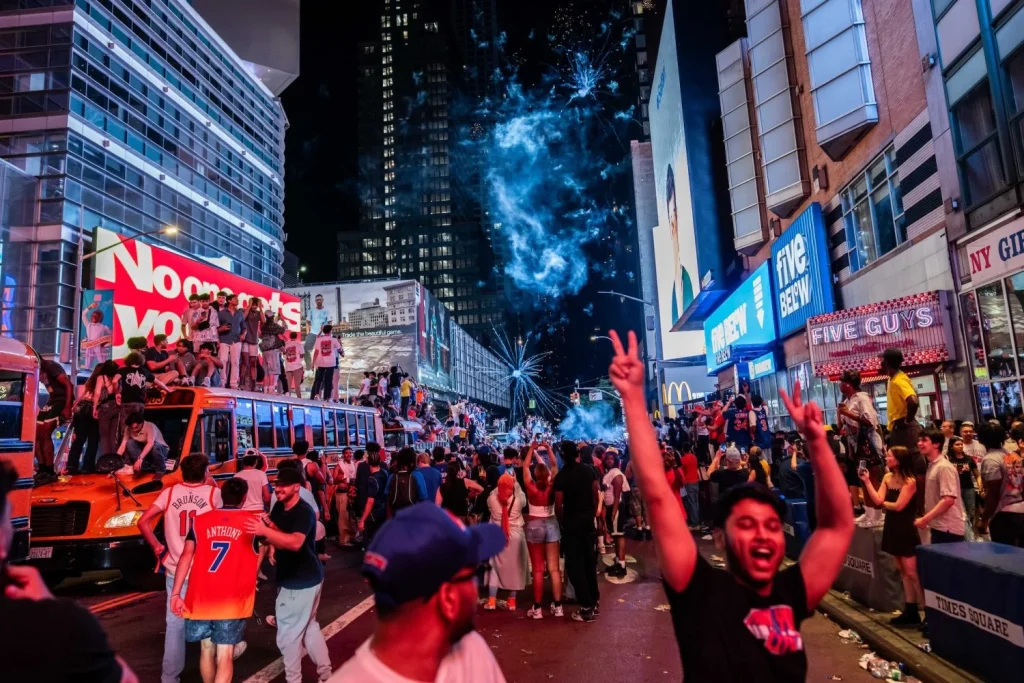
The New York Knicks won the 2026 NBA title, ending a championship drought that stretched back to 1973.
On 11 May 2021, two days after a road win over the Los Angeles Clippers, The New Yorker posted a cartoon on its social channels. A fan tells his therapist he has come to accept that “the Knicks are a good basketball team.”
Five years later, in a surge of Knicks-leaning collective emotion that had even reached coach Mike Brown, the cartoon briefly resurfaced in the magazine’s feed. As if something had quietly looped back on itself. More than half a century of disappointment, defeat, near-misses, regret, and a New York pessimism shaped by memories of baskets from Michael Jordan, Hakeem Olajuwon and Tim Duncan.
The Knicks fan is a birthright figure. Almost civic, at this point. He’s long stopped being just a stereotype. There’s a kind of learned nihilism to him, which often ends up as a quiet satisfaction in finding reasons to criticise the team. Over time, he’s become something else entirely — a kind of conduit for the city’s literary tone inside basketball.
A product of a city that never really sleeps and doesn’t have much patience for anyone. Not even for the franchise that, in its own way, still holds together the five boroughs.
It may sound overstated, but it’s there in Chris Herring’s Blood in the Garden. In the prologue, the words of a Knicks executive — urging people to hold on to those “moments that would not come again” — now read almost like a warning from before the 1990s took shape. The Riley and Ewing years, Charles Oakley and Larry Johnson, Marv Albert and Mike Breen somewhere in the background.
Which is also why, on 30 May — before Jalen Brunson’s winner in Game 1, OG Anunoby’s defence in Game 4, or Mitchell Robinson’s late offensive rebound in Game 5 — The New Yorker ran an essay asking whether Knicks fans still remembered what happiness felt like after fifty years of “exhausting agony, interrupted by brief moments of hope.”
Two weeks later, with a third banner ready to go up at Madison Square Garden, the answer arrived. On screens, mostly. Simple enough: yes, New Yorkers can still be happy for their team. Maybe the only institution in the city that, as Will Leitch wrote in The Washington Post, “knows what it means to be the underdog.” And yes, that feeling doesn’t really stop at the city limits — as long as the other team isn’t San Antonio.
There was, at some point, even a slight pull towards the Spurs and Victor Wembanyama, almost as a counterweight to everything the Knicks represent in the league’s public imagination. But New York, once again coming back from 16 down in Game 5, resisted that pull too. The story bent back on itself.
Underneath the impatience and self-mythology, there was structure. And patience, even if it doesn’t always look like it. Enough to absorb a rebuild that began in 2020, when James Dolan handed full control to Leon Rose ahead of yet another reset, just as the pandemic shut the league down.
This time, it actually took.
Six years later, the meaning of the title sits alongside Toronto 2019, Milwaukee 2021, Denver 2023. Not just as a question of market size, but of visibility — and what that does to the frame itself.
There’s something almost irrational in the impulse to watch them win just to see what it looks like, alongside the equally irrational desire to be there without ever getting near courtside seats next to Jimmy Fallon, Ben Stiller or Timothée Chalamet, or the suite occupied by Donald Trump. All of it blurs the usual distance between rivalry, access, and belonging.
As if the title spills outside the category that produced it.
Rose stays central in all of this. Not because of individual moves alone, but because he introduced a different order into something that had been running on another logic for a long time — closer to a fading idea of star power than to the league it now exists in.
A franchise without a title since the 1970s, and without a Finals appearance since an era when globalisation hadn’t yet flattened the idea of uniqueness that once defined both New York and the Knicks.
Rose changed the terms. Slower decisions, different assumptions, a kind of structural patience that doesn’t always sit comfortably in a players’ league. And without leaning on a symbolic status that no longer really holds.
If a socialist Muslim mayor active on X can run a city of eight million people, then maybe the Knicks could also win by stepping slightly outside their own recent habits.
And that’s more or less what happened. At the moment it felt least likely, while everyone — inside and outside the league — was watching as usual.
This title marks the return of a franchise, but also a shift in attention. Its effects are already visible, even if quietly so. Inside the NBA, across the game, and in the more visible corners of New York media.
They’re going to need a different tone for their cartoons.