
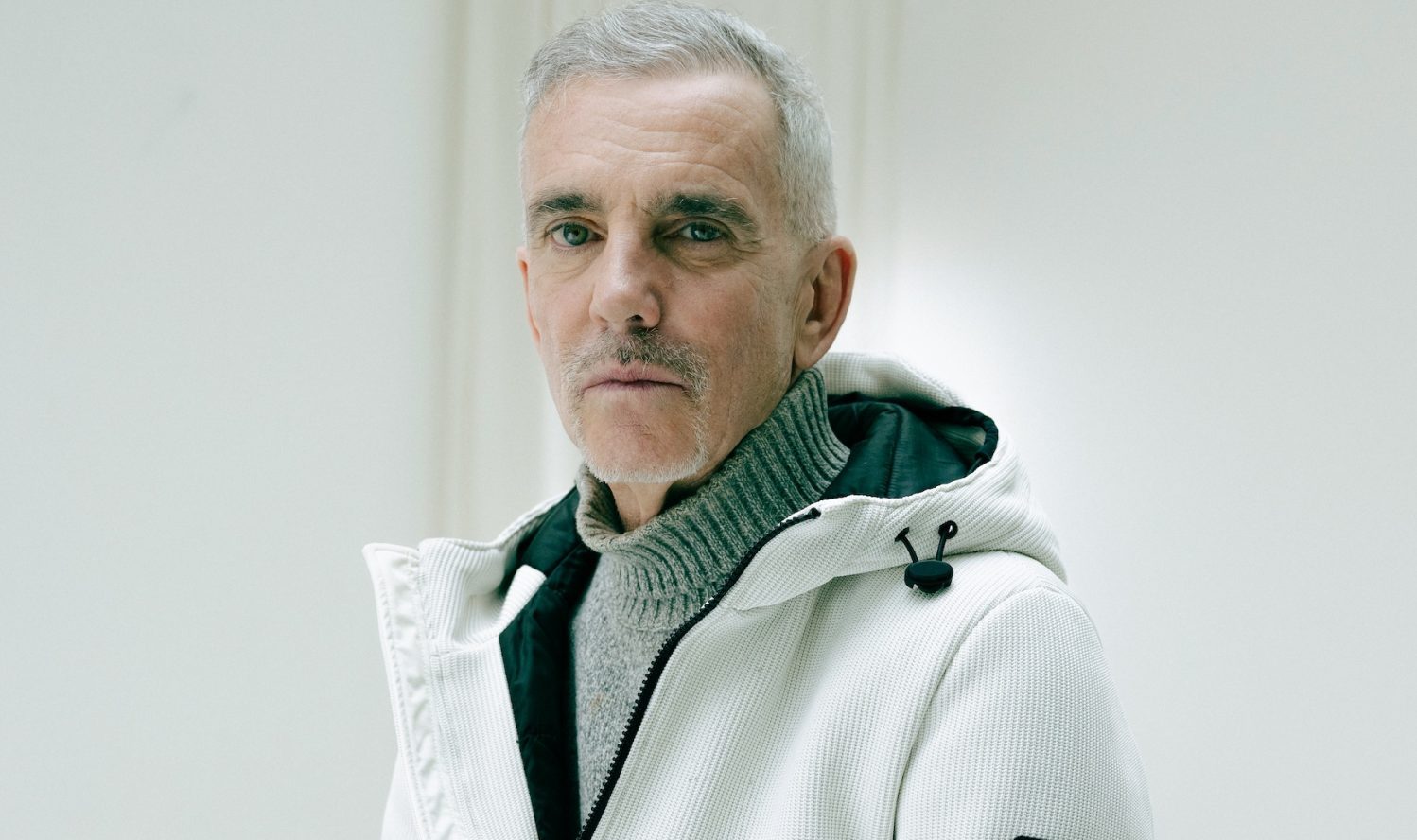
It is called Otto Infinito: Life and death of a Mamba, and it is the theatre show about Kobe Bryant that Federico Buffa is taking around Italy. After the debut last year, this year the tour touches the whole country, to celebrate the greatness and the complexity of a superstar of the NBA and of all of sport. Produced by Imarts under the direction of Maria Elisabetta Marelli and presented by Sky Sport, Otto Infinito is a journey into Kobe’s overflowing personality: his obsession with success, his thirst for knowledge and his capacity to inspire generations.
For Federico Buffa it is a return to his great passion, basketball, to focus on a character full of facets and contradictions, certainly epoch-making, indeed, infinite. Buffa describes him as the most complex character he has ever recounted. And this complexity is born right from the beginning of his formidable saga: «In the NBA certain players pass each other a baton, an ideal torch. In Kobe’s case, the torch comes from the greatest of all time. In the show I recount that Jordan tells him this is my number, call me whenever you want, but Kobe does not call him, he talks to him on the court. He asks him things like: “Michael, what do you do in these situations?”. And Jordan answers him, while they are playing! At the end of that match, an anonymous Bulls against Lakers won without any problem by Chicago, the courtside reporter asks Michael: it seemed to us that you were talking to the kid, but isn’t it disconcerting for you to have to share your secrets? And Jordan says: I did the same. I asked Magic, I asked Bird. If they don’t respect you, they don’t answer you. But if they respect you…»
It means that the champions recognise you as one of them.
Because the game has to be spread like this. The players say: we pass it among ourselves. There, this thing is purely NBA. There is no other sport, apart from American football which is little widespread in the world, where all the best play in the same league. It is a unique case.
Kobe took a great deal from Jordan: the obsession, the cult of victory, the maniacal work on oneself… and also a certain meanness.
This is a very interesting thing about Kobe. Kobe has no reason to be so aggressive. He grew up in a family where his mother considered every day his birthday. Michael grew up in the South of the United States at the end of the Sixties, his first lesson at school is in a segregated class: in short, he will have some hunger for redemption. Kobe really not, but it is evident that Kobe sensed the strength of the Jordan system, that is the idea of annihilation of the opponent, this idea of always being at the top of one’s condition. It is the reason why on 11 September he is watching the Towers fall, and he is sweaty: but where he is, on the west coast, it is six in the morning. It means that he got up at four in the morning because he cannot bear the idea that on the other side of the country someone is already training to beat him.
This competitive mysticism meant that Kobe became a model for an infinite list of professional athletes, even outside basketball.
The reason is that professional sportspeople notice someone who interprets sport as a craft. For them it is a craft. It means that you think about the game 24 hours a day, and it is a difficult thing to do. So many lads would have the gifts but do not have this type of mindset. In a certain way you have to be predisposed to being like this, but at the same time you have to work on it, a great deal. You have to toil.
For Kobe was it more satisfaction or a self-inflicted sentence?
50 and 50. Certainly a sentence, but he chose to be sentenced. So the two things coincide. On top of that it is a completely atypical, anomalous story, in the sense that he grows up in Italy and when he arrives at high school, where the African Americans speak to him in slang, he smiles and does not understand a word. He is totally devoid of African American culture, which makes him different. But he never opposed the idea of being so, despite the fact that a certain black culture attracts him. For example he tries to rap, he has a schoolmate who gives him pointers, but Kobe does not put a single street thing in his lyrics. He has only beautiful love stories.
Kobe’s Italianness is something that ended up even on the court: the use of our language so as not to be understood by the opponents.
His favourite teammate was Vujacic, who spoke a bit of Italian from having played in Udine. It happens that they speak to each other in Italian even before the two fundamental free throws against Boston (in 2010, ed.): there Kobe’s future is decided, in the balance between establishing himself as Jordan’s heir and remaining a successful loser. Kobe says to Vujacic, who is about to shoot the free throws: “If you want the ring, you have to make this one, you piece of an asshole”.
And he makes them.
In a fantastic way, as if he were on the playground. Vujacic is, after all, a super interesting figure, so much so that Phil Jackson recently called him to his home in Montana to hand him the books of his system. Of all the players he has coached, he chose precisely him. As if to say: you spread the word.
The evangelist.
Saint Sasha. Between Kobe and Vujacic there has always been a very particular bond. After all Kobe – always invited, never introduced – incredibly goes to Sasha’s birthday. At that party, in a trendy venue in Los Angeles, at a certain point Sasha, who like all Slavs is very attracted by melodic Italian, asks to put on Marina: a track by one Rocco Granata from 1959. Vujacic told me that in that moment all the Lakers players took the plates and smashed them, with Phil Jackson who left laughing at that sort of ritual.
Who could have thought that Rocco Granata enjoyed such success on the West Coast.
“Marina” is the third most famous Italian song in history, after “Volare” and “’O Sole Mio”. This is because in 1955 Italy and Germany reach an agreement between themselves for free movement, thus favouring the emigration of Italians who go to work in Germany. And “Marina” was the song of these people. Among other things I discovered that Maradona warmed up only with “Marina”.
Do you remember the first time you observed Kobe?
Flavio Tranquillo and I were supposed to commentate on his first NBA match. But he cannot resist temptations, he wants to go and play on the Venice playground, which is called The Recreation. He saw it at the cinema, in White Men Can’t Jump and in American History X. Kobe goes to dunk and hangs on the rim thinking that it is retractable, but obviously it is not. He breaks his right wrist and therefore has to miss the first part of the season. So I see him at the All Star Game of 1997. There I realised that he moved in harmony with the world, even if in that aquarium he was the latest arrival. I really had the sensation that he had something special.
And after him? Did one like him arrive?
Well, this is a problem. This compulsive obsession is not there. You see players with passion, with talent, but who do not apply themselves as he did. One name above all: someone with talent like Anthony Edwards is not remotely close to him at a mental level. There is someone who would like to, but does not have the means, and someone who would have the means, but does not have that predisposition. LeBron has an above-the-norm athleticism, and so it is an impossible message to take in. In the sense: however much you may imitate him, inside that body you do not end up.
Flavio Tranquillo sends you a message, indeed a reflection: today the NBA is populated by a star system that is no longer American-centric.
I’ll recount something about Flavio. NBA Finals, June, a restaurant in San Antonio with R.C. Buford, general manager of the Spurs. Outside it is 44 degrees, even the butterflies are sweating. In half an hour Flavio convinces Buford to choose Manu Ginobili at the Draft, of whom he has practically no notion. When they compliment him for having picked him up in the middle of the second round, Buford answers: “Just luck: if we had known he was this good, do you think we would have waited for the second round?”. Here there was Flavio’s idea of recounting to the Americans that there is another world beyond the States, even one not traditionally tied to basketball.
We know how it went with Ginobili in the NBA.
To this day I have never seen a non-American so ready for the American world, without anyone expecting it. He was an incredible thing. A pioneer. I remember game 7 of the Finals against Detroit (2005, ed.) in which he wins it playing a basketball that does not exist in the United States. He does something that had never been seen before: in his drives to the basket he rests the ball on the defender’s head or hip, taking the push from that support to go to the backboard. An unprecedented idea: I play on the opponent’s body to gain momentum. He scores four baskets like this in the fourth quarter, decisive for the victory of the title. That series was wonderful, enchanting. They don’t make series like that any more. When LeBron goes away, when there is no more Ray Allen’s shot falling backwards against San Antonio… You do not have the sensation that there are people capable of giving you back that epic quality.
And in your opinion is this thing the child of a change only of the protagonists or also of the game?
There is a climatic change in the NBA, which has made some business choices. Scottie Pippen said: well, if today the attack is always favoured, if you cannot use your elbows, if body checks are forbidden, it is obvious that suddenly there are people who score 70 points and who in our basketball would have scored 18. If you favour the attack so much, you lose a bit of the beauty of the game. On top of that having the three-point shot has taken away an entire part of the court: those who know how to inhabit it, like Gilgeous-Alexander, inevitably dominate, because the opponent struggles to defend that zone.
Your first time in the States took on the proportions of myth: a prize trip to UCLA, the year 1978.
It was not only a journey in space, it was a journey in time. At the time you went to a place that was 30 years more advanced, it was a bewildering thing. Here in Milan, to play tennis, you went to Campo Colombo and for a thousand lire you had a court of half-red-clay and few other opportunities. At UCLA you found 24 courts available for the students lit up at night, you did not even have to ask permission to play. In the canteen you saw the Americans consume a shameless quantity of food, and there was free Coca Cola. The first thing I do is take 13 glasses of Coca Cola to give myself the satisfaction: I drink them all and I pay nothing.
Then other times beyond the Atlantic came: countless.
I did the count with my passport: I’ve been there more than a hundred times. And I have risked my life at least three times. One more than all: in Louisiana, in a 12-dollar motel. I regret it immediately: around four in the morning they break down my door, a person arrives who says to me: I call the police. When the police then arrive, I have never seen a person beaten like that. But going to the south of the United States and not having another white person within thirty kilometres, or going to a university where you are on the other side of history, in my opinion is very formative. You enter into a different visual angle.
And when was your last time in the States?
I haven’t gone there since 2020, since Kobe’s death. And I’m not going back any more. They are not my own any more. They have become someone else’s.