
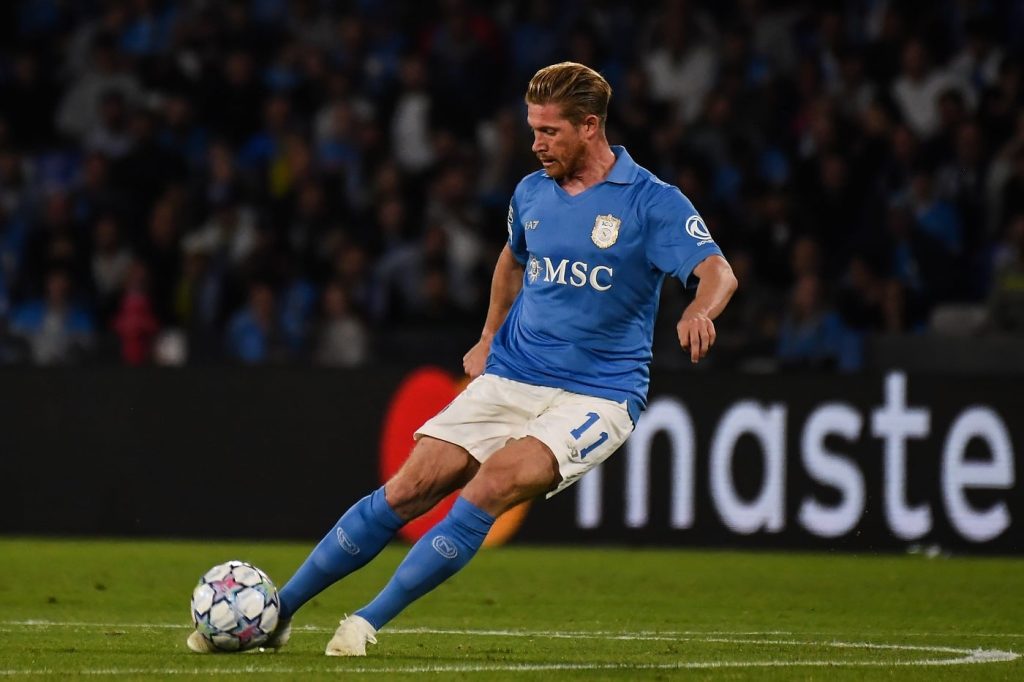
Allegri’s experiment first came into view against Frosinone a couple of weeks ago: Kevin De Bruyne as a deep-lying playmaker. The description needs some qualification. De Bruyne has rarely been a midfielder who sits in front of the defence, screens the back four and dictates play through the circulation of possession. Yet at Napoli, he could become something close to a conductor, provided we understand that his is a different kind of playmaking. An attacking one.
De Bruyne has never been simply a passer. His gift is to see the ball that opens a defence, pick out a run before it develops and turn possession into a chance. At Manchester City, under Guardiola, he did it for years, even when operating as a mezzala in a midfield three. Few midfielders of his generation have been as influential in the final third. His 119 assists put him second in Premier League history, behind only Ryan Giggs, whose 162 came over a considerably longer career.
Allegri’s idea is to build around that quality rather than ask De Bruyne to keep doing the things that once made him such a force across the pitch. He turns 36 next summer. He can no longer be expected to cover every blade of grass, burst into space and arrive in support of an attack with the same athletic authority he had a few seasons ago. His vision remains, as do the precision of his passing and his ability to give a move momentum without having to accelerate himself.
The answer may be to move him away from the most congested areas, where opposition defenders can close him down, and give him more room to look up. Starting a little deeper would allow him to help build attacks, bring Napoli up the pitch and find the passes that change a move: the ball over the top, the vertical pass through the lines, the through ball into a runner’s path. Not a holding role, but a different way of directing the attack.
Against Bodø/Glimt, there were encouraging signs. De Bruyne supplied an assist, played seven passes that led to shots and created two big chances. He completed nine of his eleven long balls, made eight recoveries and completed 59 of 65 passes. The figures show his contribution across the pitch, but the more interesting possibility lies in how he uses the ball. He can bypass the first line of pressure and find teammates running in behind, allowing Napoli to attack through the middle rather than work every possession towards the wings. He does not need to dominate the ball to dictate an attack. Sometimes one pass is enough.
A deeper role for De Bruyne would also change what Napoli ask of the players around him. His vision and range of passing demand movement ahead of the ball, passing angles and runs beyond the defence. The team would have to become more willing to play forward, trusting that a pass through the middle could be as productive as another spell of possession out wide. Napoli have too often struggled to find a way through the centre, falling back on the flanks without turning possession into a sustained threat. De Bruyne could give them another route. The runs would have to come.
McTominay is central to that calculation. A deeper position for the Belgian could free the Scot to do what he does best, without asking him to sacrifice the qualities that make him so dangerous. Against Bodø, McTominay did most of his damage with runs into the box, arriving from midfield in the space behind the centre-forward. His two goals and the shot against the post showed the value of those late arrivals. He gives Napoli another presence in the penalty area, one that is difficult to track when it comes from deep.
The two roles need not compete. De Bruyne drops back to read the game; McTominay pushes forward to attack the space. Napoli’s second goal against Bodø, which made it 2–1 just before half-time, offered a glimpse of the connection. De Bruyne’s assist was the sort of pass that makes the idea worth exploring: a runner arriving in the right space, the ball delivered at the right moment.
Whether Allegri opts for a 4-3-3 or a 3-4-2-1, De Bruyne in a deeper creative role would give Napoli another way to play. The formation matters less than the distances between players, the timing of the runs and the willingness to attack space as soon as he receives the ball. Moving a great player a few metres back is the easy part. Building a team that can make use of what he sees is harder.
The idea is plausible. Making it work will depend on the details: how Napoli protect De Bruyne, how quickly the players ahead of him move, how much freedom McTominay has to attack the box. De Bruyne could become the link between the build-up and the final ball without losing the creative instinct that has defined his career. But the position alone will not make him Napoli’s playmaker. The team has to learn to play around him.