
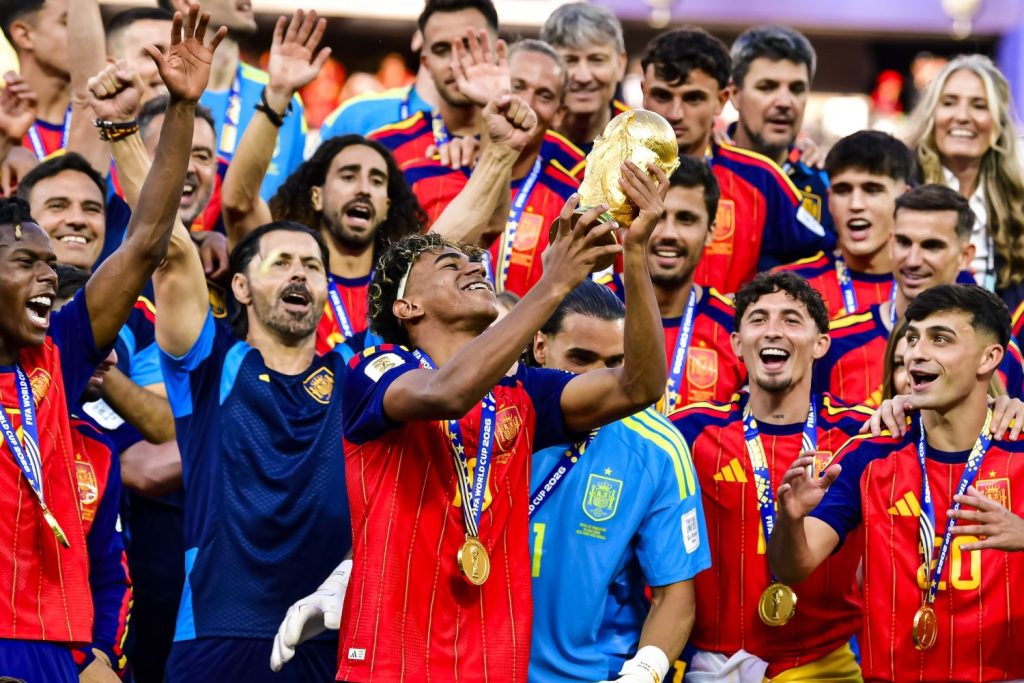
Twenty years. Then another twenty. That is how long it took Spain to become the dominant force in world football, and the story can be divided into two roughly equal stretches. The first was about sowing and cultivation; the second was the harvest. A rich harvest, abundant and sweet with trophies, with cups lifted into the sky while football executives elsewhere tried to copy, imitate or at least reproduce some part of the Spanish model. The honours boards tell their own story. It is almost impossible to work out how to stop it, or even how to contain it.
The second key date is not famous around the world, but in Spain it is celebrated almost like the patron saint’s feast in a small town in southern Italy: 13 October 2007. Spain’s senior national team, coached by Luis Aragonés, were playing Denmark away in qualifying for Euro 2008. Around the 40th minute, with La Roja leading 1-0, the Spanish players began moving the ball around with an elegance that was almost dizzying, passing it among themselves with extraordinary speed and quality, keeping it for an uninterrupted minute and 15 seconds. In that seemingly endless stretch, they accumulated 65 touches, 28 completed passes and a shot on goal, taken by Sergio Ramos, which beat the Danish goalkeeper. Raúl Tamudo, the Espanyol striker who started in Copenhagen, would later say that “that match and that goal marked a before and after in the history of Spanish football”. And they did. Between 2006 and 2007, Aragonés had begun working on a tactical model that pushed possession to its limits in both defensive and attacking phases. He turned his national team into a band playing in unison – these were, after all, players of extraordinary technical refinement who had been practising this kind of football since childhood – and used the sound of their own passing as a metronome. Sergio Ramos’s goal was, of course, only one episode in a match in which plenty of other things happened. Even so, it is still remembered as a kind of symbolic epiphany, because it was also one of the first tangible manifestations of a new way of playing and understanding football: Tiqui-Taca.
Over an eight-week stretch, between 8 May and 29 June 2008, two events unfolded that would prove epochal, at least in footballing terms. Barcelona decided to put the first-team job in the hands of the coach who had taken Barça B back to the third division, Pep Guardiola. Then Spain beat Germany in the European Championship final, 1-0, Fernando Torres scoring the only goal, and won their first senior trophy in 44 years. At the time, the connection was not obvious. With hindsight, it is almost impossible to separate the two. The day after the victory over Germany, the Guardian wrote that Spain coach Luis Aragonés “always insisted that it would be absurd for his players to play in any way other than Tiqui-Taca. And quite rightly. But the truth is that Aragonés did not accept the excesses advocated by the fundamentalists of this ideology. Instead, he used it to dominate matches, but also to protect a defence that was nowhere near the excellence of the other departments”. It was at precisely this point in the story, with the victory giving a radical tactical model the kind of validation that would have seemed impossible anywhere else, that Guardiola’s supernova began. From day one on the Barça bench, the Catalan coach placed Tiqui-Taca – after all, Spain’s European champions included Puyol, Xavi, Iniesta and Cesc Fàbregas, who played for Arsenal but had been developed at La Masia – at the heart of a system that seemed to have arrived from a distant future, changing the way space was understood on the pitch and pushing possession, aggressive pressing and positional fluidity to their limits. Within months, trophies began to arrive as if they were falling from the sky: La Liga, the Copa del Rey and the Champions League in 2009, followed by two more league titles, another Champions League and the various Super Cups and Club World Cups, all while teams elsewhere in the world seemed, from one season to the next, to belong to some remote era, the Pleistocene of football.
That perception remained intact even when Guardiola’s Barcelona managed the remarkable feat of not winning, partly because Spain, now under Vicente del Bosque, who naturally retained his predecessor’s approach, brought Piqué, Busquets and Pedro into the fold, consolidated their status as a truly elite national team, travelled to South Africa as favourites and won their first World Cup. Perhaps the most prestigious title came without La Roja reaching the absolute peaks of beauty they had touched in the previous two years. But it was a triumph achieved with great authority, because the victories that secured it – against formidable opponents such as Cristiano Ronaldo’s Portugal, Germany and the Netherlands in the final – were built on a superiority that had become psychological before it was technical or tactical. It was as if Spain had found the strength to enter the elite, and stay there, the moment they developed a footballing identity so deep and innovative that they could recognise themselves in it, prosper through it, and – why not? – admire their own reflection.
Then, two years after the triumph in Johannesburg, the whole world could do little more than sit back and admire the way Spain, there is no other word for it, tore through the European Championship in Poland and Ukraine. In some matches – above all the 4-0 final victory over Italy – Del Bosque’s team looked two or even three levels above their opponents. And the beautiful thing – or the ugly thing, depending on your point of view – was that the victories over Ireland, Croatia, France and Portugal on the way to the final were built on technical and tactical choices that had never been seen before: a system that could not be decoded using traditional formulas, a first-choice team with six central midfielders and no recognised strikers or attacking wingers, a Tiqui-Taca that had reached galactic levels of sophistication, speed and elegance. Iker Casillas asking his teammates to slow down immediately after Juan Mata’s fourth goal against Italy in the final perfectly captured what had become a footballing monopoly. Spain 2008 —> 2012 became the first national team in history to complete a Treble, winning three consecutive major international titles across the World Cup and European Championship. Meanwhile, Barcelona and Real Madrid were the two richest and most loved clubs in the world, with the best players, the most influential and glamorous coaches, at the center of the fiercest rivalry of the modern football era.
At this point, someone will be tempted to say that the poor results between 2014 and 2022 – Spain never went beyond the last 16 at three World Cups, while at the European Championship they were eliminated by Italy twice, in the last 16 in 2016 and in the semi-finals in 2021 – prove that the Spanish model works only intermittently. That the great academies across the country, after the Golden Generation, produced a lost generation instead: Morata, Thiago Alcántara, Isco, Asensio, Koke and Saúl, all players who failed to fulfil the promise of their early years and never came close to matching the standards set by the previous generation. These interpretations are perfectly understandable. For a while, indeed, there was a growing suspicion that the entire system of Spanish football – developmental, tactical and even economic and cultural – was unable to evolve, unable to move beyond the things that had made it great, beginning, naturally, with Tiqui-Taca. And yet, and yet, time showed that it was simply a matter of waiting, of the undertow – the word itself comes from the Spanish resaca – and of the inevitable cycles of sport. Experience, expertise and perseverance pay off. Working consistently, with a clear vision and a defined plan, remains the best way to build great projects, great teams, great victories.
And so we arrive in the present, at another European Championship–World Cup double across the 2024 —> 2026 cycle. Once again, Spain’s dominance begins with an extraordinary collection of midfielders – Rodri, Fabián Ruiz, Gavi, Pedri, Zubimendi, Mikel Merino, Fermín López – who know how to control a game through possession, with an almost frightening level of quality and intelligence. There are, naturally, dazzling talents elsewhere too, from Lamine Yamal to Nico Williams to Pau Cubarsí, but by then we are already downstream. Upstream are the institutions, executives and coaches who have kept Cruijff’s theories alive and carried them into the modern era, creating the conditions for another generation of champions to emerge. It cannot be a coincidence, and it isn’t, that this second winning cycle for the Spanish national team bears the signature of a head coach who came through the federation’s own system, within the federation itself, who climbed the entire pyramid of Spain’s youth national teams and was in the right place at the right time to take charge of a team that, in effect, was already his. With Luis de la Fuente, the second senior harvest began, twenty years after the first and forty years after the sowing. Even this almost perfect cycle – twenty years and another twenty – cannot be dismissed as coincidence. The evidence does not come from the honours boards of senior tournaments, but from those of youth competitions: since 1988, Spain’s national teams have won two Olympic gold medals, four European Under-21 Championships, one Under-20 World Cup, nine European Under-19 Championships, three European Under-17 Championships and four European Under-16 Championships. And if results and trophies can sometimes be, or appear to be, episodic, ultimately saying very little, in this case they mean everything.