
At the end of summer, there can be a certain reluctance to look towards the far shore: September. You need a ferryman, something to trust with the most treacherous crossing of the year. The US Open will do. It holds out a hand and tells you not to be afraid. It begins with summer still in full swing and ends with the working year already under way. For those who put themselves in its hands, the tournament carries them safely to the other side. During the final Slam of the calendar, autumn still feels a long way off. New York in summer can be brutal. When the sun is at its fiercest, it can still scorch: David Foster Wallace thought Flushing Meadows had a way of mixing heat and cold until everyone in the stands seemed both tanned and shivering. Those who were there in 2010 called it “the hottest summer in the history of the Big Apple”. On September 1, the temperature reaches 38 degrees, the humidity is high, and Victoria Azarenka, 21, the No. 10 seed, dressed in dark colours, collapses during her match against Argentina’s Gisela Dulko after just 34 minutes. It is shortly before noon. She is treated and taken away in a wheelchair, an ice-filled towel wrapped around her. Around the same time, Croatia’s Ivan Ljubičić has bags of ice pressed against his stomach.
Not every tennis player takes to big cities. Some are repelled by them, perhaps because they come from small towns, isolated provinces, places where life moves at a different pace. Pete Sampras is one of them. He arrives in New York in 1990 and feels like a stranger. He still reaches the final, beats Andre Agassi, his hair a rock star’s mane, and sets in motion a rivalry that will become part of tennis history. Agassi, born and raised in Las Vegas, has never felt at ease in big cities either. Seeing Manhattan from the airplane window is enough to unsettle him. In New York again, Sampras will find the setting he wants for his farewell. He plays his last Slam, his last professional match, his last match against Agassi. That afternoon, the sun sets over New York and over his sporting life. Martina Navrátilová does not like the tournament. For years she cannot win it, and she is compared with Borg: the Swede disliked the surface and the floodlights; she dislikes the wind, the humidity, the blinding sun, the planes passing over the players’ heads. She loves New York, though, and big cities in general. She collects books on architecture, with a particular interest in the skyscrapers of Melbourne, Tokyo and New York. After his victory, Alcaraz has a small Statue of Liberty and a small Brooklyn Bridge tattooed on his body. Among the unforgettable matches played on the hard courts of Flushing Meadows, the 1979 meeting between Romania’s Năstase and America’s McEnroe remains fixed in the collective memory. McEnroe is two sets to one ahead. Năstase feels the end coming. It is evening. He starts taking his time between points. The umpire does not appreciate it and awards him a penalty point. Năstase refuses to serve. The match catches fire. The umpire announces over the microphone: “Game, set, match.” The crowd erupts. Cans, bottles, paper cups fly onto the court. It looks like a riot. Some spectators climb onto the court, and the police have to intervene. The uprising lasts eighteen minutes, until the tournament director replaces the chair umpire. Năstase returns to the court. The penalty game is cancelled and play resumes. McEnroe wins in four sets, then, a few days later, takes his first US Open. New York is the last stop for the Grand Slam dream, the dream that got away, the great hope so often undone by spectacular failures. Lew Hoad wins three Slams in the same year, 1956, but everything slips away a metre from the finish, in New York.
In 2021, it finally seems like the year Djokovic will complete the Grand Slam. He arrives at the US Open as the favourite, having just won the three previous Slams. He reaches the final, where the last obstacle is Daniil Medvedev. Even the Serbian’s composure cannot withstand the pressure of having four consecutive Slams within reach. And for once, the crowd is on his side. That unfamiliar warmth gets to him, as he says after the match: “Today, even though I didn’t win, my heart is full of joy and I am the happiest man in the world because you made me feel special. You touched my soul, I had never felt like this.” The dream is over. Medvedev says afterwards: “We know what was at stake. I feel sorry for Novak and for the fans. I’ve never told anyone this, but for me you are the greatest of all time. Today it is understandable that most of the crowd was for Djokovic.” Serena Williams suffers her own spectacular stumble. In 2015 she wins Melbourne, Paris and London, leaving only the final piece needed to complete the miracle that had not been achieved in the women’s game since Steffi Graf in 1988. Serena is already considered by many analysts the greatest female tennis player of all time. Her opponents fear her. She can seem capable of overwhelming them with a look, even with a whisper from the baseline. She is a celebrity, feared and revered. By then, she is a serial winner at the US Open, having lifted the trophy six times since 1999. This opportunity is different. The Grand Slam is at stake, the one achievement still missing, the step that will “carry her from absolute champion to Immortal”. The sporting world is there to watch. Everyone wants to be in the stands when history happens. But there is still one last step before the final. She has to beat Italy’s Roberta Vinci.
It is Roberta Vinci who destroys Serena Williams’s dream for good. She loses the first set 6-2. She wins the second 6-4 and takes Williams into a third, dangerous territory when the tension rises beyond the limit. Against all expectation — she is given odds of 300-1 before the match — she beats the American on home soil. Ten years later, the New York Times calls it “the biggest upset in Grand Slam history”. Italian newspapers write immediately: “Only someone who lives in Paradise, with the gods of tennis behind her, could produce the most sensational sporting defeat in modern history.” They ask her how she managed to face such a difficult match. She has no answer, not even for herself. “How did I do it? Ask me another question…” There is another kind of strength at work, an inner disposition, an often underestimated weapon. “When I woke up I told myself: don’t think about who is on the other side of the net or about the Grand Slam she is about to win. Have fun. Get the ball in and run. That’s how I lived the best day of my life.” Serena Williams, meanwhile, does not want to talk about the disappointment, the fairy tale turned nightmare.
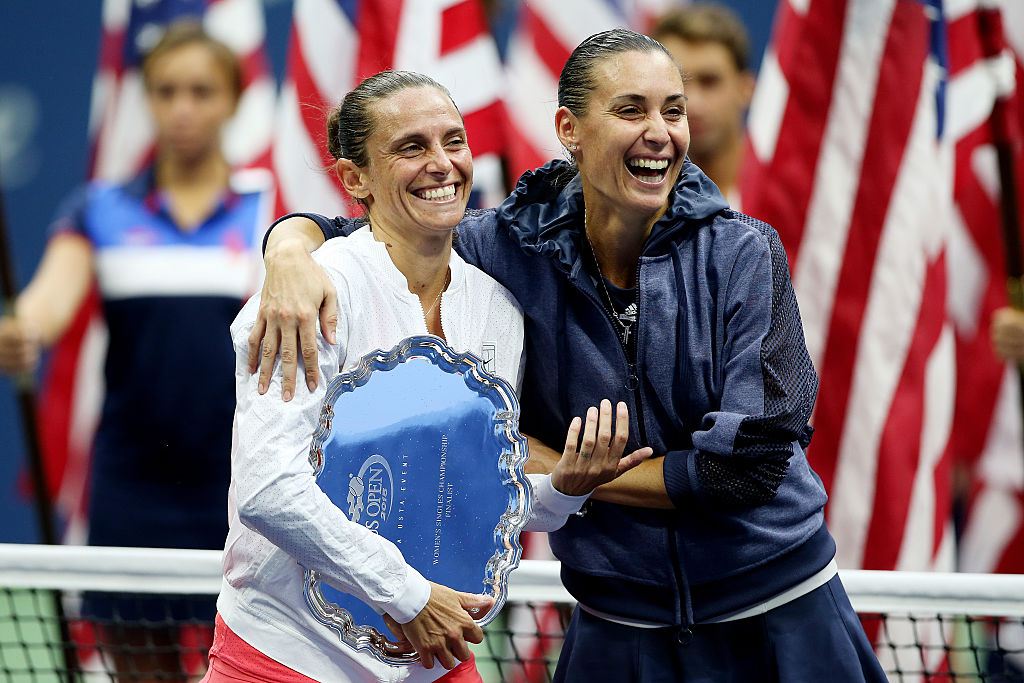
And the 2015 US Open final produces another improbability. The match that follows becomes one of the most talked-about in Italian women’s tennis, with Roberta Vinci facing Flavia Pennetta. Not just two Italians, but two friends, born 73.4 kilometres apart in Puglia, brought together by fate and separated by a net. “How do you play Robi? Let me enjoy the win over Halep and then I’ll think about it…” Flavia Pennetta says as she gets into a taxi after beating Simona Halep in the semi-final. Pennetta was the first Italian woman to reach the top ten, in August 2009. How does Flavia get there? In March, at Indian Wells, she beats world No. 2 Maria Sharapova. At Roland Garros she beats world No. 8 Carla Suárez Navarro. In New York she knocks out Australia’s Stosur in the last 16. In her previous seven appearances at Flushing Meadows she has always reached at least the quarter-finals. This time she beats Petra Kvitová, then Simona Halep in 59 minutes, 6-1, 6-3. The first set of the all-Italian final, Roberta’s one-handed backhand against Flavia’s two-hander, Robert Redford and Michael Douglas among the celebrities in the stands, goes to a tie-break. Flavia wins it. Roberta buries her head in her towel. In the second set Flavia pulls away. She knows she has to take the chance. She has waited all her life to get this far. She goes 4-0 up, then closes out the tournament 6-2. At that moment, at the peak of her tennis career, after collecting $3.3 million in prize money, after putting her name into Grand Slam history for good, she announces: “I’m stopping here.” A month and a half later she will play the WTA Finals in Singapore, then say goodbye for good after her match against Maria Sharapova.