
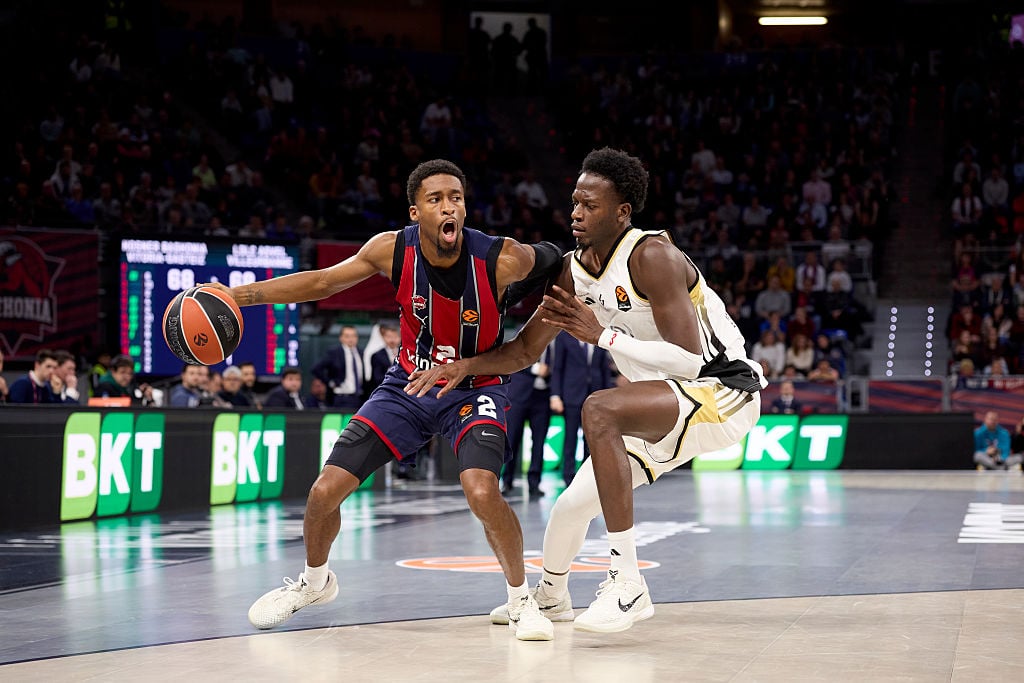
Come one, come all. Every year, without fail, it is the same story: when the FIBA competitions come around – the qualifying games for the next European Championship are being played these days – the passport market opens too, with a movement not unlike that of the players on court. Transfers, fast breaks, bureaucratic acrobatics that have little to do with common sense. The issue? Call it an inefficient allocation of resources: so many American players will only ever see the Team USA jersey through binoculars, but representing a national team remains an attractive form of self-promotion; the national teams of other continents, for their part, may be growing, but they do not have the depth to turn down a quality player who suddenly appears from nowhere – because that is what this is.
And so the usual spectacle unfolds. The latest to step into the frame are Kobi Simmons, Damion Baugh and Moses Wright. The first two play for Baskonia, the third for Olimpia Milano. All three were born and raised in the United States. Yet, for reasons that geography alone cannot explain, from today they will wear the jerseys of Ivory Coast, Congo and North Macedonia. A twist that no longer makes the news: the list of national-team passports is a long one, and increasingly difficult to keep under control.
It all comes down to a FIBA rule, set by basketball’s international governing body, that is controversial and, in any case, outdated. Under the regulations still in force, each national team can use one newly naturalised player per tournament: as soon as he takes the court, he becomes entitled to citizenship. Regardless of any actual genealogical connection. The idea behind the provision was to promote basketball even in the more peripheral corners of the world: bringing in an American known to a wider audience has always been a good way to raise a programme’s profile. The problem is that the rule has lately been stretched far beyond any reasonable measure, and every window in a FIBA competition, from the road to the World Cup to the road to the European Championship, becomes an opportunity to cash in – because there is no limit to cumulative naturalisations, provided they happen in different windows.
And so we get cases bordering on the absurd: North Macedonia, mentioned above, has naturalised no fewer than seven players from the United States in the past year alone – and when it comes to the historical presence of Americans in Skopje, the state archives might have something to say about that. In short, if it is not a farce, it is not far off. And unfortunately the trend is not confined to the so-called smaller national teams: a few years ago, by bringing in Lorenzo Brown at exactly the right moment, Spain won a European Championship. More recently, in Los Angeles, Jarred Vanderbilt has apparently expressed a desire to play for Doncic’s Slovenia – his Lakers team-mate as well. As though this were nothing more than a routine administrative transfer from one club to another. Given what goes on, the comparison is not so far-fetched.