
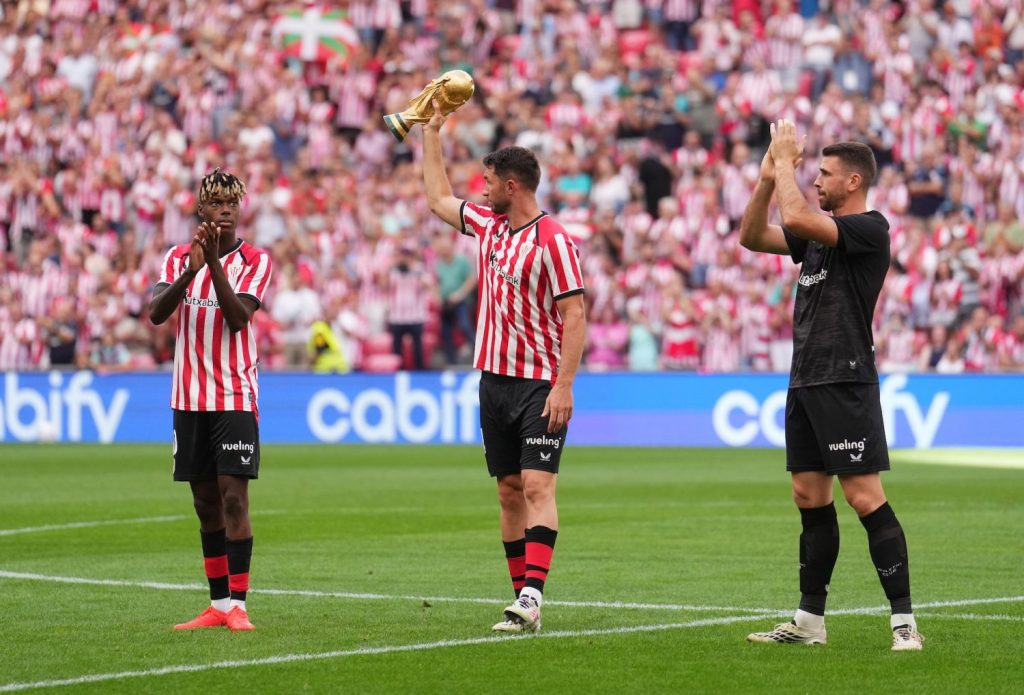
The men’s World Cup (and, in reality, the women’s one too) now belongs to Spain, which has decided to put it on display as much as possible. How? By taking it on a tour of the stadiums where the players of La Roja play, the players who lifted the trophy into the sky at East Rutherford, New Jersey, on 19 July. The basic idea is simple enough: on the first available La Liga matchday, the clubs in which the national-team players play have organised, or will organise, presentations of the trophy, brought out, naturally, by the players who won it. As Spanish Football Federation president Rafael Louzán (RFEF, short for Real Federación Española de Fútbol) explained, “seeing the World Cup will make every fan feel part of the national team’s triumph”. The problem, though, is that things have not gone exactly like that at the first stops.
At Madrid’s Metropolitano, Atlético’s stadium, there were no problems. Quite the opposite: the four Colchoneros who won the World Cup in the United States — Marc Pubill, Marcos Llorente, Álex Baena and Álex Grimaldo — were given an excellent reception by their own supporters, the applause was unanimous, a striking banner was unfurled (“Spain have two stars, we have four. Congratulations, champions”) and even the national anthem was greeted with an ovation from the whole stadium. In Bilbao, though, there was not the same enthusiasm. Athletic Club had three players in the World Cup-winning squad, goalkeeper Unai Simón, defender Aymeric Laporte and forward Nico Williams, and so the RFEF wanted to bring the trophy to San Mamés as well. The result? Applause in some parts of the stadium, but also a few whistles, even directed at the three world champions.
As El Confidencial writes, citing several local newspapers and journalists, “several expressions of discontent came from the Herri Harmaila stand; chants such as ‘Whoever doesn’t jump is Spanish’ and ‘Ia, ia Euskal Herria’ (Go, go Basque Country) could also be heard”. Spain manager Ivan De la Fuente spent years at Athletic Club himself, and said he was saddened by what happened inside the Bilbao stadium: “I think winning the World Cup was a hugely important achievement for everyone,” he said, “so I am not happy with the reaction of the San Mamés crowd. I spent 18 years there, I am an Athletic supporter and for the players who came through Lezama, in Biscay, there is no greater achievement than becoming world champions. Football is spectacle, football is unity, and respect must never be lost.”
The separatist and independence-minded sentiment that characterises Basque society, and which Athletic Club in some way represents, created this particular clash. And, frankly, it is strange that Federation officials did not anticipate — or at least underestimated — the possible negative reaction from the Bilbao crowd, or at least from part of it. It is an important issue, too, because another occasion that could produce an awkward situation is already on the horizon: after a stop at the Bernabéu in Madrid, where Marc Cucurella will be honoured, the World Cup will be presented at Camp Nou in Barcelona.
Perhaps the fact that the Blaugrana have supplied as many as eight players to the national team — Eric García, Gavi, Dani Olmo, Joan García, Lamine Yamal, Pedri, Pau Cubarsí, the new arrival Rodri and Ferran Torres, who has since moved to PSG — will persuade the Catalan crowd not to protest against Spain. But the political confrontation with the central government remains very much alive, perhaps even more so than in Bilbao. And so it will be interesting, not only from a sporting point of view, to see what kind of reception awaits the World Cup at Camp Nou.