
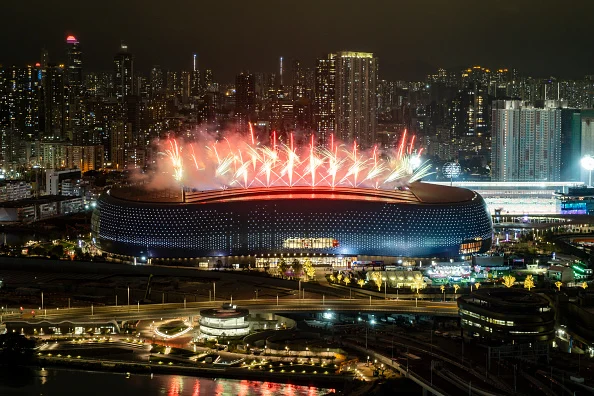
To understand what is happening in Hong Kong, it is worth starting from where the planes once landed. Kai Tak was one of the most recognisable airports in the world, famous for its dramatic approach between apartment blocks and its closeness to the city below. Arriving in Hong Kong once meant entering directly into its energy: dense, vertical and restless. The airport closed years ago, but the idea of arrival has remained. The aircraft have disappeared; today, the visitors arrive in different forms: supporters, athletes, musicians and international events.
For decades, Hong Kong was defined by finance. Its skyline, its banks and its role as a bridge between China and the global economy shaped its international identity. That story remains, but the city is now looking for another way to project itself. Kai Tak Sports Park is at the centre of that shift, turning a former airport site into a new destination for sport, entertainment and global audiences. From certain points around Kowloon, the symbolism is almost impossible to miss: the same stretch of land where aircraft once crossed above the city is now preparing to welcome some of the biggest names in world sport. The question is no longer whether a stadium can change a city. The more interesting question is whether a city can use sport to change the way it is perceived. Football offers one of the clearest answers. In the summer of 2026, Kai Tak Stadium will host the Hong Kong Football Festival, bringing Manchester City, Inter, Chelsea and Juventus to the city. It may look like another pair of pre-season fixtures in the increasingly global calendar of European clubs, but these events have become a crucial part of how football’s biggest institutions maintain their presence beyond their traditional territories.
Asia has become central to the future of European football. Millions of supporters across the continent follow the Premier League, the Champions League and the world’s biggest clubs through television, streaming platforms and social media. Distance matters less than ever, but physical presence still carries a different emotional weight. A match at Kai Tak transforms a global following into a shared experience, bringing supporters and clubs together in the same space. That is why European teams continue to return to Asia. The value is not only commercial; it is also cultural, built through memories, icons and stories that travel across generations. When Christian Vieri appeared in Hong Kong to promote Inter’s match against Manchester City, his presence represented more than a former player attending an international event. It showed how football moves across borders through the people who have shaped its history and through the emotions attached to them.
Vieri said he believed it was only a matter of time before China hosts the World Cup. Whether that prediction becomes reality or not, the wider shift is already visible: Asia is no longer simply following European football from the outside. It is becoming one of the places where the next chapter of the sport will be written. Hong Kong has always existed between different worlds, connecting China and the West. Sport offers another way of expressing that position. A European club shirt worn on the streets of Hong Kong already carries meaning, creating a sense of belonging thousands of kilometres away from where those clubs were founded.
Other Asian cities have already understood the value of sport as a tool for international visibility. Singapore has turned the Formula 1 Grand Prix, with its night race through Marina Bay and its festival-like atmosphere, into a global showcase for the city. Seoul has built international influence through a combination of Olympic legacy, technology, esports and entertainment. Hong Kong is now searching for its own model, combining its infrastructure, tourism potential and sporting ambitions. Kai Tak represents that attempt. Football is only one part of the wider project. In 2027, Hong Kong will host a stage of the HSBC SVNS World Championship at Kai Tak Stadium from 9 to 11 April, continuing the city’s long relationship with international rugby through the Hong Kong Sevens. The ambition is not to rely on isolated occasions, but to establish Hong Kong as a permanent destination on the global sporting calendar.
The real challenge begins after the crowds leave. A successful venue is not defined only by the nights when the world is watching, but by whether it becomes part of the everyday memory of the people who live around it. For decades, Hong Kong has been a place where the world comes to do business. Kai Tak represents an attempt to add another dimension: a city where the world also comes to experience something.