
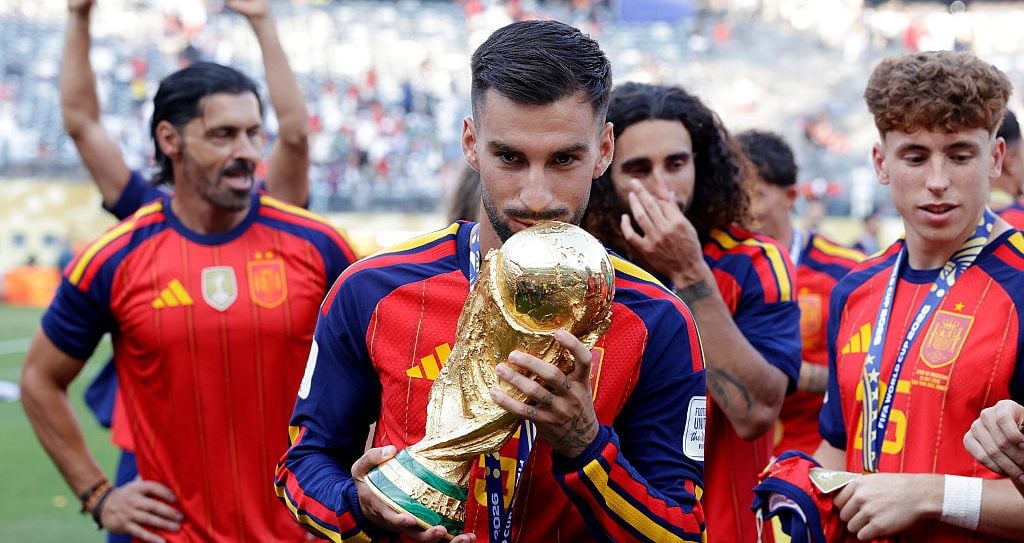
Lamine Yamal is only the most visible name in a much deeper story. As Javier Tebas, the president of La Liga, said in recent days, “all our clubs know that the road ahead is to bring academy players into the first team”. And that is what happens. Again and again. Across the country. Spain continues to produce players ready for the highest level without the need for years of expensive preparation elsewhere. They come through demanding environments, learn the rhythms of the modern game early, then move into the wider football world. The best ones rarely stay unnoticed for long. Some remain at home. Many now leave. It is this generation that sits behind Luis de la Fuente’s Spain, a side that has transformed a remarkable pool of players into a sequence of success. Long before the World Cup victory, AS had already begun to trace the scale of what was taking shape.
The summer market told its own story. Behind the biggest deals were years of work inside the academies that developed these players. Zubimendi joined Arsenal for €70 million. Jesús Rodríguez and Álex Valle moved to Como. Fer López left Celta Vigo for Wolverhampton. Yéremy Pino and Álex Baena departed Villarreal for Crystal Palace and Atlético Madrid — a club that, in this context, belongs closer to Europe’s elite than to the idea of a purely domestic side. The numbers followed. The sales of Spanish youngsters in 2025 reached €289 million, a record figure according to the local press. Not a sudden surge, but another sign of something that has been taking shape for years. And the talent is not only being exported. Inside La Liga, academy players continue to find space. Among Europe’s major leagues, Spain gives the highest share of minutes to footballers developed within clubs’ own youth systems: 19.8% of league playing time. The market value of Under-21 players coming through La Liga academies has now reached €1.46 billion. Almost €400 million more than the Premier League. Nearly twice Serie A. It was not always this way.
The change has come quickly. In five years, the share of revenue generated by the sale of players developed in Spanish academies has risen from 27% to 45%. What once belonged to a handful of clubs has become part of the language of the professional game. Reserve teams have played their part too. From the Segunda División downwards, more clubs have created genuine pathways for young players to compete, rather than leaving them at the edges of first-team football. Spain’s influence is now visible well beyond its borders. Football federations from China to Honduras and Iraq have looked towards La Liga, studying its structures and its approach to youth development, with particular attention given to the people working inside the academies themselves. The players produced by this work are no longer just prospects. They are already shaping the present. And the generation that came through these systems has become the one carrying Spain back to the top.