
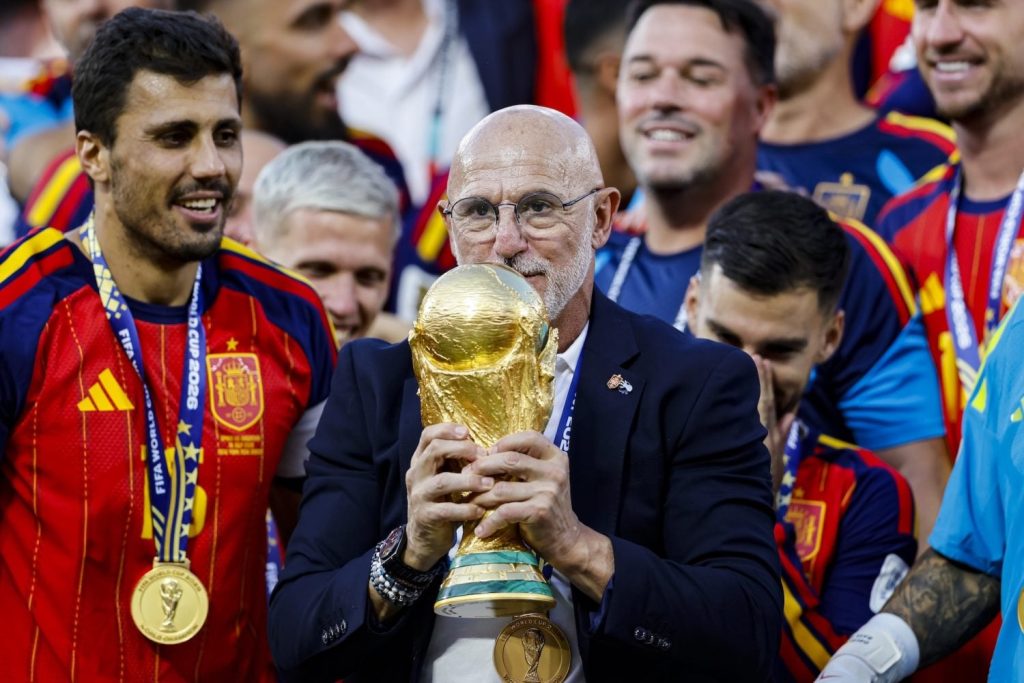
Luis de la Fuente’s first celebration as a World Cup-winning manager lasts only a few seconds. It is not the kind of scene that usually accompanies a victory of this magnitude. There is no sprint, no slide across the grass, no fists raised towards the sky. When the referee blows the final whistle, Spain’s coach simply smiles. A small, controlled smile. Almost severe in its restraint. He seems less interested in celebrating himself than in watching everything happening around him. The players embracing, those running towards the stands, those left on the pitch after the final whistle with the weight of the occasion still on them. Then he begins shaking hands, offering embraces, moving through the celebrations rather than standing at the centre of them. It feels like the reaction of a coach who does not see the moment as a beginning or an end, but as something that has been slowly approaching for years. To understand Spain’s World Cup victory, it is necessary to go back to a different stage of De la Fuente’s career, when he was not yet the manager of La Roja but the person responsible for one of the most important projects in Spanish football: following a generation of players through every level of the national team.
This Spain was not built in a single summer. There was no break with the past, no sudden change of direction. It grew gradually. The Olympic side that won silver in Tokyo in 2021 already contained seven players who would later become world champions: Unai Simón, Marc Cucurella, Martín Zubimendi, Mikel Merino, Mikel Oyarzabal, Pedri and Dani Olmo. The connection goes back further still. Merino, Oyarzabal and Dani Olmo had already won the Under-21 European Championship with De la Fuente in Italy in 2019, alongside Fabián Ruiz and Borja Mayoral. In a game increasingly shaped by urgency, De la Fuente’s work has always been based on time. He saw these players before they became established names. He coached them as teenagers, watched them develop, and eventually found them again when they had become leaders. He knows their qualities, but also their personalities: how they respond to pressure, how they react when things go against them, what they need in difficult moments. It is a kind of knowledge that cannot be reduced to data. When the Spanish federation chose him to replace Luis Enrique, the decision looked cautious from the outside. He had not arrived from one of Europe’s major clubs and his name did not carry the same international recognition as other candidates. But the logic behind the appointment was different. Spain chose the person who had spent years preparing the players who would eventually define its next era.
The achievements were already there. By the time he took charge of the senior team in 2022, De la Fuente had won an Under-19 European Championship, an Under-21 European Championship and an Olympic silver medal with Spain’s younger sides. More importantly, he had a clear idea of what the national team could become. For years, Spanish football had treated possession as its defining principle. De la Fuente did not reject that inheritance, but he refused to leave it untouched. The idea was not to abandon what had made Spain different, but to change its tempo. More pressing. More movement beyond the ball. More attacks into space. More urgency when the opportunity to hurt the opponent appeared. The Spain of De la Fuente now feels like a meeting point between two generations of the national team. They still have the technical quality and combinations that have defined Spanish football for more than twenty years, but they have added a different intensity, a different speed. They do not control matches only through possession. They control where matches are played. The trophies have followed. Nations League in 2023. European Championship in 2024. World Cup in 2026.
But the numbers tell only part of the story. The most revealing details are found in the decisions that shaped the team. Some were natural. Trusting Lamine Yamal was an obvious choice when a talent of such rare quality emerged. Others required a different kind of conviction. Giving Pau Cubarsí, born in 2007, responsibility at the centre of the defence in a World Cup he would later finish as the tournament’s best young player. Continuing to believe in Unai Simón and Aymeric Laporte after a difficult season at Athletic Bilbao. Those choices created a team that is difficult to move. A side that concedes little, that rarely loses its shape, that has turned defensive organisation into another way of controlling a match. Unai Simón’s record — one goal conceded throughout the entire World Cup — is not simply a statistic. It reflects the structure around him, a system in which every player appears to understand exactly what is required. Yet the most striking thing about this Spain is not only the way they play. It is the feeling that they are a group before they are a collection of individuals. Many of these players have grown together. They have shared camps, youth tournaments, victories and disappointments. They have followed the same path through the national team. De la Fuente has been present throughout that journey, the one constant between the different stages.
He did not have to build a culture from nothing. He inherited one. Perhaps that explains what changed after the European Championship in 2024. Spain no longer looked like a talented side searching for confirmation. They began playing with the certainty of a team that already knew what it was. After the semi-final victory over France, De la Fuente described that feeling clearly: “We faced the best national team in the world, but we are the best team in the world.” There was no provocation in those words. Only the confidence of someone who spends every day with the same group and understands what exists inside it. A coach who had seen the possibility before everyone else saw the result. Now the result is there. And with this Spain side averaging just 26.8 years of age, there is the sense that the most successful part of this cycle may still be ahead. Great national teams are usually understood only afterwards, once enough time has passed to give them their place in history. But De la Fuente’s Spain already have the elements that matter: talent, continuity, identity and a group of players who know each other. Much of that comes from a coach who, when he was appointed, was hardly the obvious choice. Then he won everything.