
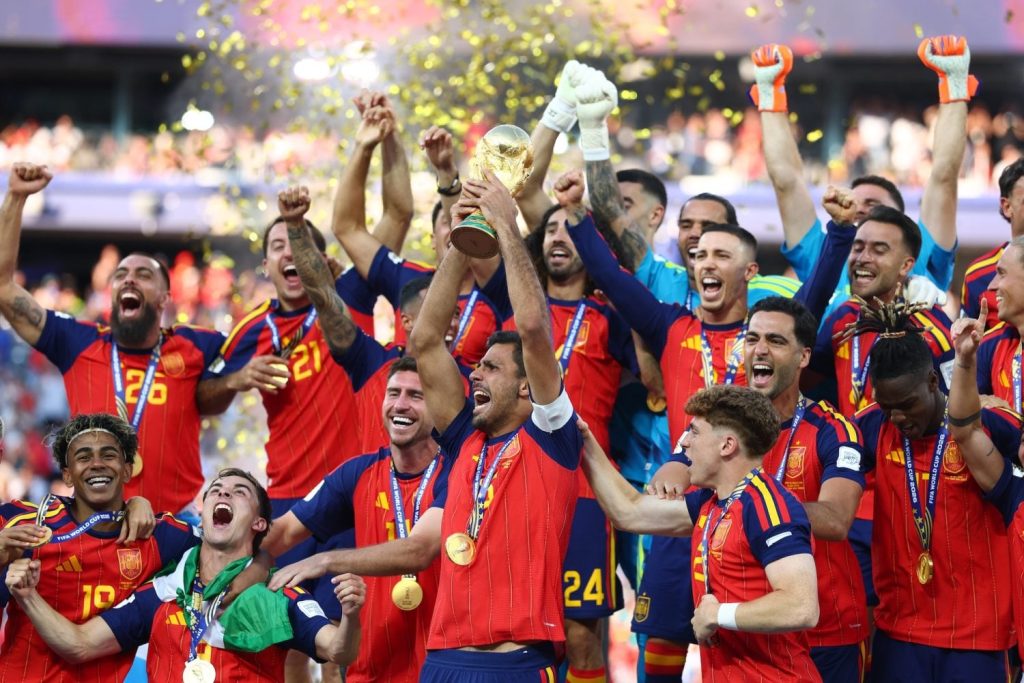
Spain won their second World Cup without ever receiving the performance everyone had been waiting for from the player expected to define them. Lamine Yamal arrived in America as the tournament’s most anticipated talent and left it without a signature moment. Nico Williams, too, found himself on the margins of a campaign in which many had expected him to be central. The Athletic Club winger, one of the heroes of Spain’s European Championship triumph, did not start a single game. His decisive contribution came late in the final, in the 106th minute, when he played Ferrán Torres in for the goal that settled the tournament. It was an important intervention. A World Cup final can turn on a single touch. But it was still a quieter tournament than anyone had imagined after the brilliance of his summer before. That was one of the strange things about Spain’s victory. The players around whom the World Cup had been built all found their moments. Mbappé had his. Haaland had his. Dembélé, Kane, Vinícius Júnior, Bellingham, Messi: each of them left some trace on the tournament. They appeared when the stage was largest. Spain’s biggest names did not need to do the same.
They won because the team itself was greater than the sum of its most visible parts. Because the structure underneath them was strong enough to absorb the absence of individual brilliance. Because, by the end of the tournament, Spain looked less like a collection of stars waiting for their moment than a side that already knew exactly what it wanted every match to become. The final against Argentina only completed the picture. Argentina arrived there having spent almost everything required to get that far, and Spain exposed the difference between the two teams. But the victory had been taking shape long before East Rutherford. The more revealing part of Spain’s World Cup was what happened when their most dangerous weapons were not fully available. The version that had won Euro 2024 was built around speed, aggression and the ability to turn wide areas into open space. Yamal and Williams gave Spain a kind of unpredictability that few opponents could handle. The World Cup required something else. Without their wingers at full force, Spain did not try to recreate what they were missing. They did not search for another player to imitate them. They changed the terms of the game instead. They made it slower. More controlled. More familiar. De la Fuente understood that if Spain could not dominate through acceleration, they could dominate through possession. The ball became not simply the beginning of attacks, but a way of limiting the opponent’s possibilities. It was not about returning to the past. It was about returning to the foundations. The foundations were always there.
https://www.youtube.com/watch?v=7LL3xy2KwPQ&pp=ygUQc3BhZ25hIGFyZ2VudGluYQ%3D%3DCalling this a return to tiki-taka would be too easy, and ultimately wrong. The Spain that lifted the World Cup in 2026 has little in common, stylistically and structurally, with the side that conquered the world between 2008 and 2012. The players are different. The game has moved on. The demands placed on elite teams have changed. Rodri is not Busquets. Dani Olmo is not Iniesta. Fabián Ruiz is not Xavi. Cubarsí, Laporte and the rest belong to another generation, shaped by another version of football. What remains is not a collection of names or a set of patterns frozen in time. It is an understanding. Spain still believe that the match should be organised before it is won. They still produce midfielders who seem to have been taught the same instincts from childhood: where to stand, when to slow things down, when to move the ball and when to keep it. Their control is not based on possession as a statistic. It is based on possession as a form of authority. That was the defining quality of their World Cup. They did not overwhelm opponents through constant attacking waves. They did something more difficult. They made matches belong to them. They decided the rhythm. They decided where the game would be played. They forced opponents to react rather than create. France understood that in the semi-final. Argentina found out in the final.
There was a fitting symmetry in Rodri lifting the trophy in East Rutherford. The player at the centre of Spain’s entire footballing logic was the one who carried the cup into the night. He was not the most spectacular figure of the tournament. He did not need to be. His importance was in the things he removed from the game: chaos, uncertainty, the possibility that matches might escape Spain’s control. That control is not produced overnight. It comes from a system. De la Fuente has become the face of this generation, but the story goes much further back than the current coach. Spain’s success has always been connected to the way the country develops players before they reach the highest level. The federation’s scouts work across every autonomous community, searching for the best young talents and bringing them together long before they become professionals. The most promising Under-14 and Under-15 players are invited into national camps, where they begin to know one another and, more importantly, begin to understand the same football. It is a slow process. Most of those players will never reach the senior national team. But the ideas remain. They return to their clubs with a shared vocabulary. They grow in different environments, with different coaches and different challenges, yet they carry something familiar with them. By the time they eventually arrive in the national team, they are not learning a new way of playing. They are returning to one they already know. That may be Spain’s greatest advantage. Their football is not introduced at the moment of selection. It has been built long before that.