
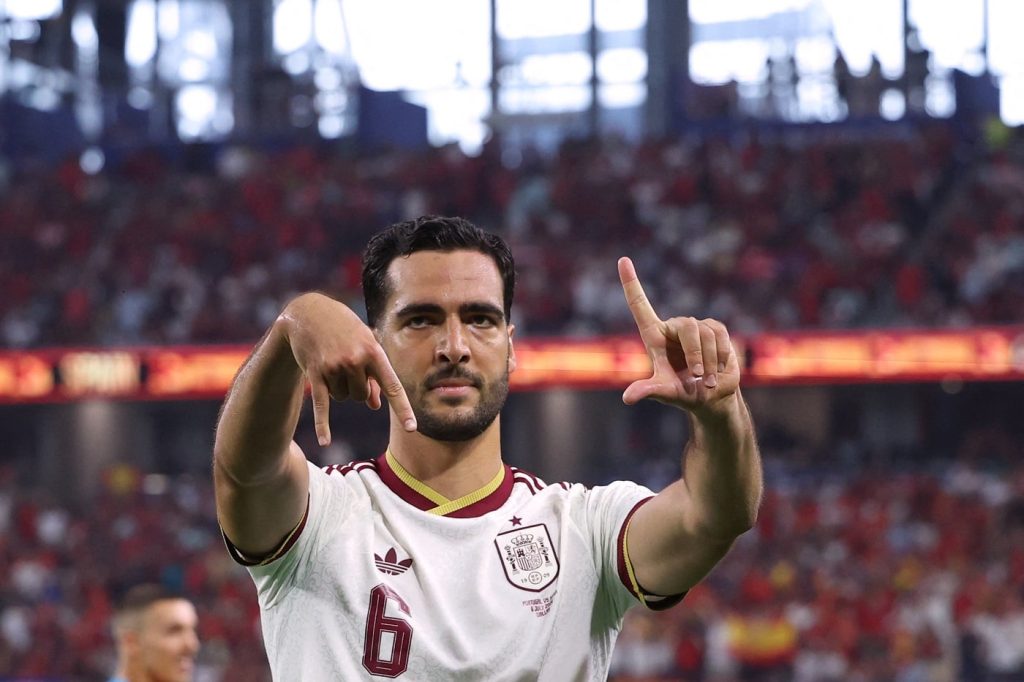
There are matches that leave players believing even more deeply in their own ideas. Against Portugal, Spain found one of them. They came through the toughest game of their World Cup so far by trusting the identity that has carried them this far. The turning point came from the bench. As La Roja’s possession kept running into a compact and disciplined Portugal, Luis de la Fuente altered the shape of his attack, introducing Ferran Torres and Mikel Merino for Dani Olmo and Álex Baena. For long stretches, Portugal were content to defend from a mid-block rather than press high. It was an unusual choice for Roberto Martínez’s side, but the fear of stepping onto Spain’s build-up, getting the timing wrong and leaving space behind the defensive line—the territory Lamine Yamal, Dani Olmo and Mikel Oyarzabal enjoy more than any other—clearly outweighed the temptation to be aggressive. Better to sit deeper, squeeze the space and force Spain into slower, less vertical possession.
That inevitably made for a different kind of game. The ball remained at the feet of De la Fuente’s players for long spells, yet their territorial control rarely became clear chances. For the first time at this World Cup, Spain looked as though they might have to accept that controlling the game, on its own, would not be enough. That was when the depth of a team built on principles rather than automatisms came to the surface. Torres interpreted the false-nine role differently from Oyarzabal. He kept dropping into midfield, offering his teammates another passing lane and, above all, drawing Portugal’s centre-backs out of position. For almost twenty-five minutes he misread the spaces and the timing. Then he got them right, and the game changed.
His pass for Merino was inspired. Merino, who seems to have developed an almost instinctive relationship with decisive goals, recognised the situation with his usual awareness, arriving through the right channel at exactly the right moment. Just as he had against Germany at Euro 2024, one of De la Fuente’s most trusted players settled the match. The move also revealed something about Portugal. Defending deep for more than ninety minutes does not naturally suit the players in their back line. Rúben Dias, Renato Veiga and João Cancelo are defenders shaped to control possession, not to spend entire matches protecting the final twenty metres in front of goal. So when concentration slips, even for a second, the cracks appear. Dias steps out a fraction too late, João Neves reacts late to the run, Veiga fails to provide the cover behind them. One lapse was enough.
Against this Spain, it usually is. Yet it would be unfair to reduce Portugal’s performance to that single moment. For long periods Roberto Martínez’s plan worked. Nuno Mendes probably produced the most convincing individual display anyone has managed against Lamine Yamal at this tournament. He almost never allowed him to dribble, anticipated his intentions and forced him to play half a beat later than he usually does. The Barcelona winger came alive only once in the first half with a shot from distance before drifting to the margins of the game. Mendes was also Portugal’s biggest attacking threat, driving forward repeatedly and forcing Pedro Porro into a decisive intervention to divert his left-footed effort.
Precisely because Yamal had such a subdued evening, Spain’s greatest strength became even clearer. They can break a defence with extraordinary quality and speed, but they can also do it in different ways while remaining faithful to the same underlying principles. If individual talent cannot dismantle the block, collective movement does. If the dribble is taken away, they attack the space instead. If the tempo drops, they simply become more patient. That is what De la Fuente has built: a national team that never abandons the same positional ideas, simply waiting for the opposition to concede the sliver of space it needs.
Even without Nico Williams, whose absence continues to deprive the left flank of depth and acceleration, Spain never questioned its identity or the principles that carried it to the top of Europe two years ago. If anything, those two additional years together have added another layer to the team’s maturity. It showed in the first genuine test of this World Cup, against a Portugal side that lacked sparkle but remained organised, balanced and notably humble in its approach.
With this victory, Spain reach the World Cup quarter-finals for the first time since 2010, the tournament that ended with triumph in Johannesburg. Sixteen years have passed since then, years in which the memory of that generation became more a point of comparison than a legacy truly inherited. This team may not dominate matches as Xavi and Andrés Iniesta’s Spain once did, but it is chasing the same feeling while building an identity that is unmistakably its own. Perhaps that is its greatest strength: the ability to keep winning through its own system even when the game seems to be asking something else of it.