
The tears in the stands told the whole story. The stunned faces of Cape Verde’s supporters, motionless as Argentina celebrated a gruelling 3–2 victory, became the defining image of a match that will live on in the history of both the World Cup and the African nation. These were not the tears that follow an ordinary defeat. They belonged to a side that watched its dream slip away nine minutes before penalties, when Diney Borges’ own goal in the 111th minute brought to an end a story that had seemed, for long stretches, entirely possible. That is where the regret comes from. The upset was close, but more than that it felt attainable. On their first appearance in the knockout stage of a World Cup, Bubista’s team did far more than hold out against the reigning world champions. They put them under sustained pressure, forced them into chasing a place in the quarter-finals that never truly felt secure and, deep into extra time, came within inches of landing the decisive blow.
On the eve of the game, almost everyone expected a one-sided contest. Instead, Cape Verde imposed its own terms with remarkable clarity. The defensive line sat extremely deep, the block remained compact, the distances between the units barely changed, and every player embraced the work without hesitation. At times nine shirts defended behind the ball, leaving a single outlet to give the team a way forward whenever possession was recovered. It was the obvious response to Argentina’s quality, but it never drifted into resignation. That was where Bubista’s work became impossible to ignore. Even while accepting long spells without the ball and surrendering possession almost entirely, Cape Verde never abandoned the search for space beyond Argentina’s back line. Every recovery became an immediate attempt to play forward, to attack a defence that looked increasingly vulnerable whenever it was forced to retreat. The weakness in Scaloni’s side had been identified with precision: circulation that was slow and predictable, little ability to create superiority between the lines, and a defensive structure that looked far less convincing once opponents broke into transition.
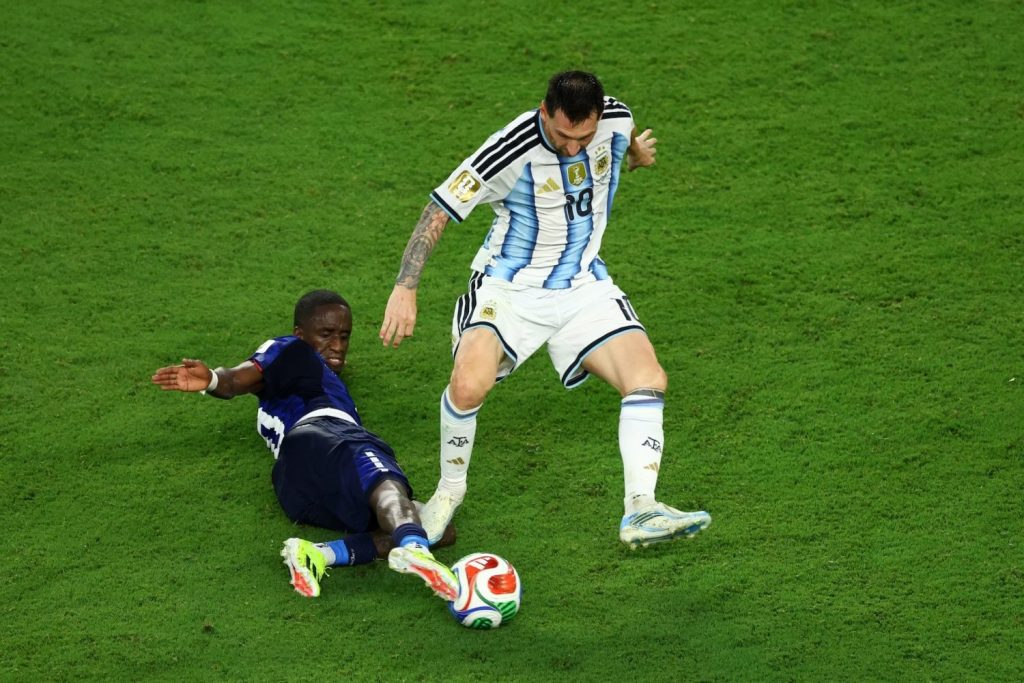
Argentina still found the breakthrough through a piece of invention that belonged to Lionel Messi alone. In the 29th minute, Lisandro Martínez clipped a long pass towards his captain, who killed it with a sublime first touch that took the defender completely out of the picture before finishing with the ease of someone who has spent two decades making the extraordinary look routine. It was a magnificent goal, greeted by the roar of a stadium that was almost entirely behind the Albiceleste. It felt as though the balance had finally shifted, yet Argentina never really stirred. Even with the lead, Scaloni’s side continued to play at a tempo that was simply too slow. Possession remained sterile, the build-up struggled to find players between the lines and attacks repeatedly developed along predictable routes, allowing Cape Verde’s defensive block to slide across without ever exposing the centre. This looked nothing like the Argentina that had won the World Cup. Too many touches, too few bursts of pace, hardly any movement away from the ball.
Cape Verde, by contrast, seemed increasingly convinced that the opportunity would arrive eventually. It did, in the 59th minute. Duarte finished one of the few but incisive counter-attacks produced by the Africans, rewarding a side that had never stopped looking for a way forward despite spending so much of the evening defending. The equaliser altered the mood completely. Until then Cape Verde had been pursuing a miracle. From that moment on, it was Argentina wrestling with uncertainty. Their superior technical quality eventually carried them back in front, but never with the sense that the game was under control. Every time Scaloni’s players threatened to pull away, Cape Verde found fresh energy, renewed courage and enough organisation to pull themselves back into contention.
They managed it again in extra time. Just as fatigue appeared ready to overwhelm them, Lopes Cabral produced another moment of brilliance, bending a superb right-footed effort into the net to restore parity. The small but relentless Cape Verde section erupted. Everywhere else, the stadium fell quiet. By then it genuinely felt as though anything could happen. Argentina grew increasingly tense and continued to struggle to create clear openings. Their slow circulation allowed Cape Verde’s defensive block to recover its shape again and again, while every misplaced pass opened another route into transition. The cruellest moment arrived only in the 111th minute, when Romero’s header forced Diney Borges into the own goal that finally broke the deadlock and turned what had seemed moments away from becoming one of the tournament’s defining stories into heartbreak.
Even that failed to extinguish Bubista’s team. Cape Verde came desperately close to another equaliser, first through Lopes Cabral and then Benchimol, only for Emiliano “Dibu” Martínez to produce two outstanding saves that spared Argentina from facing penalties. They may well have been the goalkeeper’s most important interventions of the night, preserving a victory that had looked anything but inevitable.
Reaching the quarter-finals is ultimately all that matters for Argentina, yet little about the performance felt reassuring. La Scaloneta looked slow, short of sharpness and unable to accelerate the game through central areas, while appearing surprisingly vulnerable whenever possession changed hands. Individual quality continues to make the difference, as Messi’s masterpiece demonstrated once more, but the collective fluency that made Argentina one of the most complete international sides of recent years has become harder to find. If they are to keep pursuing another World Cup, that sharpness will have to return. Against stronger opponents, a display like this may not be enough.
For Cape Verde, though, there is only pride. They leave to sustained applause, having already earned plenty of it during the group stage. Arriving at the tournament ranked 64th in the FIFA standings, they not only reached the knockout rounds but showed something even more significant: ideas can narrow the technical gap. Through organisation, courage, discipline and an unwavering belief that the decisive moment would come, Bubista’s side pushed the world champions to the limit until the very last seconds. The upset never arrived, but for 120 minutes Cape Verde convinced everyone inside the stadium that it still might. Perhaps that is the most extraordinary achievement of all.