
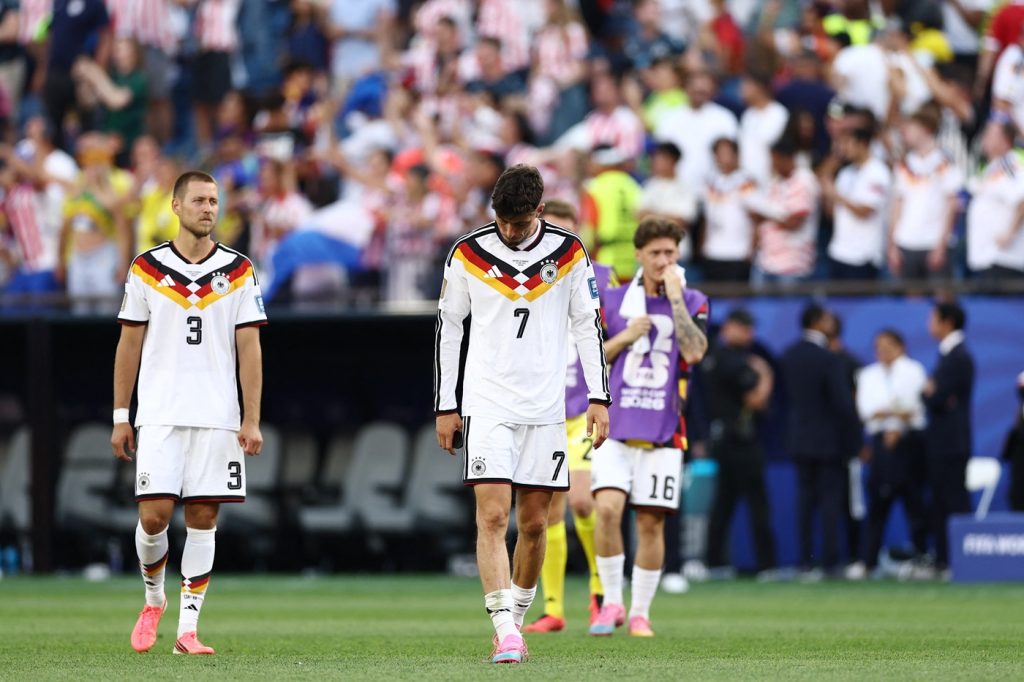
There are defeats that echo, and there are those that leave something heavier behind than the result itself. Germany’s penalty shootout exit against Paraguay in the Round of 16 belongs firmly to the latter. The match brought Julian Nagelsmann’s project to an abrupt end. The reaction that followed was even harsher. Across Germany’s newspapers, the elimination became less a defeat than a collective indictment. The headlines said as much. They were never just about ninety minutes and a shootout. They pointed to something deeper. A crisis of the system itself.
Bild went first, with the kind of bluntness that has long been its trademark: Wir sind raus! — We’re out! Two words. No context, no cushioning. Just the shock of an exit that landed like a national failure. The reporting offered little comfort. Germany had “lived through a nightmare”. The performance was “awful. Slow. Dull. Lethargic.” Sport1 took a more measured approach, framing the evening as an Elfmeter-Drama — a penalty drama. But the penalties were never really the point. The familiar pattern mattered more: another game controlled without ever being finished. Sterile possession. Little incision. A team that kept playing without ever delivering the decisive blow.
Die Zeit looked elsewhere. Its live blog drifted into something closer to a parallel narrative, suspended between irony and melancholy. Then came the final entry: Aus: Sprachlosigkeit im ZEIT-Büro. Finally. Silence in the Zeit newsroom. The story simply stopped. Nothing more was required. The Frankfurter Allgemeine Zeitung dispensed with drama altogether: Eine Niederlage, die die deutsche WM auf den Punkt bringt — A defeat that perfectly sums up Germany’s World Cup. The headline reached well beyond Paraguay. One match became the tournament in miniature: order without threat, control without conviction, quality without consequence.
Even Kicker, rarely given to exaggeration, dropped its usual restraint. The first headline read like a verdict: Drei fatale Fehlschüsse: Dramatisches deutsches WM-Aus im Elfmeterschießen — Three fatal misses: Germany’s dramatic World Cup exit on penalties, referring to the spot-kicks missed by Kai Havertz, Nick Woltemade and Jonathan Tah. The second cut deeper still: Ein Armutszeugnis für Fußball-Deutschland – und Nagelsmann — An embarrassment for German football — and for Nagelsmann. It was no longer simply about losing. It was about a system, a squad and a coach all falling short together. Armutszeugnis is a word reserved for failures too obvious to ignore, and too embarrassing to excuse.
Then came Der Spiegel: Von Deutschland ist nichts mehr übrig — There is nothing left of Germany. The harshest headline of them all. Not a judgment on one performance, but on an identity. The Germany that once owned tournaments and defined decisive moments no longer seemed to exist. Read together, the verdicts leave remarkably little room for ambiguity. Germany were knocked out by Paraguay. They were dissected by everyone else. From Bild‘s emotional punch to the FAZ‘s restraint, from Die Zeit‘s quiet irony to the systemic criticism of Kicker and Der Spiegel, the conclusion barely shifts. This was never treated as an isolated setback.
Which is why Sport1‘s “penalty drama” ends up meaning something else entirely. The three missed spot-kicks were only the final act. The real story had already unfolded: a team that controls but never hurts, that plays without imposing itself, that edges towards the finish without ever crossing the line. That helps explain the severity of the coverage. It was never just about one bad night. It was about too many nights that have looked painfully similar.
Over the past three World Cups, Germany have drifted a long way from the team captured in Gary Lineker’s famous line: “Football is a simple game. Twenty-two men chase a ball for 90 minutes and, in the end, the Germans always win.” The judgment may be unforgiving. It is difficult to call it gratuitous. Beneath the frustration lies something more enduring: genuine concern.