
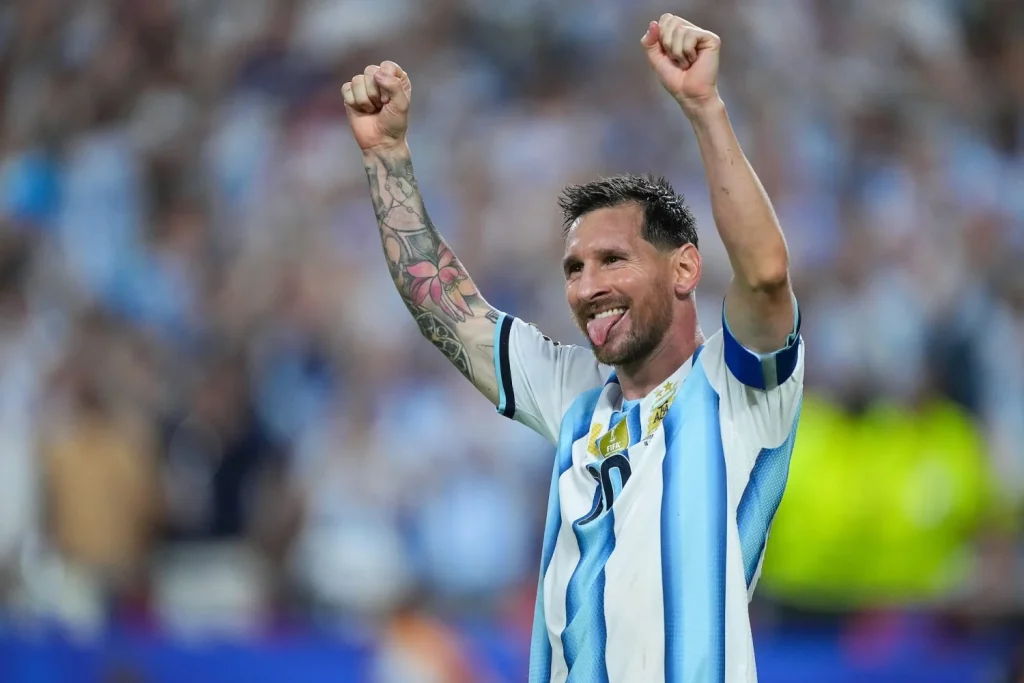
For much of his extraordinary career, Lionel Messi remained an enigmatic figure in his own country. Almost as if two versions of him inhabited the same body: the dazzling boy from Barcelona and the awkward teenager arriving each month from Spain to pull on an Argentina shirt a size too big. Leo and Messi, Messi and Leo, belonged to different realities and produced different reactions. The beauty of his football was never enough to break through the shield of identity supporters carry with them. For Argentinians, Messi — until proven otherwise — remained something close to an outsider.
With that suspicion around him, even with youth titles already won, Leo wore the shirt of the national team he had chosen. Twenty years ago, in 2006, on the eve of his nineteenth birthday, he played his first World Cup in Germany. An apprenticeship of sorts, inside a team led by Juan Román Riquelme. A side that never renounced his talent, but seemed to see him as something additional. An option. A card to play. The final image before the penalty defeat to the hosts said enough: after 120 minutes, Pekerman never called on him.
There was, though, something that resonated with those willing to look beyond the surface. Suffering. Messi was hurt by the indifference shown towards the love he felt for his own country. The criticism stayed with him. Then more arrived. No titles. Comparisons. The distance between the player Argentina watched in its own colours and the one appearing every weekend on television.
Leo was still himself. Only elsewhere.
Young, established, wealthy, questioned by one half of his own identity. Perhaps not even the competitor inside him could have imagined that, on the verge of 39, football would find him preparing for a sixth World Cup — this time as reigning champion.
That became the achievement of the Argentine Leo. The irrational one. The version that kept returning even after stepping away, convinced he had become the obstacle. Stubbornness is not exclusively Argentine, but only one side of Messi still required perfection. Everything else had already been won. Barcelona. The trophies. The records. Numbers that seemed to belong to another era.
The World Cup in the United States, Mexico and Canada will probably not end neatly. Age says one thing. Statistics another. More than ever, what follows will depend on much more than Messi alone.
The fascination remains.
One last World Cup. One more journey through a competition that has accompanied almost his entire career. What remains of the story. What remains for him.
The geography feels familiar. The same country where, thirty-two years earlier, Diego Armando Maradona played his final World Cup. Another parallel among many. For years, Diego served as the measure used against Messi whenever Argentina disappointed. The World Cup title in Qatar did not create something new so much as reveal what had already been there.
His contribution to Argentina was footballing. It was also persistence, availability, continuity.
The records accumulated. Then accumulated again. Appearances. Goals. Assists. Titles. Numbers beside numbers. Enough to place him, by any measure available, among the defining figures in the history of the national team. Perhaps above all of them.
In America, what is at stake extends beyond competition. Kansas City. Dallas. Perhaps Miami, Atlanta, New York. Along the way there is also something more personal.
Part of it belongs to Maradona’s story. To 1994. To the doping test that removed him from the tournament and abruptly ended what had looked like one last act of defiance.
“They cut my legs off,” Maradona said.
The other part belongs to Messi himself.
To the relationship between those two versions that travelled alongside each other for so long. Even if his returns home have mostly been limited to holidays, Inter Miami has become the final chapter in the gradual Argentinisation of Messi the footballer.
An environment that welcomed him as family. One that returned the image of a competitor still intact, but no longer defined only by competition.
The performance against Algeria suggested as much.
The next matches will say the rest.