
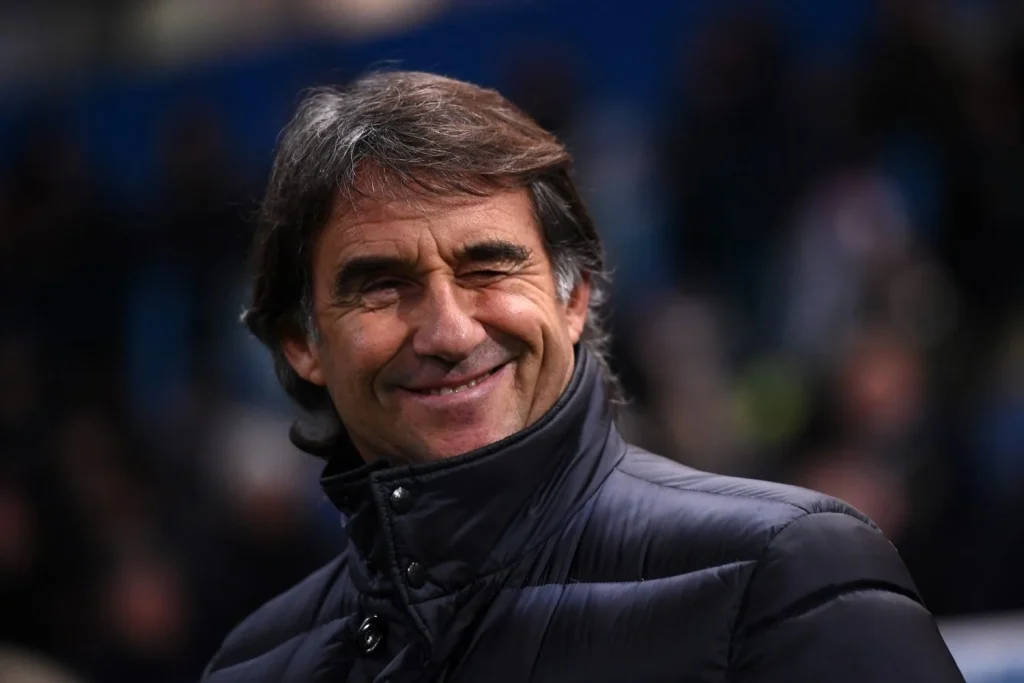
A résumé many would envy, an image kept consistently immaculate, a smile that suggests savoir-faire and ease in front of cameras. Giovanni Carnevali has all the traits of the classic Italian executive: a figure who projects assurance and tends to inspire trust, as though no contingency could really unsettle him. He belongs to a lineage rooted in northern Italian football administration, often placed alongside Braida, Galliani and Marotta — names that shaped his professional formation. Not only in presence, but in the way he has learned to inhabit the media space built around the transfer market.
It is within this frame that Juventus have turned to him. After twelve years at Sassuolo, Carnevali becomes the club’s new CEO and General Manager. The move follows Damien Comolli’s brief tenure, ended after a year.
Comolli’s spell at Juventus never quite settled into a clear register. Communication remained opaque, the sporting direction failed to translate into results, and the project struggled to take shape. He arrived with the profile of a data-driven reformer, yet his language and posture never fully aligned with the dressing room or with the wider culture of Italian football. “I read and learn all the time, I never stop. But I never read about football, it’s boring,” he said at Hudl Performance Insights. A line that, in Turin, ended up defining his perimeter more than any of his plans.
The issue was never the idea of a more analytical approach to football. It was the question of translation. The model did not take root in the environment it was meant to operate in, and the distance between system and context remained unresolved. His background at Toulouse under RedBird only reinforced the sense of a methodology shaped elsewhere, in a different football culture.
Carnevali sits at the opposite end of that spectrum. He is a figure comfortable in public, shaped by a managerial path that began with the founding of Master Group in 1996 — a marketing and events company tied to the operational side of Italian football ceremonies, from fixture draws to transfer deadline-day productions — and by an even longer history in the game that stretches back to the 1980s, when he founded Milanese, an amateur club.
The contrast, though, is too neat. His appointment is not a return to an “old” model against a “new” one that failed. At Sassuolo, over twelve years under Giorgio Squinzi, Carnevali effectively built a top-flight structure from scratch: infrastructure, training facilities, and the decision to relocate home matches to Reggio Emilia to strengthen the club’s commercial base, aligning its revenues with far more established Serie A sides.
The sporting project followed the same logic. Coaches such as Di Francesco, De Zerbi and Grosso were selected within a coherent framework, and the club developed a recognisable identity built on progression and player value. Locatelli, Frattesi, Scamacca, Raspadori, Boga — profiles shaped and moved on within that system.
Juventus, at this stage, present a fragmented structure still searching for stability. Carnevali’s experience within the institutional and operational fabric of Italian football, and his familiarity with its informal codes as much as its formal ones, places him in a position of immediate relevance.
His arrival also reopens a line of continuity with Inter CEO Beppe Marotta — former mentor, colleague in Monza, Como and Ravenna, and later best man at his wedding. Carnevali describes him simply: “He is a friend as well as my mentor. We met when he was at Monza and I was at Milanese Calcio, a youth side. I suggested a player, he trusted me, and I handed over the registration. That’s how it started.”
Seen in this light, the appointment reads less as rupture than adjustment. Juventus turn to a figure who understands the internal geography of Italian football — its formal structures and its unspoken ones — in equal measure. Whether that restores balance is another question. For now, it marks a shift that feels deliberate, and entirely considered.