
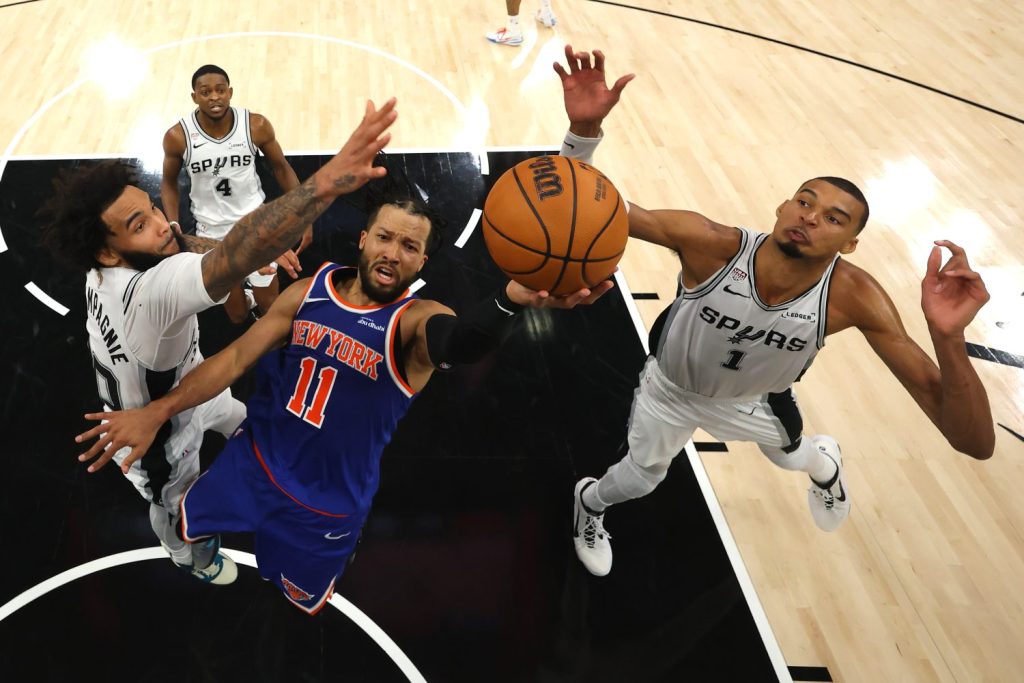
On the evening of 28 January 2011, the Boston Celtics arrived in Phoenix with a record of 35 wins and 10 defeats. This was the Celtics of Kevin Garnett, Paul Pierce and Ray Allen, seven months on from their second NBA Finals appearance in three years. Waiting for them were the Suns, one of the worst defensive teams in the league. Boston lost 88–71. At one point, Garnett threw a pass into empty space, then got himself ejected for striking Channing Frye below the belt. Ed Lacerte, the team’s long-serving athletic trainer, had his own explanation. “We should go and see the sleep doctor. This is the game he picked out.” The doctor was Charles Czeisler, director of sleep medicine at Harvard Medical School, whom Doc Rivers had asked to examine the Celtics’ schedule. Boston were due to arrive in Arizona having played in Portland the previous night and hosted Cleveland two nights earlier. “It’ll be like playing basketball drunk. You’re not going to win this game,” Czeisler had warned.
In the NBA, games like that have a name: scheduled losses. They are lost long before tip-off, when someone decides the order in which a team will play its 82 games, and the intervals between them. Today, that task falls to a mathematical model working with more than 3,000 constraints. Many have little to do with basketball. They come from television networks, which pay billions for the right to determine when the biggest games are shown, and from arenas, which must also accommodate hockey, concerts, rodeos and college tournaments. There is no way to fit everything together perfectly. Every year, the finished schedule is one enormous compromise. In August, Evan Wasch, the NBA’s executive vice-president, described it as “effectively the world’s largest mathematical problem”. The possible ways of arranging 1,230 games across roughly 180 nights, he said, outnumber the atoms in the universe.
Television comes first. “The very first building block of the schedule is the national television slate,” Wasch explained. Since last season, that slate has been divided between the broadcasters who will pay the league $76 billion over eleven years: Peacock on Mondays, NBC on Tuesdays, ESPN on Wednesdays, Amazon on Thursdays, Amazon and ESPN on Fridays, ABC on Saturday nights and Sunday afternoons, and NBC on Sunday evenings. Each broadcaster pays for a selection of games in prime time and on the dates that matter. There are around 60 major viewing windows, from opening night and Christmas through to the NBA Cup. Only 10 teams can play on Christmas, and this year the NBA has to share the day with three NFL games.
The television commitments bring a further set of restrictions. Teams cannot play the night before nationally televised games during opening week, on Christmas, Martin Luther King Day or Presidents’ Day, ahead of the 10 Saturday night games on ABC, the six Sunday games on ABC, the 16 Sunday night games on NBC, or any of the NBA Cup fixtures. The Cup group stage occupies every Friday from 30 October to 27 November, as well as Tuesday 24 and Wednesday 25 November. The final two games for each team cannot be arranged until the groups have been decided, and must then be fitted into the period between 4 and 10 December. The number of moving parts is extraordinary. Even the most sophisticated algorithms are put to the test.
This season, 247 games will be shown nationally. The Philadelphia 76ers and the San Antonio Spurs have 34 apiece, the maximum permitted, while the Milwaukee Bucks, now without Giannis Antetokounmpo, have been given just two. The league even had to wait for LeBron James, who did not decide to join Philadelphia until late July. Halfway through the month, Adam Silver had acknowledged the problem at a CNBC event in New York. “We need to finish the schedule, and where LeBron plays will affect the schedule.” His decision would determine when the 76ers travelled to Los Angeles, a fixture eventually placed on Christmas Day, and with it a series of other broadcasting arrangements. The commissioner was not leaving much room for doubt. “I need him to make a decision.”
But every date demanded by television still needs an available arena. The process of gathering availability begins in November, almost a year before the first tip-off. Teams classify dates as open, blocked or provisional. The provisional ones are particularly common in arenas shared with hockey teams, where a date remains available until the NHL decides whether it needs it. Eleven of the NBA’s 30 teams share their home with an NHL franchise. This season, the NHL has increased its schedule from 82 to 84 games, meaning that 83 regular-season fixtures must be accommodated in those arenas between late September and mid-April. An NBA team typically has between 60 and 70 available dates. For those sharing with a hockey team, that figure can fall to around 50, with 41 home games to fit in.
Concerts and other events make the picture more complicated. In 2022, Gene Li, then the NBA’s national scheduling manager, recalled that one of his colleagues had a single overriding responsibility: collecting the hockey schedules from every arena, along with dates provisionally reserved for concerts and shows that occupy a venue for several consecutive days, such as Disney On Ice. Madison Square Garden, home to the reigning champion Knicks and the Rangers, is a particularly awkward case. From late August until 31 October, Harry Styles played 30 concerts there, every Wednesday, Friday and Saturday. The Knicks, as a result, played at home only on Tuesdays and Sundays in October. Their opening night on 20 October, featuring the championship banner ceremony and LeBron’s debut for Philadelphia, was broadcast live on NBC. It fell the night before Styles’ twenty-fifth concert.
The Spurs face a similar clash of commitments in February. From 11 to 28 February, their arena hosts the historic San Antonio Stock Show & Rodeo: 22 performances, accompanied by concerts. After their last home game on 6 February, the Spurs will spend the next 10 games away from San Antonio, beginning in Dallas on 9 February and ending in Houston on 5 March. Two of those fixtures are technically home games, but will be played in Austin. The Lakers have their own annual disruption, a journey they have long called the Grammy road trip. This year it means seven games in 12 days, from 28 January to 8 February. In the middle of it comes 7 February, when the Crypto.com Arena, shared with the NHL’s Kings, hosts the 69th Grammy Awards.
There are the distances to consider as well. Across the 80 games already scheduled, each team will cover an average of around 42,500 miles. The Spurs will cross the Atlantic twice to play the New Orleans Pelicans, first in Paris on 14 January and then in Manchester on the 17th. The league’s ambitions in Europe, and the marketing opportunities that come with them, have to be accommodated too. Back-to-backs have become less frequent. In 2014-15, teams played an average of 19.3 sets of games on consecutive nights. This season, the figure is down to 14.2, with a maximum of 16. No team has to play four games in five nights. Even so, 59 of this season’s back-to-backs involve a journey of more than 750 miles between games.
For decades, the NBA schedule was put together by hand. Eddie Gottlieb, the legendary owner of the Philadelphia Warriors, wrote it out on a pad of yellow paper. From 1985 onwards, Matt Winick handled the job for around 30 seasons, working from a spreadsheet in which home games were marked in blue and away games in red. “I tell the teams, ‘Hey, the computer did it this way’,” he told Bleacher Report in 2015. “But it was never the computer. The computer was me.” Today, the job belongs to Fastbreak, a company founded in 2022 by Chris Groer, Tim Carnes and John Stewart, which has also been working with Serie A since June 2026. Wasch describes its approach as “constraint-based optimisation”. Each rule is assigned a penalty: an infinite one for anything that cannot be broken, a smaller one for preferences, such as avoiding Monday home games. Teams can also be given, for example, 2,000 points to allocate to their own requests. The Miami Heat might use theirs to ask for home games during Art Basel, one of the world’s leading fairs for modern and contemporary art.
The hardest thing to put into numbers is common sense. To teach its model what makes a good road trip, Fastbreak asked a group of executives to rate thousands of previous trips on a scale of one to ten. A straightforward journey from one nearby city to another might score eight or nine. A back-and-forth across time zones might get three. Using those ratings, the machine’s assessments came closer to each expert’s judgement than the experts came to agreeing with one another. Even so, Stewart admits: “I’m always surprised when we produce a playable schedule.” When the groups for the first NBA Cup were settled in 2023, Wasch asked his team to run the model through two possible scenarios after midnight: one in which the Sacramento Kings won, the other in which the Golden State Warriors did. The remaining fixtures were announced at 1.45am New York time.
Once the model has done its work, the schedule goes back to the teams. Each receives an initial draft and has 48 hours to respond. When the dates are finally confirmed, the complaints begin. Every summer brings protests from franchises and supporters alike. But no team is particularly keen to turn its objections into a matter of principle. The television revenue that dictates Christmas and Sunday night fixtures is shared equally between all 30 NBA teams. Last season, that meant around $143 million apiece. It is difficult to sustain a protest when the money is divided so evenly. Stewart regards the complaints as a reassuring sign. If the work has been done properly, everyone will find something to grumble about. He calls it “the art of distributing disappointment equally”. “If everyone hates you equally, you’ve done your job.”
The season is only a few weeks old. The first indications of who might contend for the championship are beginning to emerge. The schedule for 2027-28 is already taking shape, starting with the collection of dates on which arenas will be available. The process never really stops. Somewhere in the mass of competing demands, television slots and arena bookings, the next Phoenix is taking shape. A date on the calendar. A game Boston are not supposed to lose.