
The Tropicana was Las Vegas in miniature. A 22-storey white tower on the Strip, it had been there since 1957, a fixture of the city’s old glamour and the setting for some of its most memorable nights. Frank Sinatra had performed there. So had Louis Armstrong. Then, two years ago, it was brought down. Demolished. At the junction of Las Vegas Boulevard and Tropicana Avenue, the old hotel has given way to an enormous, diamond-shaped construction site. In little over a year, it is due to become the new home of the Las Vegas Athletics, the city’s first Major League Baseball franchise. Think Brad Pitt in Moneyball. These are Billy Beane’s Athletics, the team that made a virtue of doing things differently back when they were still based in Oakland. One of the most decorated franchises in MLB history, they have not won a championship since 1989. A long time ago. Las Vegas is offering them the chance to start again, beneath the neon lights that never go out. Their new stadium will cost more than two billion dollars, making it one of the most expensive in the United States.
Until recently, the idea of a baseball stadium a short walk from the Bellagio and Caesars Palace would have seemed absurd. These are the landmarks that made Las Vegas what it is: the gambling capital of the world. But the city is changing. The green felt of the poker tables is giving way to the green of the playing field. Casino carpets are being replaced by the hardwood floors of indoor arenas. Sport is moving into the Mojave Desert.
For years, Las Vegas and professional sport occupied separate worlds. The city appeared in the sporting pages almost exclusively as a boxing venue, the setting for the great fights of Muhammad Ali and Mike Tyson. Now it is making room for just about every sport going. The first to arrive, ten years ago, was perhaps the least obvious. In 2016, the T-Mobile Arena opened in Paradise, ready to welcome the newly formed Vegas Golden Knights. Ice hockey in the desert might have seemed an unlikely proposition, but the NHL was the first of America’s four major professional sports leagues to establish a franchise in Las Vegas. The owners, Bill Foley and the Maloof family, were already familiar names in the city as the founders of the Palms Casino Resort, just off the Strip. Yet the Golden Knights quickly became more than a business venture. They made their NHL debut in the 2017/18 season and, just six years later, won the Stanley Cup. Few teams have reached the top so quickly. In 2023, the best ice hockey team in the world was based in the middle of the desert. The Golden Knights remain among the strongest contenders for the title.
There is a particular kind of ambition at work here. Las Vegas is fast becoming a new capital of world sport, and it is no idle claim. For decades, the Professional and Amateur Sports Protection Act, a federal law that prohibited sports betting in much of the United States, had kept the major leagues away from the country’s gambling capital. That changed in 2018, when the law was struck down. Sports investors soon began arriving, quick to spot the potential of a city whose economy had long revolved around gambling and tourism. The two, they realised, could work rather well together.
The next arrival was football. In 2020, the Raiders moved from Oakland to Las Vegas, following a route the Athletics would take a few years later. Their arrival coincided with the opening of Allegiant Stadium, designed by the renowned architecture practice MANICA and built at a cost of two billion dollars. It quickly established itself as one of the country’s premier football venues. In 2024, the NFL brought the Super Bowl to Las Vegas for the first time. The San Francisco 49ers and the Kansas City Chiefs, led by superstar Patrick Mahomes, were the finalists. More than 300,000 fans descended on the Strip over the weekend, generating an estimated one billion dollars in economic activity. The figures surrounding the game tell another story, too. According to the American Gaming Association, more than 23 billion dollars was wagered across the United States on Super Bowl LVIII. Nearly 70 million Americans placed a bet, roughly a quarter of the population. One in four.
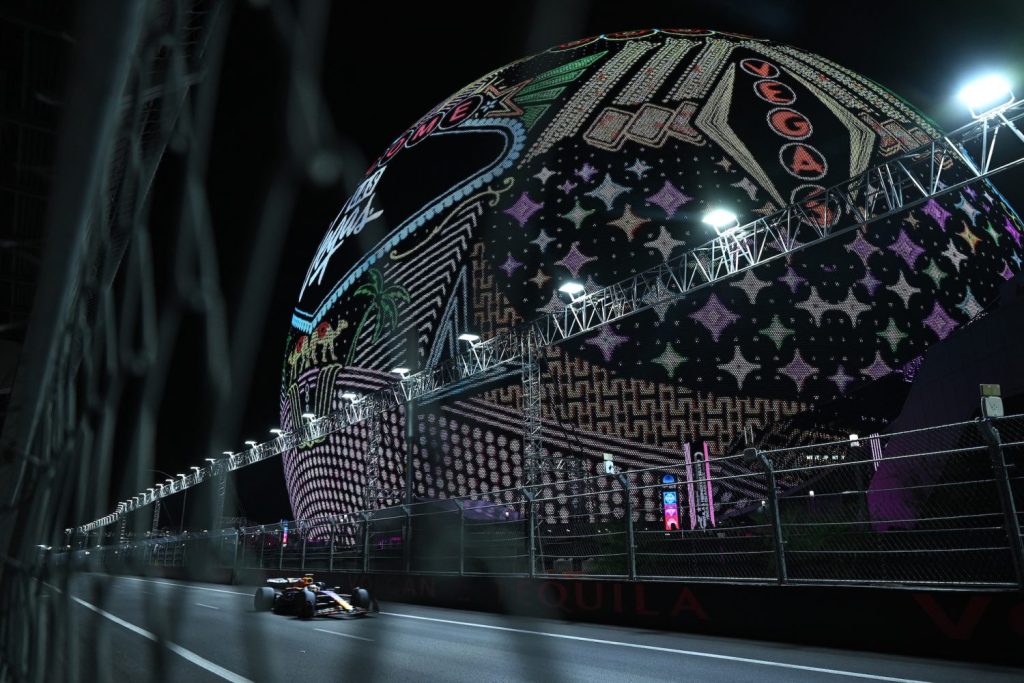
By then, Las Vegas had become a natural destination for the biggest names in sport. Formula One was next. For the past few years, its cars have been hurtling through the city at 300 kilometres an hour. The Grand Prix is now a fixture on the calendar, staged at night through the heart of the city. It has won over drivers and fans alike, despite the scepticism that greeted its arrival. Before the inaugural race in 2023, Max Verstappen dismissed it as «99% show and only 1% sport». By the time he crossed the finish line, he was singing Viva Las Vegas. He would later describe the circuit as «fun and spectacular». It had clearly made a rather different impression from the one he had expected.
The crowds came, too, from all over the world. The first Grand Prix weekend generated a net economic impact of 1.5 billion dollars. Estimates suggest that visitors spent three times as much as tourists who stayed in their hotels playing the slots. The 2023 edition remains the most lucrative event in the city’s history. Liberty Media, the American group behind Formula One, had staked heavily on Las Vegas as part of a wider effort to raise the sport’s profile. A billion dollars went into promoting the race alone. The investment paid off. A few months ago, Formula One CEO Stefano Domenicali announced that the Grand Prix would remain on the calendar until 2037.
There is one conspicuous absence from this growing collection of sporting properties. Basketball. More specifically, the NBA. Women’s basketball already has a strong presence in the city. The Las Vegas Aces, owned by Mark Davis, who also holds a majority stake in the Raiders, have won three WNBA championships in the past five years. The NBA will have to wait for the league’s planned expansion from 30 to 32 teams, expected from the 2028/29 season. Las Vegas is widely expected to be one of the two new destinations. Three groups are in the running to secure a franchise: Bill Foley, already the owner of the Vegas Golden Knights; the partnership of Steve Apostolopoulos and Marc Lasry; and Nancy Walton, heiress to the Walmart fortune. The sums involved are extraordinary. The franchise and a new arena could require an investment of at least 12 to 13 billion dollars.
Basketball may be the missing piece, but it might not be the last. In recent months, a special Major League Soccer committee has met to discuss the possible relocation of the Vancouver Whitecaps. Among the destinations under consideration is, once again, Las Vegas. A group of investors is reportedly ready to bring Thomas Müller’s current club, now firmly in contention for the title, away from Canada’s chilly west coast and into the Nevada desert. Any move would still need the approval of the league’s owners, along with a relocation fee likely to exceed 500 million dollars. But money, as ever in Las Vegas, is part of the attraction. The old Las Vegas was built around the promise of what might happen when you walked through a casino door. The new one is making a similar promise in a different arena. A championship, a big fight, a Grand Prix, a Super Bowl. The lights are the same, the appetite for spectacle hasn’t changed. Only the game is different. And somewhere on the site where the Tropicana once stood, another piece of that new Las Vegas is taking shape.