
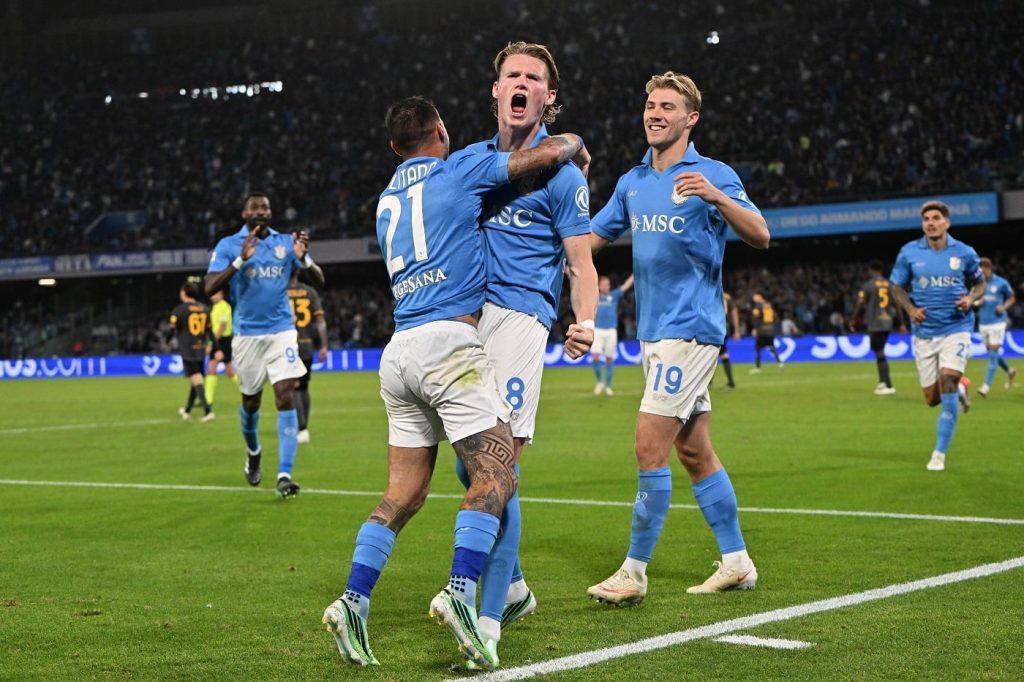
Massimiliano Allegri’s fury was the final image of a Napoli-Roma match played almost without a moment to breathe, an evening that ended with the Napoli coach seeing red. In the closing stages, he lost his temper with Colombo over the contact on Beukema in the build-up to Balerdi’s 3-3 equaliser and was sent off. In Allegri’s eyes, Roma’s comeback had been completed with the help of a refereeing decision he could not accept. Speaking to DAZN afterwards, and later at his press conference, he made no secret of his disappointment at a victory that had slipped away twice, first after Napoli had gone two goals ahead and then after McTominay had restored their lead in the 83rd minute. The result, though, does not tell the whole story. If anything, it risks obscuring the most significant development of the evening: Napoli had arguably played their best football of the season.
The 3-3 inevitably left a degree of frustration. Napoli had twice failed to protect their lead, and this was not the first time it had happened this season. Yet for more than an hour, despite the chances they conceded, they looked like a different side: quicker in their decisions, more aggressive in the duels and better at attacking space. They had found a more convincing balance between the qualities of their best players, without forcing them to occupy the same areas of the pitch. That is where the focus should lie, rather than on Allegri’s anger in the closing stages. Napoli have found a tactical approach worth pursuing.
It starts with Kevin De Bruyne, who, as against Bodø, operated as a playmaker of sorts, directing the game from deeper positions without becoming a conventional holding midfielder. Against Roma, the idea gained further weight. De Bruyne dropped back to take part in the build-up, but his real value lay in receiving the ball in areas where he could turn towards goal, play forward and bring the attackers into the game. He did not need to spend long on the ball to give possession a purpose. Finding the right passing lane at the right moment was often enough to break through Roma’s press.
The role has effectively given him the starting place at the heart of Napoli’s midfield ahead of Lobotka. That does not mean the Slovak has lost his importance, nor that Napoli can do without his ability to control the tempo. Rather, Allegri appears to have found a solution better suited to the team’s overall characteristics, at least in this configuration. With De Bruyne in that position, Napoli play with greater speed and verticality. The ball moves with the intention of breaking through an opposition line, rather than simply retaining possession; the forwards receive it more readily on the move, while the midfielders can make their runs without waiting for attacks to develop at a slower pace. The difference is particularly clear in the way Scott McTominay now approaches the game.
For a long time, the challenge was not to establish how good the Scot was, but to find a way for him to coexist with De Bruyne. Both need freedom, both like to attack space and get close to goal, and if they are forced into the same channels, they risk limiting one another. When one takes responsibility for building the play and the other is free to run beyond the ball, attack the box or arrive in support, their qualities begin to reinforce each other. Against Roma, they finally stopped getting in each other’s way and started to complement one another, with De Bruyne giving direction to Napoli’s play and McTominay attacking the space ahead of him with his physicality and timing.
The Scot’s first goal, in the 48th minute, came from Politano’s cross, McTominay timing his run perfectly to beat the defence in the air. The second, in the 83rd, revealed another side of his game: a strike from outside the box that restored Napoli’s lead just as the match seemed to be slipping away. The goals were different, but both pointed to the same quality. McTominay is becoming a midfielder capable of making an impact across the pitch. De Bruyne’s new position helps bring that out, allowing the Scot to concentrate on what he does best: driving forward, exploiting space, arriving late and attacking the far post. Napoli are getting more from both players without compromising either, and a partnership that once seemed difficult to accommodate is beginning to produce results.
The opposition matters, too. Roma like to turn matches into a succession of individual duels, using man-to-man pressing to deny their opponents time to think and play. For much of the evening, Napoli responded with quick combinations and intelligent movement, finding ways out of the press and attacking the space behind the defence. They had chances to put the game beyond reach, came close to making it 3-0 and then found the strength to regain the lead after conceding to Soulé and Balerdi. Roma’s comeback does not erase what Napoli had built before it, but it does underline the need to be more clinical when the opportunity comes to secure a result, and more resilient when opponents turn up the pressure.
The distinction is between an encouraging performance and a complete one. Napoli still need to improve defensively. Ten goals conceded in the league is a damaging figure, more commonly associated with the bottom half of the table, and cannot simply be dismissed as the price of attacking football. Soulé’s and Balerdi’s goals showed how a few minutes of disorder can undo the work of an entire evening. Yet it would be wrong to suggest that Napoli defended poorly throughout the match. For long stretches, they tracked their men well, competed aggressively in the duels and matched Roma’s intensity. The trouble came when their collective organisation began to break down, the gaps between players widened and the visitors found room to punish them.
It is a weakness Allegri must address, particularly with a side that commits so many players forward. Attacking with greater ambition requires a structure capable of protecting against transitions and maintaining its shape when possession is lost. Napoli have not yet found that balance consistently enough.
Allegri had every reason to be angry. A team that scores three goals and takes the lead twice should expect more than a draw, especially after having the chance to finish the job. But there was plenty in Napoli’s performance that the result threatened to obscure. They have found a more convincing tactical set-up, made better use of De Bruyne as a playmaker and given McTominay the freedom to impose himself on games. Now they must learn to protect what they build. The final outburst captured the coach’s frustration, but it need not define the team’s performance. For all the points dropped and the goals conceded, Napoli have finally begun to show a recognisable identity.