
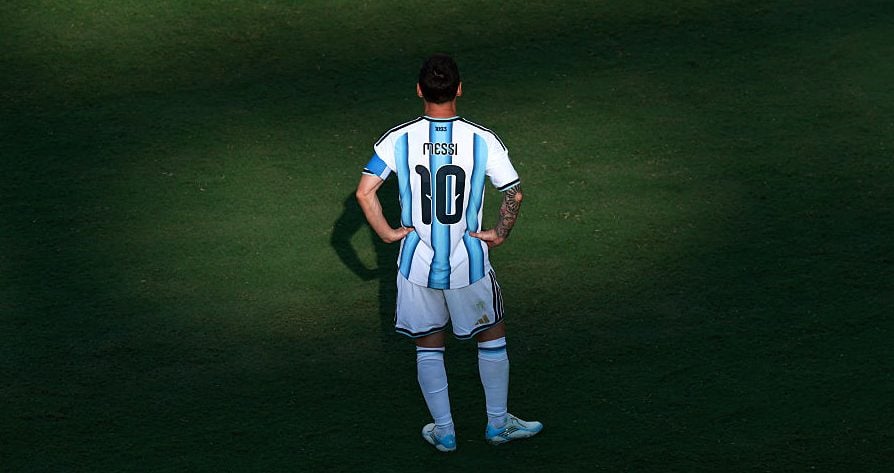
Two decades of legend, 207 appearances and 125 goals. A World Cup won between two bitterly lost finals, both decided in extra time, the latest just a month ago. Lionel Messi reveals today that his farewell letter to the Selección, that second skin for which he gave everything and then some, was actually dated 21 July 2026, just two days after the bitter ending in America. Then it stayed there, shut away in a drawer for weeks — some of the hardest of the man’s life, after the loss of his father Jorge at the beginning of August — before finally seeing the light of day, spreading across social media and news bulletins around the world on Monday. Messi leaves Argentina. He leaves an irreplaceable void on the pitch. He leaves behind a quiet kind of leadership, one around which memorable sides have flourished, built from teammates willing to do anything for their captain. He leaves an image that, since 2006, has made the Albiceleste and the number ten from Rosario an inseparable pair. But beyond all that — perhaps at the very bottom of the emotional hierarchy, if not that of the federation executives in Buenos Aires — Messi also leaves a gigantic hole in the economic and commercial value of the Argentine national team.
It could hardly be otherwise when one man has become bigger than the institution around him. Especially in recent years, the AFA has grown enormously around Messi. The triumph in Qatar, two Copa Americas, a Finalissima: what happened on the pitch certainly helped. Yet even without all that, there was a whole world mobilising to follow Leo — and, perhaps, Argentina with him. The fee demanded by the football federation — source: Calcio e Finanza — for an international friendly with Messi guaranteed to play has so far hovered around $5 million. Sometimes more. Much more: to celebrate the 50th anniversary of Angola’s independence, the federation in Luanda was prepared to pay between $10 million and $12 million simply to host a showcase match featuring Messi, who at least went on to score — as for the ethics of the decision, made by a country where 30–40 per cent of the population lives below the poverty line, better to draw a veil over it.
But back to Messi. Sometimes the captain, now approaching 40, could pull out of a friendly at the last minute: protecting his physical condition has always taken precedence over any commercial commitment, and nobody has ever questioned that. In those cases, though, the fee paid to the AFA by the opponents could fall dramatically. Or the whole thing could end up at the centre of a long and hugely expensive legal dispute: the AFA itself went to court over a $7 million agreement for a friendly that Messi’s Argentina were supposed to play in Venezuela, only to pull out.
One way or another, the pattern is clear: this is a genuine one-man show. Lionel not only guarantees a full house; he has enormous weight when it comes to television rights, merchandising and sponsorships. The player himself earns $70 million a year, with global giants such as adidas, Mastercard and Michelob Ultra among his partners. A gold mine, one that Argentina has exploited to the fullest. The AFA has become one of the wealthiest football federations on the planet, taking its brand into the United States, the Arab world and the Far East. Football academies established on the ground, relentless advertising campaigns built around the cult of the number ten shirt. An irresistible draw, a strengthening of the brand that owes an enormous amount to its star man.
Today the AFA’s annual turnover is approaching $150 million, with 80 per cent resting on the economic value of global commercial agreements. Since that night in June 2006, when the prodigious Leo became the youngest player ever to make his debut for Argentina, total turnover is estimated to have risen by more than 700 per cent, with the sharpest growth coming in these golden years, when Argentina began winning everything, on and off the pitch. Even industry publications talk about the “Messi Economy” The problem now: with the captain finally saying goodbye, the Selección will have to reinvent its financial model. And however solid the foundations built over the years may be, there is no guarantee it will manage it. After all, there is only one Messi. His millions of followers will follow him, and the Albiceleste may lose them too. The dynamic is simple, and economically irrational, summed up by the homespun wisdom of Nino D’Angelo in Tifosi: “For a true Neapolitan, a photo with Maradona has no price.” The same goes for Messi, and for the rest of the world that, until now, has paid just about anything to be part of his epic.