
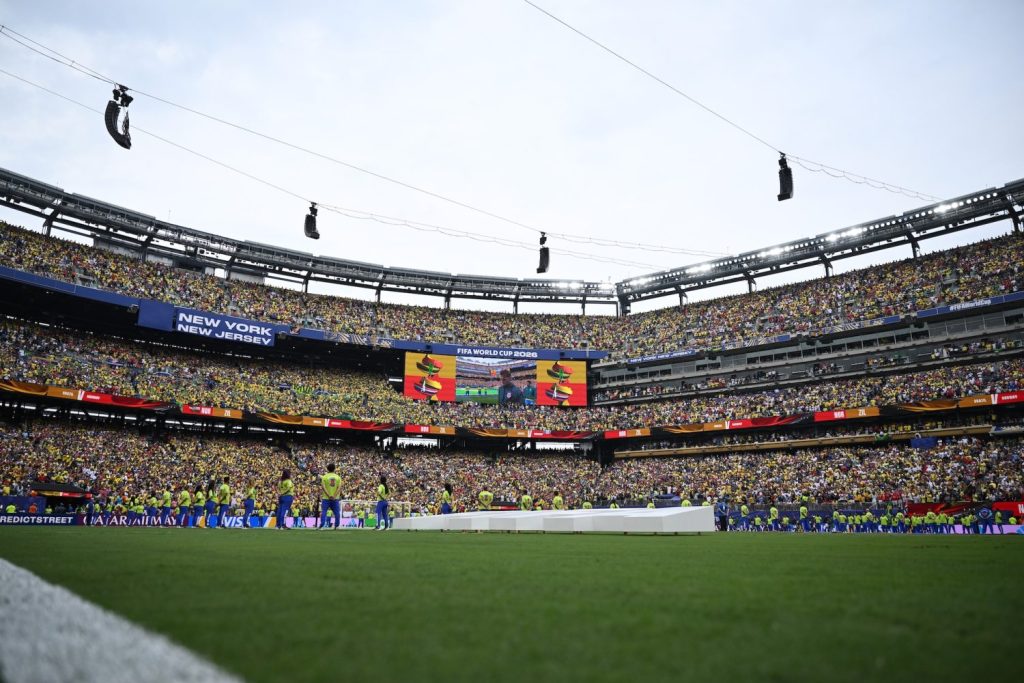
The World Cup final is set. On Sunday 19 July, either Leo Messi or Rodri — the captains of Argentina and Spain — will lift the trophy at MetLife Stadium in East Rutherford, New Jersey. The choice of venue for the tournament’s biggest match has become one of the World Cup’s talking points over the past month. Not because of the stadium itself, its architecture, its modernity or its size. This is, after all, the home of the New York Giants and the New York Jets: an 82,500-seat stadium opened in 2010, and the stage for last year’s Club World Cup final between PSG and Chelsea. There was never much doubt about MetLife as a venue. Its reputation, its scale and its recent history all made sense. Until the pitch became the story.
As Diario AS reported, every team to have played at East Rutherford so far has raised the same concern: the surface. More specifically, its hardness. Vinícius Júnior was the first to speak about it. After Brazil’s group-stage match against Morocco, he was direct: “Even when it is watered, the pitch dries out quickly and becomes very hard. In those conditions, increasing the tempo and moving the ball becomes really difficult.” Adrien Rabiot, who played two matches in New Jersey, made a similar point: “You cannot call this grass. It is closer to an artificial surface. It is true that it is the same for us and our opponents, but that does not change anything: the pitch is hard and rigid.” The same doubts have been raised from the touchline. Norway manager Ståle Solbakken also questioned the MetLife surface, describing what lies beneath the top layer as “short, hard grass that feels artificial”.
Now the final is approaching, and the conditions could make things even more demanding. Temperatures are expected to reach around 30 degrees or higher at kick-off, with Argentina and Spain due to begin at 3pm local time. Not the easiest setting for two teams that want to play through close combinations, quick exchanges and passes along the ground. Especially Spain under Luis de la Fuente, but also Argentina under Lionel Scaloni — two sides built around the same idea: keep the ball moving. Provided the pitch allows it.