
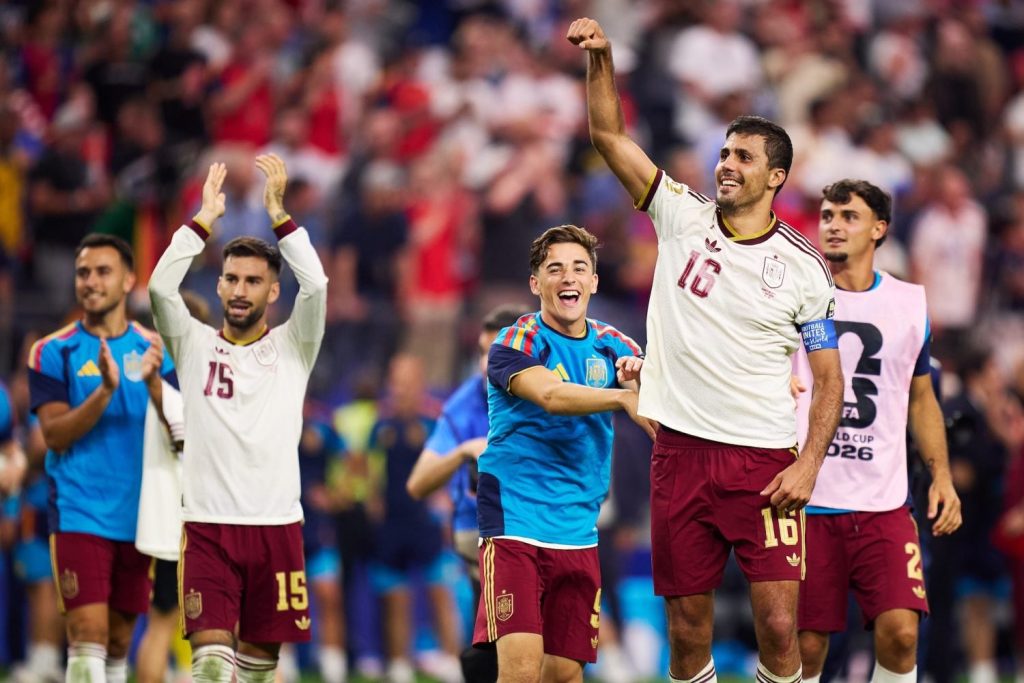
One of the most striking and significant images from France–Spain arrived a few moments after the final whistle. Luis de la Fuente’s face carried a kind of pure satisfaction, the expression of someone who had just seen an idea that had been taking shape for years finally find its clearest form. “We believed in an idea created four years ago,” the Spain coach said. “Today we saw the best national team in the world against the best selection in the world.” De la Fuente is 65 years old. He has won the European Championship, yet his path has always been a little different from that of coaches who arrive at this level surrounded by expectation. He came through Spain’s youth sides, working with the different age groups before taking charge of the senior team. At the end of the match, perhaps because of that journey, he seemed to need a few seconds before fully accepting what had happened. In front of him there was the image of a team moving towards the centre of the pitch, a bench emptying itself onto the grass, a stadium celebrating a Spain side that had reached the second World Cup final in its history, 16 years after the first. But his expression suggested something beyond the occasion itself. It was the look of someone who had seen a process become visible.
Spain’s run now stands at 37 consecutive victories, a record for a national team shared, for the moment, with Roberto Mancini’s Italy. It is an extraordinary number, but it does not tell the whole story. The fact is that Spain controlled France. The opponent mattered. Until this semi-final, France had looked like the most complete side left in the tournament. A team that, through Kylian Mbappé, Ousmane Dembélé, Bradley Barcola and Michael Olise, had reached this stage without ever appearing genuinely close to breaking. They had imposed their football, their tempo, their individual superiority. Matches seemed to follow a familiar pattern, one in which the quality of Deschamps’ attackers eventually found the space needed to decide the game. Spain took that pattern away almost from the beginning. After 20 minutes came the moment that changed the shape of the semi-final. Lucas Digne misplaced a control that appeared harmless, Lamine Yamal took the ball away from him and was brought down inside the area. Oyarzabal stepped up and converted the penalty for 1–0. It was an individual mistake, certainly, but reducing the match to that episode would miss what followed. The goal gave the game a different weight. Spain no longer needed to demonstrate that they belonged there. France, for the first time during the tournament, found themselves dealing with a situation they had not experienced before. They were the side chasing.
From that moment, the differences between the two teams became clearer. France had built their tournament around attacking patterns that were already easy to recognise. Mbappé receiving in wide areas before attacking the weaker side of the defence, Dembélé stretching the pitch with his movement beyond the back line, Olise finding spaces between midfield and defence. These were sequences repeated so often that they had almost become instinctive. They had also been effective because France had usually been allowed to play the games in the way they wanted. Spain changed that. The lead gave them the possibility to use possession as something more than a way of moving the ball. It became a way of controlling the match. They did not retreat into a lower block, nor did they slow the rhythm because they were protecting an advantage. They kept playing, but in doing so they removed the points of reference France had relied on throughout the tournament.
A Spain possession was rarely only about keeping the ball. There was always something else inside it: taking time away from the opponent, waiting for the next opening, preparing the next movement. Rodri and Fabián Ruiz were the clearest examples of this. They were present everywhere, always close to the player in possession, always offering an angle, always ready to close a passing lane when France tried to escape. Their performance did not come through spectacular moments. It came through the feeling that the match was being played at their pace. The semi-final gradually became the kind of game Spain wanted. And when a team that has spent an entire tournament controlling matches suddenly finds itself without that control, the effect is not only tactical. It becomes visible in the way players react. The decisions become faster, the movements less certain, the frustration harder to hide. France finished with three shots on target, but very little genuine danger. The attacking players who had carried them through the competition struggled to find the spaces where they had previously looked almost inevitable. Spain, by comparison, needed only two shots on target.
The second goal came from a move that seemed to contain the identity of the entire team. Oyarzabal moved away from the penalty area, pulling defenders with him. Dani Olmo connected the play. Pedro Porro read the space, attacked it like a striker and finished the action. It was not a goal built around one moment of individual brilliance. It came from understanding between players who already knew where the next movement would appear. That is what makes this Spain different. The talent is obvious, but the real strength lies in the relationships between the players. No one has to carry the team alone because the team itself has become the way every individual expresses his quality.
That was also why Lamine Yamal’s evening felt so revealing. The teenager had a decisive role in the opening goal, winning the penalty that changed the course of the match, but after that he did not need to turn the semi-final into a personal stage. He remained inside the structure. He made the right movements, offered the usual solutions and allowed the game to continue around him. For a player whose talent has made him the natural focus of attention, that kind of performance says something important. When the brightest individual can have a relatively quiet night and the team still looks complete, it means the foundations are strong enough to support everyone. Spain did not win because one player produced a moment that nobody else could create. They won because the whole side seemed to move with the same understanding. It was not an obvious achievement considering where several of these players were coming from. Some arrived at the tournament carrying the weight of difficult club seasons. Pedro Porro had spent much of the year with Tottenham in a difficult situation, with European qualification only secured on the final day. Aymeric Laporte and Unai Simón had not found their best rhythm with Athletic Club. Mikel Merino had dealt with injuries that interrupted his season.
None of them represented the obvious image of a star-driven national team. There was no single player around whom everything had been built, no face that existed above the others. Instead, they became essential. That may be the most recognisable feature of De la Fuente’s Spain. The idea comes before the name on the shirt. It explains why the team feels so settled. The system is not there to hide the individuals, nor is it built around one of them. It gives everyone a place within something larger. Perhaps that is why the image of De la Fuente after the final whistle has remained so powerful. It was not only the reaction of a coach who had reached a World Cup final. It was the expression of someone who had watched a belief slowly become reality. There was no revolution. No declaration that football had been reinvented. No need to search for something entirely different. Just a process. A group of players learning the same language, refining the same movements, until the idea became visible in every part of the game. The final will decide whether that is enough to become world champions. But the tournament has already changed the perception of this Spain side. They arrived as a team with ambition. They now reach the final as the team everyone else has to measure themselves against. And behind it is the same thought that has guided the whole journey: an idea that began with De la Fuente, but only became real once it belonged to everyone.