
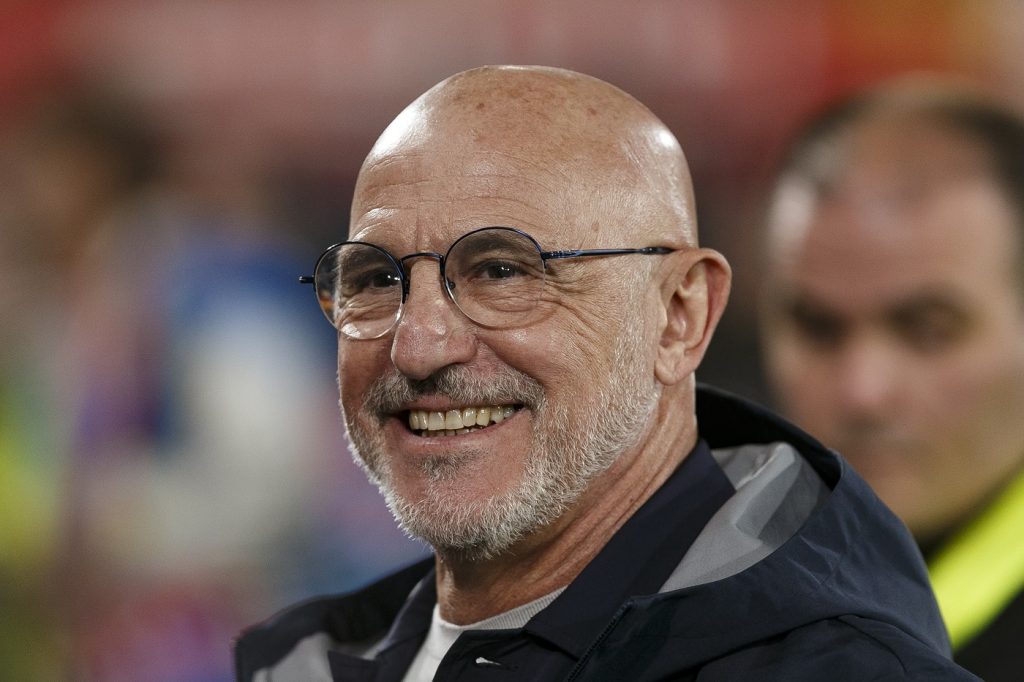
What kind of impossible universe could bring together Eurovision Song Contest, the Spanish television quiz show “Un, dos, tres” and the millennia-old reflections of the emperor Marcus Aurelius? Only in the mind of Luis de la Fuente, Spain’s national team coach already carrying the mark of a great – the honorary title would surely be invictus: unbeaten across European Championships and World Cups, no coach with at least 13 matches in the two competitions has achieved what he has achieved. Apparently, among the secrets of this record-breaking Roja – Unai Simón’s unbeaten run, the 36-match unbeaten streak, just one victory short of Mancini’s Italy – there is also the philosopher-emperor of the second century AD. A timeless model of temperance, according to the coach. Still useful today, in life as in football: who knows what Marcus Aurelius would think of the modern game, having written his reflections at the edge of the Empire, between one military campaign and the next. The analogy between war and sport – or rather, the sporting language that has always borrowed from war – is nothing new. Yet this was not what caught de la Fuente’s attention while reading the writings of the ancient ruler. As El País reported, the coach came across a copy of “Meditations” years ago, the autobiographical notes Marcus Aurelius gathered in old age, part of an inner journey that was extraordinary by the standards of his time.
The work itself, written with no intention of publication, was also a guide to the emperor’s own conduct: a path towards becoming better, in search of the moral and intellectual integrity at the heart of Stoicism. In other words – historians may forgive the comparison – it was, in certain respects, an early guide to personal discipline. Not quite philosophy as we would describe it today, perhaps, but something close to that territory. It is no coincidence, then, that the copy kept by de la Fuente in Madrid is worn and battered, its pages repeatedly underlined and its margins filled with notes. The coach has read it and reread it, finding one idea after another for his work with Spain – a journey that began with the youth teams and has continued since 2013. “I admire many of Marcus Aurelius’ phrases,” the coach said. “He said that what is harmful to the hive is harmful to the bee too. And it is true: each of us has to think like a team, like a group. And for this national team it works well, because we have very valuable people who make it up.”
Another key passage, another ipse dixit: “Calm is power. Tranquillity is power,” de la Fuente repeats in his World Cup press conferences. The Red Fury as imperial legions. If the coach appears so serene and detached, if his team is so patient and clear-headed in decisive moments – just ask Mikel Merino – then among the many secrets of this Spain there is also a millennia-old affinity with a weary emperor, called upon to do what was right for Rome at the dawn of its decline and forced into war despite his love for art and culture. In that whirl of events, Marcus Aurelius found refuge in himself, in his writings and in his reflections. Until he reached – despite everything, including family tragedies – a certain degree of imperturbability. “We live focused on what we can control, which is football,” says de la Fuente. “If you are troubled by an external cause, it is not the cause itself that disturbs you, but the judgement you pass on it,” Marcus Aurelius wrote two thousand years ago.
The coach gives the same answer today, beyond every criticism he has received throughout his winning cycle: “We place ourselves beyond these evaluations, these analyses. I live happier and this allows me to make decisions with serenity. I don’t need it. If it added something, if it contributed in a positive way, I would read everything, but I truly don’t need it.” He has no need to chase every judgement that arrives from outside. And so, one page at a time, his Spain has reached the semi-final against Mbappé and company. On one side, the “lucky general”, as the French have called Deschamps. On the other, de la Fuente: Madrid will wait before deciding what name belongs to him. The celebration, when it comes, will bring its own title. And perhaps the book will be there too.