
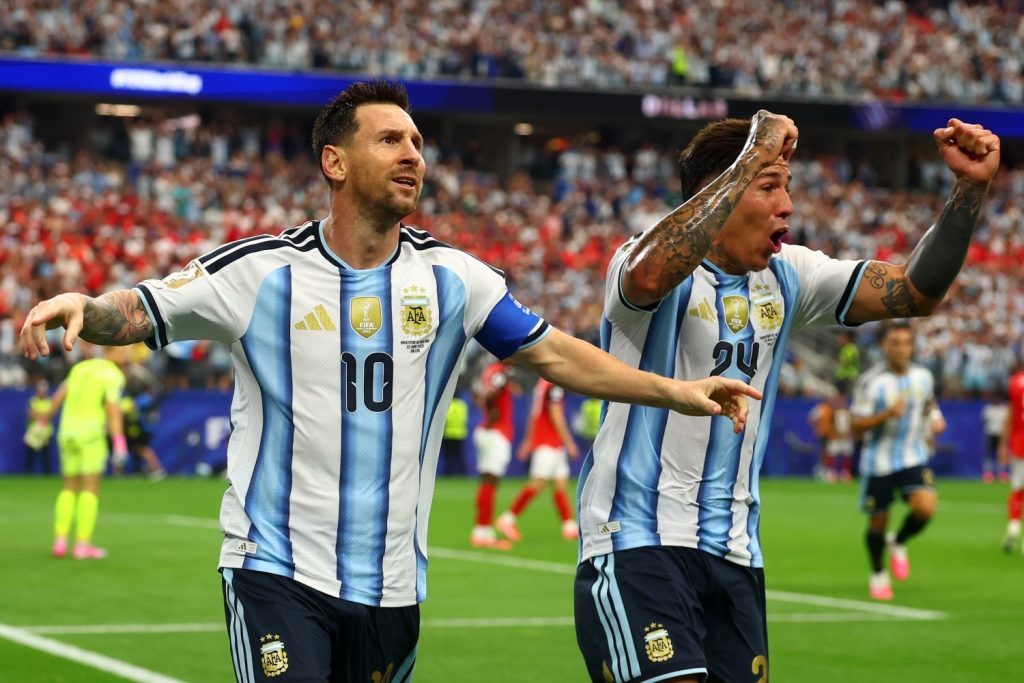
“It seems that mine is a false modesty,” Lionel Scaloni says, in one of those moments of unexpected lucidity that occasionally interrupt his natural reserve. “But it is not a question of whether modesty is false or genuine. You do not need to be a magician of the game. We have great players. That is the reality.” It is a short speech, delivered a few hours after Argentina’s emotional — and, in the way it arrived, surprising — victory over Egypt in the World Cup round of 16. Yet those few words contain much of what has shaped Scaloni’s Argentina: its philosophy, its ethics, its understanding of football. Scaloni has been Argentina’s coach since 2018, when, after another disappointing World Cup campaign and a wait for a major international trophy that had reached 25 years, the Argentine Football Association dismissed Jorge Sampaoli. Scaloni, his assistant at Sevilla and with the national team, was appointed on an interim basis while the federation searched for a permanent successor.
What followed became an entire football era. Only two years earlier, Lionel Messi had walked away from international football after three consecutive final defeats: the 2014 World Cup and the Copa América finals of 2015 and 2016. Scaloni’s beginning was different. After only a few friendlies, he won the trust of the dressing room and placed Messi at the centre of his tactical and human vision. Even when Messi decided not to play those early matches, Scaloni refused to give away the number 10 shirt. “That shirt belongs to Leo,” he said. “Until he decides whether he wants to continue with the national team.” Since then, Argentina have won the Copa América twice, in 2021 and 2024, and lifted the World Cup in Qatar in 2022. But the trophies alone do not explain Scaloni’s work. The most interesting aspect is how they arrived: through a style of football that deliberately rejected many of the dominant ideas of the modern game.
While football has increasingly moved towards physical supremacy — pressing, intensity and the ability to win duels everywhere on the pitch — Scaloni’s Argentina followed another path. A slower, calmer, more patient football. His idea was simple: surround Messi with players capable of understanding his language. After Ángel Di María’s international retirement, Argentina abandoned the traditional use of attacking wingers and instead built a midfield of four central players supporting two forwards. It is an unusual structure for contemporary football, but one that creates the ideal environment for Messi. The relationship between Messi and the national team changed completely under Scaloni. After Russia 2018, Messi’s mother, Celia Cuccittini, revealed how much criticism had affected him. “Leo suffered and cried because of the criticism.” Until then, Messi had never scored in the knockout stages of a World Cup despite playing eight matches. In 2010, with Diego Armando Maradona on the Argentine bench and expectations at their highest, he left the tournament without a goal. Those were difficult years. Argentina constantly compared him with Maradona, sometimes questioning his personality and his connection with the national shirt.
“Pecho frío” was the accusation repeated most often: a player without hunger or character. Today those judgments seem absurd, but they were part of Messi’s reality. Matías Manna, Scaloni’s video analyst and one of the most influential members of his staff, explained in 2024 that even the greatest players in history needed the right support around them. “Platini needed Giresse, Fernández and Tigana; Zico needed Andrade, Tita and Adílio; Cruyff needed Neeskens, Haan and Mühren. Messi also needs support, because midfielders who are comfortable with the ball can make the best players even better. And, naturally, Messi has made all of them better too.” This is why Scaloni has always trusted his midfield. Rodrigo De Paul provides energy and rhythm; Leandro Paredes controls the tempo from in front of the defence; Alexis Mac Allister and Enzo Fernández connect different areas of the pitch through movement and intelligence. They are complete midfielders: players who understand not only where to receive the ball, but why. “We are an intelligent team,” Messi said in 2022. “We know what we have to do. We never lose sight of what we have prepared. That is thanks to Scaloni and his staff.”
That staff is another part of the story. Alongside Manna are three important figures in Argentine football: Walter Samuel, Pablo Aimar — Messi’s childhood idol — and Roberto Ayala. All four first crossed paths in the national team under José Pekerman, the coach Scaloni considers his greatest teacher. “I carry inside me what he taught me,” Scaloni has said. Everything surrounding Argentina follows a precise idea: football based on creativity, combinations, intelligence and freedom. Its roots go back to the 1940s and 1950s, when Argentine football developed a particular identity known as La Nuestra — a style shaped by quick passing, improvisation, dribbling and the culture of the potreros. Scaloni, however, did not rebuild Argentina out of nostalgia. He did it out of necessity. When he took charge, he knew the team was entering a generational transition. Sergio Agüero and Gonzalo Higuaín were leaving the national team, while Carlos Tévez had already disappeared from the scene. The decline of attacking options forced a reconstruction, and Scaloni chose to build around Messi. Before selecting players, he selected personalities.
That is why Argentina’s relationship with Messi became something beyond admiration. Rodrigo De Paul expressed it clearly: “When you play with Messi, you don’t only want to win for Argentina. You also want to win for him.” Emiliano Martínez described the same feeling differently: “When he speaks, everyone is silent. Even the president of the Republic.” Messi is the centre of gravity of Scaloni’s Argentina: the player who gives direction to his teammates and meaning to the hopes of a nation. The affection Scaloni created within the group is reflected in the way he speaks about his players. When Julián Álvarez replaced Lautaro Martínez during the World Cup in Qatar, Scaloni still found words of tenderness for Inter’s striker: “He is a complete forward. A player who is always there, whether he scores or not. I know him and I value him like a son.” That atmosphere translated into results. At the World Cup in Qatar, Argentina lost control of three matches after taking the lead — against the Netherlands and twice against France — yet each time they found a way back. Their resilience came from years of trust, shared experiences and belief in the group.
Messi’s evolution also shaped the team. He is no longer the same physical force he once was; statistics show that he spends much of matches walking. His genius has changed. It is now based less on constant movement and more on choosing the perfect moment. The players around him allow that transformation to exist. They run for him, protect him and create the conditions for him to decide matches. Argentina cannot play the modern game in its purest form. It cannot rely on endless pressing or constant attacks into open space. At times, the team appears patient, even languid. Egypt and Cape Verde have exposed its tactical and physical limits through quick transitions. Yet those weaknesses are also part of its identity. Scaloni’s Argentina is a peculiar expression of football: a team that does not fear being different from the dominant ideas of its era. After the victory over Egypt, Scaloni struggled to contain his tears. Later, he explained why. “The boys call me La Llorona,” he said. “But I don’t care. When I am on the bench, I suffer like all of you. I started coaching to feel these emotions.” Perhaps those words explain Scaloni better than any tactical analysis. He did not build Argentina by trying to create the most modern team. He built one that understood what it was: a team of intelligence, memory and emotion, built around the greatest player of its generation and the people capable of giving him the freedom to be himself.