
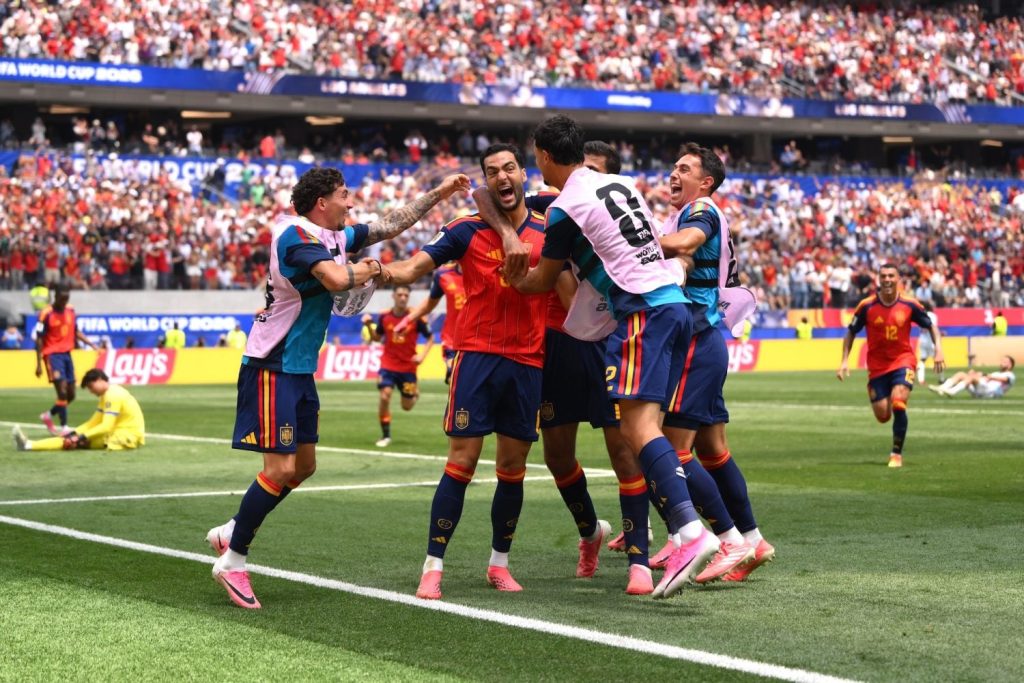
Some matches tell the story of one team’s superiority. Others expose the gulf between two squads. Belgium v Spain belonged firmly in the latter category. For more than an hour, whatever the scoreline suggested, Luis de la Fuente’s Spain and Rudi Garcia’s Belgium operated within the same tactical framework. The game only drifted decisively in Spain’s favour once the benches came into play. That was where La Roja secured just the second World Cup semi-final in their history. It was not that Spain’s substitutes transformed the contest. Ferran Torres, Pedri and Mikel Merino — with Nico Williams still clearly short of full fitness — simply ensured the team’s level never dropped. Belgium could not say the same of Axel Witsel, Romelu Lukaku, Seys, Alexis Saelemaekers and, above all, Senne Lammens.
The difference was subtle, yet decisive — exactly the kind that often determines knockout football. Teams that go deep into major tournaments are usually those capable of replacing starters without weakening the collective. Belgium discovered just how little margin for error its squad really has. Garcia set his side up in a disciplined mid-block, alternating man-oriented marking behind the ball with consistent protection of the central passing lanes. It was not passive defending but a carefully constructed plan that slowed Spain’s circulation and steered them towards less comfortable areas of the pitch. Then Thibaut Courtois limped off injured, and the match changed. Lammens, enduring the most difficult evening of his season, made the mistake that ultimately settled the tie. Pau Cubarsí’s long-range effort should have posed few problems, but the goalkeeper failed to hold it, spilling the ball straight into the path of Mikel Merino.
Merino continues to do what few players in world football do better: arrive where nobody expects him. It was his second consecutive goal at this World Cup and another reminder of how distinctive a player he has become for Spain. He does not enter simply to raise the tempo. He changes the geometry of the attack. His movement creates an extra presence between the lines, improves Spain’s occupation of the penalty area and offers an entirely different attacking reference point without altering the team’s underlying structure. Lammens’ mistake inevitably brings another Belgian story back into focus. Against Spain, Mile Svilar could have been between the posts. The Roma goalkeeper, born in Belgium, had long been expected to represent the Red Devils. But the change of sporting nationality required after appearing for Serbia — a country whose passport he holds through his father’s family — was never completed before the deadline. At the time, it seemed little more than an administrative detail. Watching the contrast between Courtois and his replacement, it no longer feels that way.
Focusing solely on the goalkeeper, however, would overlook the broader problem. Belgium’s other substitutions also weakened the side. Lukaku was introduced to provide a physical outlet and help sustain attacks, yet the opposite happened. The Napoli striker never found the rhythm of the game, rarely became involved and struggled to turn direct passes into meaningful possession. Witsel’s impact was even more telling. He failed to slow Spain’s circulation and offered little continuity in possession. Rather than changing the match, Belgium’s substitutions felt like unavoidable reminders that time eventually catches up with every generation. Spain’s replacements had the opposite effect. Ferran Torres stretched the pitch without sacrificing technical quality. Merino, as he so often does, directly influenced the outcome. More importantly, every substitution preserved Spain’s identity. That may be La Roja’s greatest competitive advantage.
It is not merely that they possess an outstanding starting eleven. It is that the hierarchy within the squad can change without changing how the team functions. Different players, same collective behaviour. Even so, this quarter-final should not be mistaken for proof of Spain’s unquestioned superiority. If anything, Belgium may have handed France a blueprint for the semi-final. Spain found far less space than in previous matches because Garcia’s compact mid-block restricted central progression and forced De la Fuente’s side away from their preferred combinations. Whenever Belgium managed to provoke the individual duels they wanted, Spain looked noticeably less comfortable. Belgium’s goal illustrated the point perfectly. Charles De Ketelaere stepped in front of Cubarsí, disrupted Spain’s defensive line and initiated the sequence that ended with the decisive cross. It was far from an isolated incident. On several occasions Belgium’s forwards combined quickly around Spain’s defenders, creating the one-against-one situations De la Fuente’s side would rather avoid.
Against France, those vulnerabilities could prove far more costly. With Kylian Mbappé, Ousmane Dembélé, Désiré Doué and Michael Olise attacking open space, even the smallest defensive imbalance can become decisive. Ultimately, Belgium v Spain reinforced a simple truth. In a short tournament, having a strong starting eleven is not enough. You need a squad capable of absorbing the unexpected without losing quality. Belgium lost Courtois and, with him, much of its sense of security. Spain removed key starters and continued playing exactly the same game. That is an enormous difference. Perhaps the defining difference this World Cup has revealed so far.
It is also why La Roja are in the semi-finals. One warning, however, remains. If the bench was enough to make the difference against Belgium, it may not be enough against France. Spain will need cleaner defensive decisions, better protection for Cubarsí and the defenders isolated in one-against-one situations, and, above all, greater control of defensive transitions. Belgium demonstrated that Spain can be hurt when opponents create high-quality connections around the ball. France possess even greater individual quality to exploit those moments. The semi-final will reveal whether Belgium merely exposed a weakness—or uncovered the blueprint for eliminating one of the tournament favourites.