
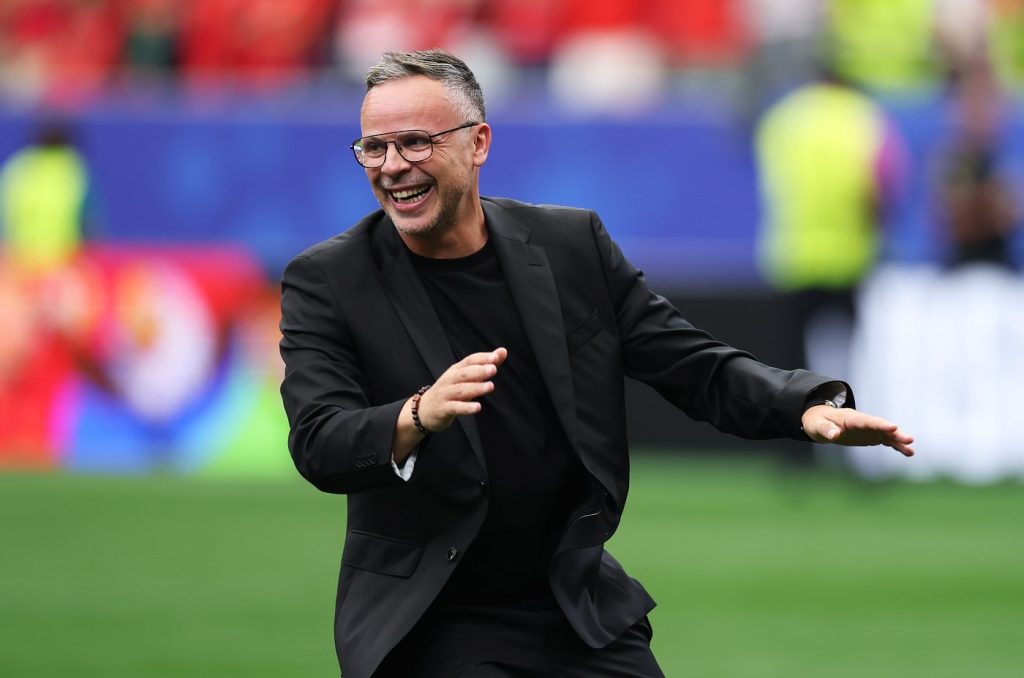
Among the great stories of this 2026 World Cup, Mohamed Ouahbi’s may be the most unexpected. Morocco’s new head coach arrived at the tournament from a place few would have predicted. He replaced Walid Regragui, who stepped down after the controversial Africa Cup of Nations final, before the appeal against Senegal was accepted, following pressure from the federation. Ouahbi’s rise has been unlike almost anyone else at this level. In the space of eighteen months, he won the Under-20 World Cup with Morocco and found himself in charge of the senior national team. Before October 2025, his name was barely known outside the circles that had followed his work for years.
Born in Brussels to Moroccan parents, Ouahbi spent much of his early adult life away from football’s spotlight. For years he taught physical education in a school in the Belgian capital, only entering Anderlecht’s academy at the age of 27 after a playing career that had never moved beyond youth football. Inside the dressing room, everyone calls him “Coach Momo”, according to El Mundo. Without the background of a professional player, he had no established network in the game and no obvious route towards the elite. He moved between amateur football and the classroom, teaching at the École du Canal in Brussels, where his pupils were children between six and twelve. No cameras, no major stadiums.
That changed in 2003, when a personal friend opened the door to Anderlecht’s academy. Ouahbi began with the youngest players and gradually climbed through the system. The pitches where he worked produced some of European football’s most recognisable names: Romelu Lukaku, Youri Tielemans, Jérémy Doku, Dodi Lukebakio. They all encountered his methods and his way of understanding the game. Among those children was also Remco Evenepoel, who for several years divided his time between football and cycling before becoming one of the finest riders in the world.
Ouahbi stayed at Anderlecht for seventeen seasons, moving through every level of the academy before joining the first-team staff. During that period he met Yannick Ferreira, the Belgian coach of Spanish descent who brought him to Al-Fateh in Saudi Arabia in 2021. That experience abroad, combined with the reputation he had built in Belgium, brought him closer to Morocco’s attention. The federation had spent years searching across Europe for players, coaches and figures capable of connecting the national team with its diaspora. In 2022, it chose Ouahbi to lead the Under-20 side. In Morocco, he was still a relatively unknown figure, but federation president Fouzi Lekjaa saw in him the right person for one of the country’s most promising generations.
The reward came quickly. Morocco won the Under-20 World Cup, beating Argentina in the final after eliminating France earlier in the tournament. When Regragui left after the Africa Cup of Nations, the federation turned to Ouahbi, choosing continuity over a complete change of direction. Like Luis de la Fuente in Spain, Ouahbi reached the top after years spent working in youth football. He was part of the scouting structure Morocco built across Europe to convince young players of Moroccan origin to choose the Atlas Lions. Many of the younger members of the squad already knew him: some had played under him at Under-20 level, while others had met him during the delicate process of international recruitment.
His own background helps explain the connection. Born between two cultures, he understands the questions faced by players who grow up elsewhere but carry another identity. Choosing a national team is never only a sporting decision. His Morocco is among the youngest teams at the World Cup, with an average age of 26.4 years, combining technical quality, courage and the defensive organisation that has become the signature of the national side. The ambition behind it reflects that of King Mohammed VI: changing the mentality around Moroccan football and making the idea of winning a World Cup something tangible rather than distant.
“Morocco has entered a new era, an era in which we must truly believe in the possibility of becoming world champions,” Ouahbi said after the group-stage victory over Haiti. “We must aim for the title, because we have everything we need.” His story belongs to the wider project Morocco has built over recent years: a coach who is European and Moroccan at the same time, a teacher before a coach, shaped by Anderlecht’s academy but raised with the memory of the 1986 World Cup team that reached the knockout stages before losing to West Germany after winning their group. Back then, he was simply a child playing football on the streets of Brussels. Now he is the man asked to turn that memory into the ambition of an entire nation.