
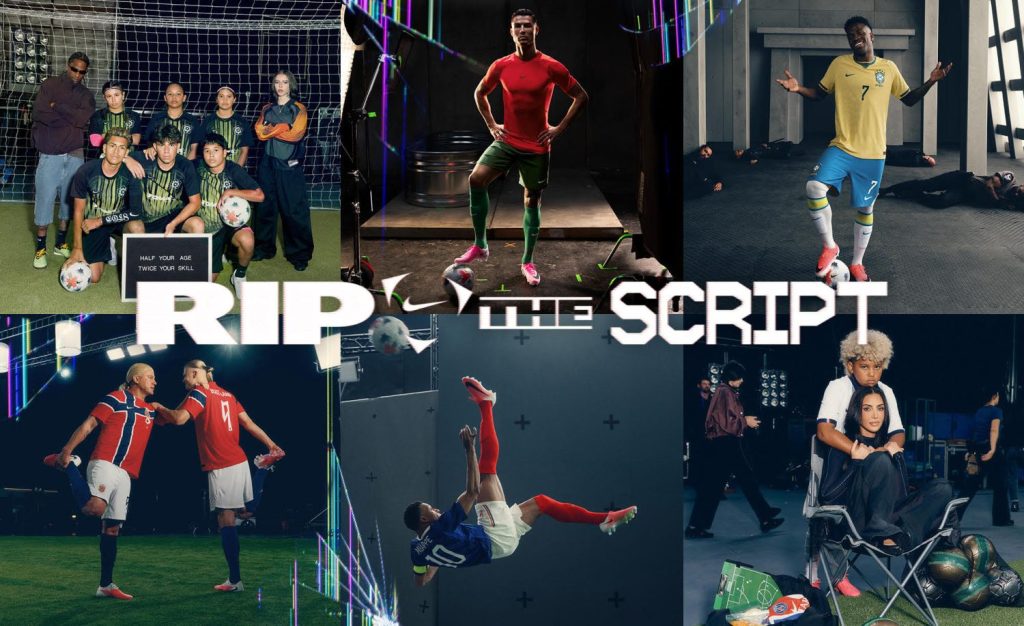
“We want to shine a light on cultures, on the street. Our idea is to give young people a platform to express themselves, to play brilliant, fast, and free football,” Camilo Andrade, Vice President and General Manager of Nike Football, told us.
We met him in New York during the presentation of Nike’s new campaign for the 2026 World Cup, trying to understand where the sport is heading. The answer, almost a contradiction. Back to the beginning. Asphalt, street football, instinct. Or something else. Past and present folded together, balance slightly off.
That is the direction Nike has chosen. Boundaries gone. No line between stadium and street, football and lifestyle and music. Everything overlapping. The launch film for the next World Cup built around one idea: rewriting the rules.
The ball appears everywhere, crossing spaces that usually don’t meet. Cristiano Ronaldo and LeBron James, Travis Scott, Kim Kardashian. A short circuit between Hollywood gloss and something looser, more unstable, just behind the frame. The film released in recent weeks stays there.
Its title: Rip the Script.
Literally. Tear up the script.
A slogan. A statement.
The question comes anyway: for the generation arriving in 2026, is this the new Just Do It?
Rip the Script as a layered thing, a cinematic puzzle of small hidden details. Helena Thornton, Nike’s VP of Global Brand Marketing, walked us through it, the precision in every frame. Easter eggs everywhere. Goat cheese — GOAT cheese — in the boardroom with Cristiano and LeBron. The book Channing Tatum reading, trying to read Erling Haaland’s coldness.
Nothing random. Built to create noise, extend beyond itself, open different readings. Fragments moving outwards. As Andrade puts it: “All these stories, all these extensions within the narrative, will be able to travel and resonate with different communities around the world.”
But Rip the Script doesn’t stay in advertising. It becomes physical in TOMA, the street-football tournament through which Nike drops the game into unexpected urban spaces.
Local communities. Football stripped down. Outside the frame of the professional game and its rituals. Three against three. Small pitches. Small goals. Music, noise, everything running alongside it.
In New York, we saw it.
Manhattan. A paradox. Centre of global finance, rules, glass, repetition. A pitch appears.
TOMA New York.
An abandoned bank a few steps from the Stock Exchange and the Charging Bull. Rip the Script made real.
Ball on marble. DJ set spilling through the space. Voices over each touch. For a few hours Lower Manhattan shifts, slightly out of register.
It becomes a kind of celebration. Young men and women from across New York, selected through Youth 4 Youth FC — a development programme for emerging American talent — there all evening.
La Famiglia running through it. Italian-American New York, pizza, gelato, shirts along the touchline.
Then the product.
How it translates on the pitch.
The new Mercurial.
Ultra-light. Slightly out of step by design. Mercurial has always belonged to a certain type: the irreverent player, space broken through speed, instinct before structure. The disruption doesn’t sit only in the story. It moves into the product, into design, into engineering.
Andrade again, at the end.
“Our job is to be constantly obsessed with the process of innovation through the lens of iteration, always asking ourselves how to do something great, break it apart, and make it better.”