
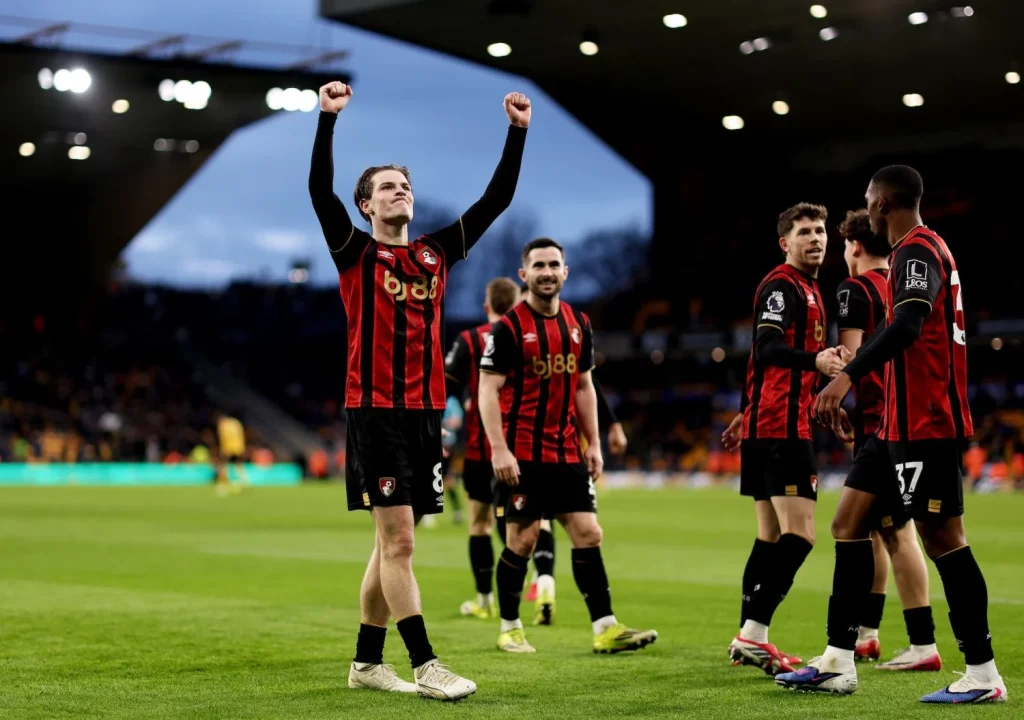
The 2025/26 season will be remembered at Bournemouth as the most successful in the club’s history.
Sixth place in the Premier League. Three points short of Champions League qualification. A first-ever entry into European competition, with the Europa League awaiting next season.
For a club representing a town of around 183,000 people, playing in a stadium that holds just over 11,000, and which had never appeared in the top flight before 2015, the scale of the season sits slightly out of its usual proportions.
It has been built over time.
A model based on player development, data-led recruitment, careful financial recycling, and a continuity of ideas that has survived multiple managerial cycles. Alongside that, significant investment from the American ownership group led by businessman Bill Foley has provided the structural backing required to accelerate growth.
Both elements sit in the same frame.
Foley’s presence is often described through outcomes rather than process. The results, across different sports, have become the most visible part of his ownership style: appointment, delegation, and rapid progression once the right structures are in place.
At Bournemouth, that chain includes figures such as Eddie Howe, Tiago Pinto and Andoni Iraola, each linked to different phases of the club’s recent rise.
But the pattern extends beyond football.
In the NHL, Foley is also owner of the Vegas Golden Knights. The franchise reached the playoffs again this season and is competing for a second Stanley Cup title in its short history. It is a club that only entered the league in 2017 as an expansion team, the first of its kind in 16 years.
They reached the Stanley Cup Final in their inaugural season. They won the championship in 2022.
Before the first puck had even been dropped, Foley had stated publicly: “We will win the Stanley Cup within six years.” The timeline proved exact.
Off the ice, the organisation has continued to grow. According to Sportico’s 2025 NHL valuations, the Golden Knights are now the 12th most valuable franchise in the league at $2.02 billion.
Recent changes inside the organisation suggest an ongoing expansion phase rather than consolidation. In 2025, Foley appointed John Penhollow as chief business officer, arriving from the Minnesota Vikings. His tenure has coincided with structural changes in media operations, marketing, and fan engagement, including adjusted pricing models for concessions, more flexible season-ticket renewal structures, and lower playoff ticket prices compared to previous years. Season-ticket renewal rates have risen alongside those adjustments.
Bournemouth’s trajectory follows a similar curve.
Foley’s acquisition of the club in 2022 was completed for $148 million. The most recent estimates place its value at around $665 million. Plans to expand the Vitality Stadium to 20,000 seats have already received approval from Bournemouth’s local council.
The portfolio has continued to expand beyond England and North America. Auckland FC, based in New Zealand, won the A-League title in its second year of existence. Further investments have followed at Hibernian in Scotland and Exeter Chiefs in English rugby.
Each move extends the same pattern into a different context: entry, restructuring, early acceleration.
Whether that trajectory continues at the same pace across different sports and leagues remains to be seen.
For now, Bournemouth’s season stands as one point on that map.