
In the magnificent setting of the Royal Palace of Naples, during the presentation press conference, Antonio Conte cannot know it, but he is about to pronounce the words that will be the manifesto of his relationship with the club and the city that has just adopted him: «I promise seriousness from every point of view. I can say that we will give more than the maximum, because sometimes even the maximum is not enough. My objective is to make the fans proud». It was 25 June 2024, a little less than two years ago. That is how long the visceral, yet mature, love story between Conte and Napoli lasted. A story that produced criticism and tensions, but above all successes. With Conte on the bench, in fact, Napoli won two trophies in the same calendar year – a Scudetto (2024/25) and an Italian Super Cup (2025). Moreover, by beating Udinese at home on the final matchday, the azzurri closed Serie A 2025/26 in second place. All things considered, this is an extraordinary continuity for a club like Napoli, which had not strung together a first and a second place in the league since as far back as the golden age of Diego Armando Maradona.
«With De Laurentiis, Napoli is in safe hands» said Conte, explaining the reasons for his farewell: «The decision is mine, I feel that my journey has come to an end». It seems paradoxical: for the first time we have seen Conte separate from a club in a serene way, even spending affectionate words for his president. The reason lies precisely in that «seriousness» promised by the Salento coach at the moment of his arrival. Chosen by De Laurentiis as the architect who was to rebuild Napoli after a foolish tenth place, Conte brought his own work culture right from the start. The club embraced his vision in everything, satisfying his demanding requests on the transfer market and entrusting him with the complete management of Castel Volturno.
Conte had to reckon with a depressed environment, with players who were discontented and who in most cases had already abandoned ship. It is easy to take the cases of Giovanni Di Lorenzo and Khvicha Kvaratskhelia, retained by Napoli thanks to his status. Conte took on the role of a coach-manager, immediately changing the mentality of Napoli: «I decide who leaves and who stays». Other elements, instead, were revitalised through work on the pitch, an aspect that is always a little underestimated when one talks about Conte and his career. Just think of the midfield: on the threshold of thirty, Frank Anguissa rediscovered himself as a fantastic forward-running central midfielder; Scott McTominay evolved, transforming himself from a midfielder with peculiar characteristics into a total and decisive player.
Despite the objective difficulties encountered along his path, and a game that was not always brilliant, in the first year Napoli won a historic scudetto, overtaking Inter in a point-by-point marathon. It did so even while losing Kvaratskhelia in January, the best player in the squad and, by now it can be said, one of the best in the world in his role. A few days after the victory, another statement by Conte had set Napoli’s agenda: «I am staying because there is a contract and because we have a scudetto to defend. Ammà faticà again».
Conte’s second Neapolitan season was in reality more arduous than it should have been, with the scudetto hopes already evaporated at the beginning of January. Due to serious muscular injuries, the azzurri lost for months Romelu Lukaku and Kevin De Bruyne, the two players around whom the team’s new tactical setup was supposed to revolve. Then David Neres too suffered an incident that kept him out for a long period. In their place Napoli relied on two up-and-coming talents like Rasmus Hojlund and, in January, Alisson Santos. Conte accepted this new challenge, knocked the rough edges off them and put them at the centre of his system of play. Today Hojlund is one of the best centre-forwards in our league at leading the line on his own, and with 16 goals and eight assists in all competitions he closed the most prolific season of his career. «The credit for my growth is his. He is one of the strongest coaches in the world and I came to Napoli also because he was there» said Hojlund to DAZN.
The continuous injuries to the regulars undermined the season, and indeed if Napoli did not sink the credit goes to Conte’s pragmatism. From the “Fab Four” to the 3-4-2-1, from man-to-man pressing to a more prudent defence: we had learned to frame Conte as a dogmatic coach, anchored to his ideas, but this latest experience with Napoli has shown us the exact opposite. It has reminded us that Conte, in reality, is an extraordinarily flexible coach, who like a tailor sews the best suit onto the skin of his own players. While never having been a sinuous, captivating team, Conte’s Napoli knew how to interpret moments and situations that differed from one another, always managing to get by within problems without going into a panic.
It goes without saying that not everything was positive. Some investments wanted by Conte turned out to be mistaken – like the signings Lorenzo Lucca and Noa Lang, who arrived in July and were hastily sold off as early as January because «they had not fitted into the historic group». By necessity one cannot then fail to mention the ugly elimination from the Champions League, where Napoli finished thirtieth out of thirty-six teams qualified for the league phase – behind opponents like Pafos and Qarabag.
Napoli, in short, in not even two years became a perfect creature of Conte – with its defects (few, very well defined) and its merits (many). In a club with a lean staff such as De Laurentiis’s is and will remain, being the coach means something more than being only the coach. Conte’s two-year period demonstrated this to us: his merits on the pitch are undoubted, but it is all the management beyond the green rectangle that really made the difference. He wanted ready-made players and he also knew how to bring value out of the younger ones, fishing out in the emergency even the class of Antonio Vergara; he managed from a media point of view a complicated, divided and therefore oppressive environment, giving the sensation of always being in control of the situation; above all, Conte made Napoli a winning side.
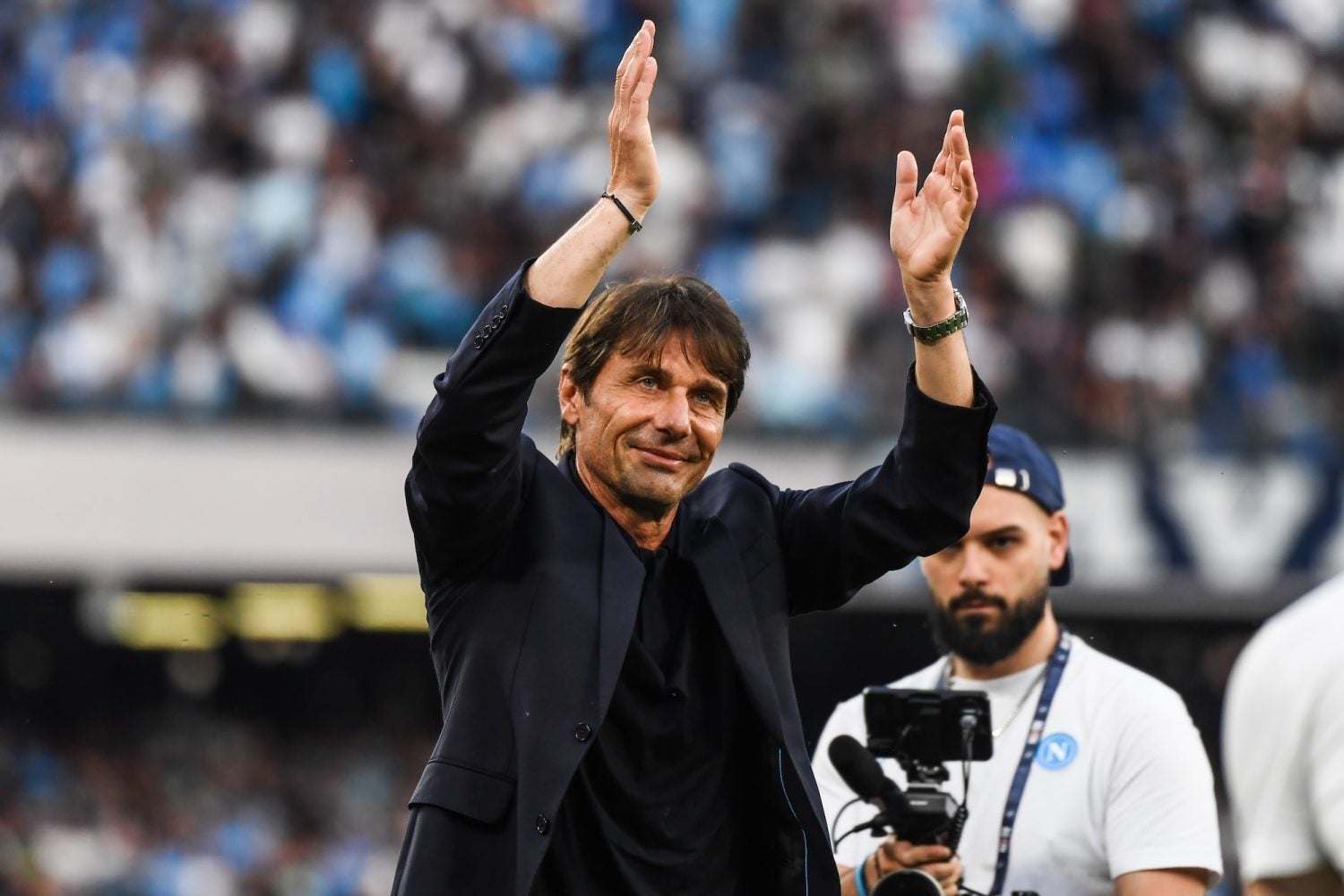
And it was not a matter of an episodic victory, but of a sort of medium-to-long-term project. Thanks to such a charismatic and respected figure, Napoli’s ambitions made a leap forward: as if the season of the tenth place and the three coaches Garcia-Mazzarri-Calzona had never existed. Conte, in effect, found a Napoli that was worn out, tired and with ideas that seemed to be running out. After two years, at the peak of a cycle that perhaps could have lasted even longer, he does not leave rubble behind. Neither technical, nor still less emotional: in the final lap beneath the curve stands, Napoli’s players hung back, leaving to Conte the affection and the applause of the public. It was a genuine gesture. Conte in turn applauded the stadium, almost moved.
A few hours later, despite all that wave of love, he reproached himself for not having managed «to bring the environment together». This too is part of being Antonio Conte: judging others, and consequently himself, with severity, always aiming for the maximum. Indeed, for something more, because the maximum is not always enough. He had said it himself, at the Royal Palace, a little less than two years ago.