
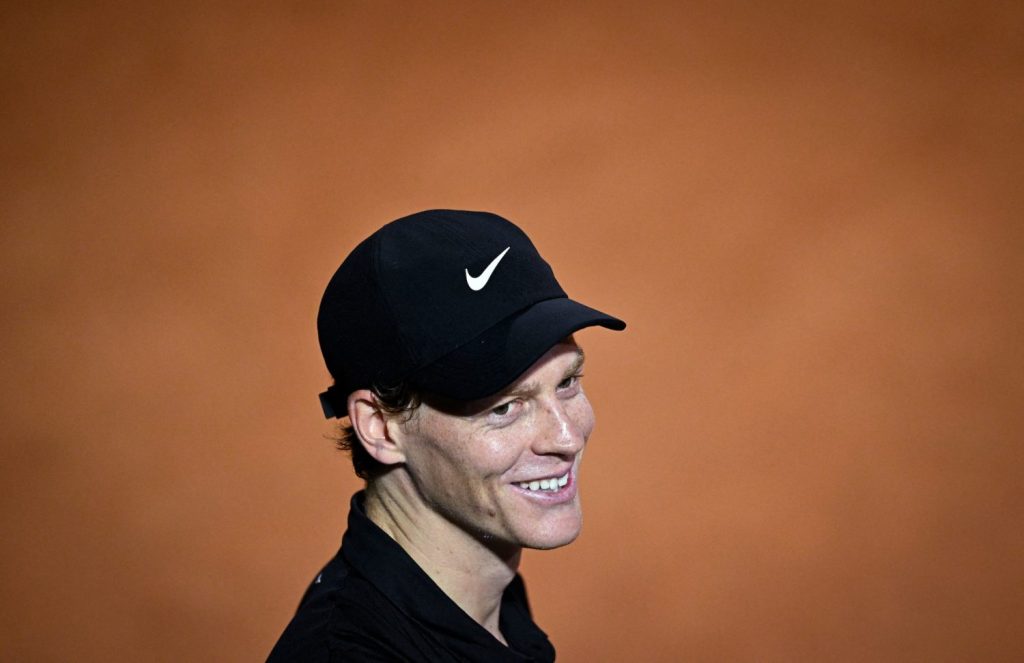
Not yet twenty-five, Jannik Sinner already carries more than a dozen commercial partnerships spanning almost every corner of consumer goods. Watches and pasta. Banking and coffee. Cruise lines and school notebooks.
The most lucrative, inevitably, is Nike.
He has been with the brand since the second half of 2019, and in 2022 signed what is widely reported as a landmark deal: a ten-year contract worth around $15 million per season, roughly $150 million in total. As in the Federer and Nadal era, Nike has effectively secured a controlled duopoly in men’s tennis, offering a near-identical agreement to Carlos Alcaraz. The result is predictable: a Swoosh present in the final stages of most major tournaments, across a significant stretch of the calendar.
There is also the question of what comes next.
Sinner is often mentioned in the same bracket as Nike’s lifetime athletes — a category reserved for figures such as LeBron James, Michael Jordan, Kevin Durant, and Cristiano Ronaldo. For now, he remains outside it. But the direction of travel is clear.
Nike has already incorporated his personal logo into its apparel lines — something it does only selectively. Roger Federer’s RF, Rafael Nadal’s bull. Now Sinner’s initials, JS, stylised into a fox motif, an image he is said to identify with.
The commercial ecosystem around him is already fully formed.
A Gucci-branded bag. A Head racket. A Rolex watch appearing on his wrist moments after match point, visible again in post-match interviews. Then the broader rotation: Lavazza coffee, De Cecco pasta, Alfa Romeo, La Roche-Posay sunscreen. Intesa Sanpaolo, Fastweb, Pigna, Panini, Enervit, Allianz, Technogym, Parmigiano Reggiano.
A portfolio estimated at close to €50 million per year. Roughly equivalent, at this stage of his career, to his cumulative prize money on court.
In practical terms, a single advertising break could be filled entirely with Sinner-led campaigns.
For some, there is too much of it. But the argument is not new. Modern elite athletes increasingly function as default commercial vehicles: stable, recognisable, present across daily routines. More accessible, in many cases, than actors or musicians. Trust becomes familiarity. Familiarity becomes value.
Sinner operates within that system as his peers do — Carlos Alcaraz on one side, Federer and Nadal before them — without ever attracting accusations of excess. Federer, for instance, signed a reported $300 million, 20-year deal with Uniqlo late in his career, at 37, after leaving Nike.
Behind the commercial structure sits a carefully managed public identity.
Not only what Sinner earns, but what he shows.
His relationship with the media — particularly in Italy — has become increasingly controlled. Press conferences are mandatory, but often resemble a set-piece exchange: journalists searching for a headline, Sinner offering minimal deviation from prepared restraint. Very rarely does the exchange break pattern.
After his semi-final win over Novak Djokovic at Wimbledon 2025, an Italian reporter asked what headline he would like to see the next day. “None,” he replied. “I don’t read them.”
Taken at face value, it is a rejection of attention. More likely, it is a form of distance.
At the US Open, journalist Ubaldo Scanagatta publicly criticised the lack of one-to-one access granted to Italian media unless tied to sponsorship commitments. Sinner initially deflected the point with a brief remark that did not fully land, before confirming, more plainly, that he attends “the interviews I am told to do”.
As his results have risen, so too has the pressure around him — both on and off the court. The final stages of his ascent into the elite, and later the suspension linked to the Clostebol case, contributed to a shift in approach. Access narrowed further. The perimeter around his public presence became more defined.
Social media follows the same logic.
Content exists, but within limits. Tennis dominates. Everything else is reduced to framing. Even with more than five million followers on Instagram, the tone remains institutional rather than personal, shaped in part since late 2024 by a dedicated social media manager, Alex Meliss, also from South Tyrol.
“I don’t like social media because it doesn’t show reality,” Sinner said after his first Grand Slam title.
There is a YouTube channel, too — a familiar extension of modern elite sport. In one video, following the Australian Open, his day off is shown in full: ice bath at nine, breakfast of eggs, ham, yoghurt and fruit, transport to Melbourne Park, gym activation, practice, sushi lunch, physiotherapy, dinner out. No narrative arc, no attempt at drama. Just sequence.
It is, in its own way, the point.
What happens off court is not designed to reveal more. Only to confirm what is already visible on it.