
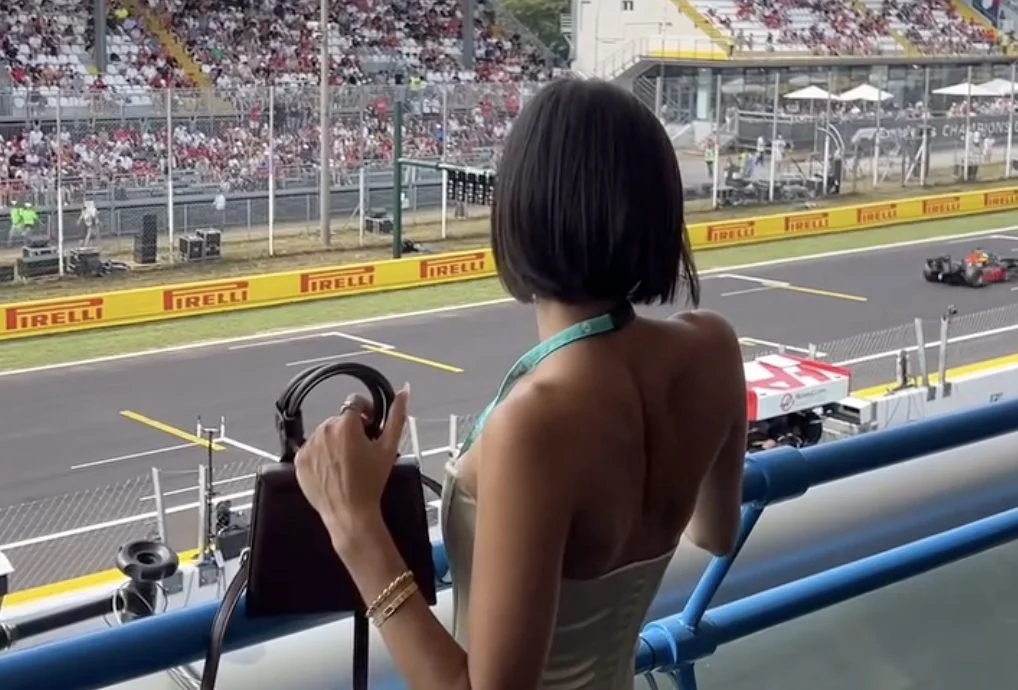
Formula One, today, you watch it vertically. Even before the lights, a subtitled team radio reaches you, a strategy explained easily, a shot stolen in the paddock, a meme that recounts a rivalry better than an editorial. The race remains the centre, but around it an ecosystem has formed that never sleeps: the championship as a continuous flow, an infinite series of micro-chapters that scroll on the phones. Within this flow, the clearest signal of the mutation is that, ever more often, the ones acting as a guide are female voices.
It is a fact as evident online as it is rare on the track. In 2026 Formula One has eleven teams and 22 seats: all occupied by men. The team principals, in the same way, are all men. In over 75 years of history, only five women have taken part in the World Championship as entrants of a Grand Prix, but only two qualified and took the start: Maria Teresa de Filippis and Lella Lombardi, the last to race regularly between 1974 and 1976. Outside the grid, however, there is another genealogy. Susie Wolff, after her appearances in free practice in 2014 and 2015, ended her career as a driver and in 2016 launched “Dare To Be Different”, an initiative conceived to increase the female presence at every level of Motorsport. Today she is the managing director of the F1 Academy, the “all-female” series created to give structure to a path that, otherwise, would too often remain symbolic. Alongside her push from inside the system, an ecosystem of creators has arisen that pushes the storytelling forward and that often, by now, allows access to the sport.
This leap is not a natural evolution.
For years Formula One has worked to be less opaque and more accessible: more content, more stories that arrive from behind the scenes, more characters, more pop language. The turning point is located in 2017, when Liberty Media completes the acquisition of the championship and F1 accelerates on a more global, more aggressive, more “entertainment” communicative strategy. Then Netflix, with Drive to Survive, did the rest: it gave a face and a plot to a sport that seemed understandable and appreciable only to those who were born into it or to those who were willing to study it. F1, from a Motorsport, became a cultural product. And when a sport becomes culture, the one who recounts it also changes.
Thus the figure of the content creator has grown, who here has a precise job: to translate. Because social media are immediacy, while F1 is technique, mechanics and regulations. «Regulations that they commit themselves to making ever more complicated», admits frankly Carolina Tedeschi, @carolinatedeschi, 300 thousand followers between Instagram and TikTok, face of the programme Sky Race Anatomy. The creators put two different times into communication: the long time of the sport and the short one of the algorithm. For those who enter now F1 is a new language, and someone has to make it comprehensible without passing through an initiation rite and hours of study. It is precisely this the most difficult task of the creators, who dissemble with nonchalance. «The technical part, I said ok, you don’t know it so well: you know what you do? You study it and you try to explain it in the simplest way possible so that everyone manages to understand it», adds Tedeschi. «Even my grandmother who is 93 watches the video and says: ok, I didn’t know this thing, now I know it too. Because this process in my opinion closes the distances a bit». It is a concrete idea of access: if those who are outside understand, the distance shortens. If the distance shortens, the sport grows.
Visualizza questo post su Instagram
Maria Nicoletta Floris, known as @laragazzadelmotorsport, over 60 thousand followers on Instagram and TikTok, sees and relaunches; «From the first day on social media I have always wanted to explain in a simple and clear way every concept of Formula One to bring as many people as possible closer to this world». Floris recounts months spent «every evening» studying technical details and the attempt to hold together simplicity and precision: «It takes time to study the regulations and write content in a simple but correct way». She starts from a more journalistic approach, having a past as an editor, thanks to which she has «the good fortune of having many journalist friends or people in the sector with whom I confront myself daily». Their work, therefore, is not talking about Formula One: it is deciding how to talk about it. Above all because the algorithm does not love complexity: «It is not easy to go viral with technical content… but I like challenges», concludes Floris.
Without this work of translation, many curious people who arrive through pop culture crash against a wall of information: jargon, overload and a certain type of gatekeeping that demands the fan’s licence. Here guides, columns and serial formats come into play. Toni Cowan-Brown, for example, has transformed a “Beginner’s Guide” conceived for friends into short and digestible content, going as far as building a community of over 100 thousand people with @F1Toni. Her underlying philosophy is as simple as it is disruptive in a world as closed as that of motorsport: «There is not just one way to be a fan: this is the beauty of living a passion like this». The same logic also applies when the “translating” does not pass through technique, but through experience. Desiree and Virginia Stubbe, twins and German creators behind the account @pitlane_twins (over 100 thousand followers on Instagram), build their content above all on the point of view of fans present at the circuits and on the continuous dialogue with the community: «Our focus», they explain, «has never been on the technical aspects and neither do our followers ask us for them. They know that they can find solid information on other channels».
Formula One, as an industry, has understood how useful this philosophy and cultural infrastructure is. It is no coincidence that drivers and social media teams have increasingly adopted a light, “complicit” language, made of trends and self-irony. Also because Drive to Survive is an annual fuse, not a daily presence. Between December and March there is a long desert: no track, few press releases, a silence that in other sports would be filled by the transfer market or by tradition. In F1 the creators fill it. Ironic, driver-centric content, recaps, explanations, repeatable formats: maintenance work, more than reporting. When the championship then restarts, and analyses and statistics return, they continue to offer something different from the TV: a personal point of view, closer to the way in which a young audience consumes sport.
The myth of Drive to Survive, moreover, must also be downsized a bit: a report by Buzzradar suggests that, among the new arrivals, the first channel of discovery is not Netflix. Ahead are social media (22%) and family habits (21%). The series is third (14%), ahead of video games (9%). If these voices today weigh more, it is also because Formula One has decided to become a lifestyle stage: fashion, celebrity culture, brand activation. The logic of the paddock club and of the premium experiences coexists with the logic of “native” content: short, vertical, serial. The teams too behave like media houses and, ever more often, legitimise the creators as part of the storytelling. An explicit example is Aston Martin’s Creator Collective with TikTok, a programme that promises access behind the scenes and mentorship over the course of a season. The creator economy is no longer the periphery: it enters the official perimeter of the Circus. In parallel, Liberty Media has progressively loosened the constraints on communication from the paddock and has begun to invite creators and influencers to the Grands Prix to amplify the official channels. It is not a neutral move: in 2023, according to Buzzradar, F1’s annual new followers fell by 46% compared to the previous year, in a season dominated by the Red Bull–Max Verstappen pairing and therefore less narrative on the sporting level. If Sunday becomes predictable, the storytelling has to work more off the track.
This is even more true when the one recounting is a woman, in a sport that has never been in any particular hurry to seem open. But if inclusion has become a strong theme in the communication, the sporting structure remains traditional. It is the central contradiction: F1 sells itself as new, global and open, while access remains elitist and the control of the image extremely rigid. At the point where this friction is most visible, the female dimension enters.
Visualizza questo post su Instagram
The closure of the “all-female” W Series championship (which occurred in 2022 due to financial problems) has left a void that is not only sporting, it is narrative. In 2023 the F1 Academy arrived, more integrated into the official pyramid; the narrative affirms that “there is a path”, and yet in practice the female path remains marginal, and the absence of women on the grid continues to make the idea more symbolic than real. Maria Nicoletta Floris says it without beating about the bush: «Will a woman return to Formula One? For me it will happen, but now the moment is unripe». Because the risk is immediate: «Only a lot of criticism would arrive. […] She would be seen only as a marketing move and not for her talent». It is the nightmare of the token: being read as a symbol even before as competence. And, underlying it, it is a parallel risk also for those who recount: being treated as a narrative accessory and not recognised as professionals.
On this point the Pitlane Twins too maintain a realistic outlook: «It is very interesting that the economy of women creators is so large — as far as we know, larger than the male one. I think that women like to be creative about the things they are passionate about. Whether this has an impact on the motorsport ecosystem we do not know. However, there is still no woman on the grid and I do not see this changing in the near future».
Carolina Tedeschi, instead, shifts the axis onto talent and onto the freedom to listen to anyone, onto the attention towards the «content rather than the wrapper: I don’t give a damn whether a man or a woman talks to me about Formula One». And yet, at the same time, Tedeschi recognises the value of representation: «When I happen to meet people in person, very young girls who say to me “I would like to do what you do”. And she returns to her home-made origin: “I started from a hole of a room with a camera […] if I made it, you really can make it too». The Stubbe twins too confirm this dynamic, observing that representation is not only inspiration, it is protection: «We read it in the private messages: many women appreciate content created by other women and feel the need for a safe space». Floris agrees: «Many girls tell me that they started talking about motors thanks to me, because with my content I offer them too the possibility of talking about this world and reality. Because they know they are not alone». It is not motivational rhetoric, but the simple social effect by which, if you see that it exists, you authorise yourself to try. «Girls! If you want to talk about motors, do it… don’t be afraid of the judgement of others», concludes Floris.
The data confirm that this broadening is not marginal. The female fanbase has grown a lot in recent years: analyses based on Nielsen/Reuters speak of women at around 41% of the total of fans, with the 16-24 age segment among the fastest-growing. And the Global Fan Survey 2025 (F1 + Motorsport Network) signals that women are three out of four of the new fans, with a strong weight of Gen Z and daily consumption of digital content. The evolution of Formula One has begun and will not stop. The women creators are not only a “category” to be recounted: they are a useful lens for understanding what Formula One has become. Not because it has suddenly become an equal place, but because the Circus has become a media ecosystem, and so it has created space for a new cultural infrastructure: people who make the sport inhabitable, not only watchable.