
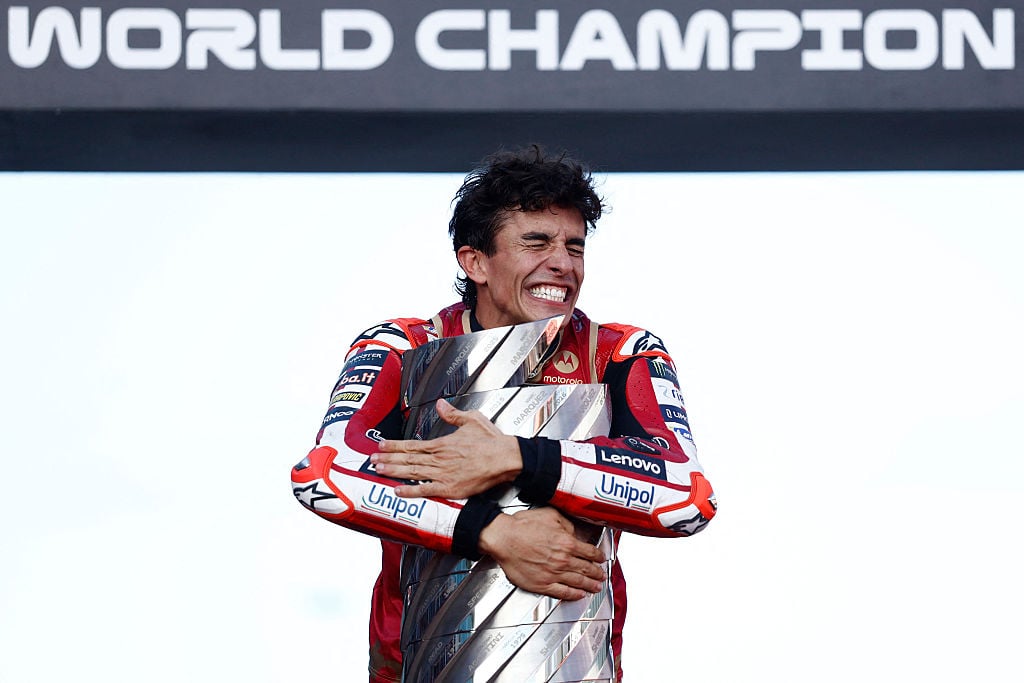
At the end of the Portuguese Grand Prix, where Marc Márquez claimed his tenth world title, the celebrations produced an image that may outlast the race itself. Márquez climbs a flight of stairs towards an imaginary podium. On a giant LED screen behind him, a goat appears in the half-light, making its way up the steps alongside him. At the top, a small door opens. Out comes Giacomo Agostini, the most successful rider in Grand Prix motorcycle racing history. The two greet each other and embrace. It has something of the ending of The Truman Show about it, when Jim Carrey’s character finally steps out of the artificial world he has always known. But this is not an escape. It is a handover. The old GOAT, the greatest of all time, meeting the new one. For years, the title belonged to Agostini. Now it belongs to Márquez. And there is another presence in that scene, even if it remains offstage: the Ducati beneath him.
Márquez’s comeback has been extraordinary. He overturned a deficit of more than 100 points, came through devastating crashes and injuries, and returned to the top with a resilience that sometimes seemed almost mechanical. He may be the greatest natural talent MotoGP has ever seen, but even Márquez cannot do it alone. There were his engineers, the Ducati Lenovo Team and the technology developed to give him every possible advantage on track. “Marc Márquez’s 2026 MotoGP World Riders’ Championship title demonstrates what is possible when technology and human performance work together,” said Claudio Domenicali, CEO of Ducati Motor Holding. “[…] The entire Ducati Lenovo Team has worked with unwavering commitment, using Lenovo technology to make informed decisions and improve performance.”
One of the most important developments this season has happened away from the track. Ducati and Lenovo upgraded the team’s High-Performance Computing (HPC) infrastructure, increasing processing power by around 48 per cent and almost doubling available memory. It was an investment that came into its own when Márquez was sidelined for an extended period after his crash at the French Grand Prix in Le Mans. The bike could keep evolving, even while its rider was unable to turn a lap. The engineers, in effect, had a virtual Márquez to work with. Some 1,500 simulations supported his programme. Around 100 setup changes were assessed across testing and race weekends, alongside approximately 80 hours of track activity and 300 GB of data relating to the Spanish rider alone. A considerable amount of work for someone who, for much of that time, wasn’t even on the bike.
From the Ducati Lenovo Remote Garage in Bologna, specialists kept processing information, running simulations and working with the trackside team. There was no need to wait for Márquez to return before getting on with development. Engineers could explore possible changes, preserving the characteristics he relied on while balancing performance with predictability and, just as importantly, the confidence he would need when he climbed back aboard. His return brought another set of questions. How had the injury changed his riding? What was different about his braking, his use of the throttle, his speed through corners, his lean angle? The team compared his performances before and after the accident, looking at the smallest details. At this level, nothing is incidental.
Nor is there much time to work things out. In MotoGP, data has to be processed and understood in minutes, often under intense pressure and with no room for error. Lenovo’s infrastructure gives the team the processing power, storage and connectivity to work through the information quickly, compare it with Márquez’s feedback and identify possible improvements before the next session. By the time the riders are back out, the engineers need to have done their homework. The next chapter is already under way. Data gathered throughout 2026 is feeding into the development of the 2027 Desmosedici GP. Márquez has another season ahead of him, Ducati another bike to build. The records are still there to be broken.