
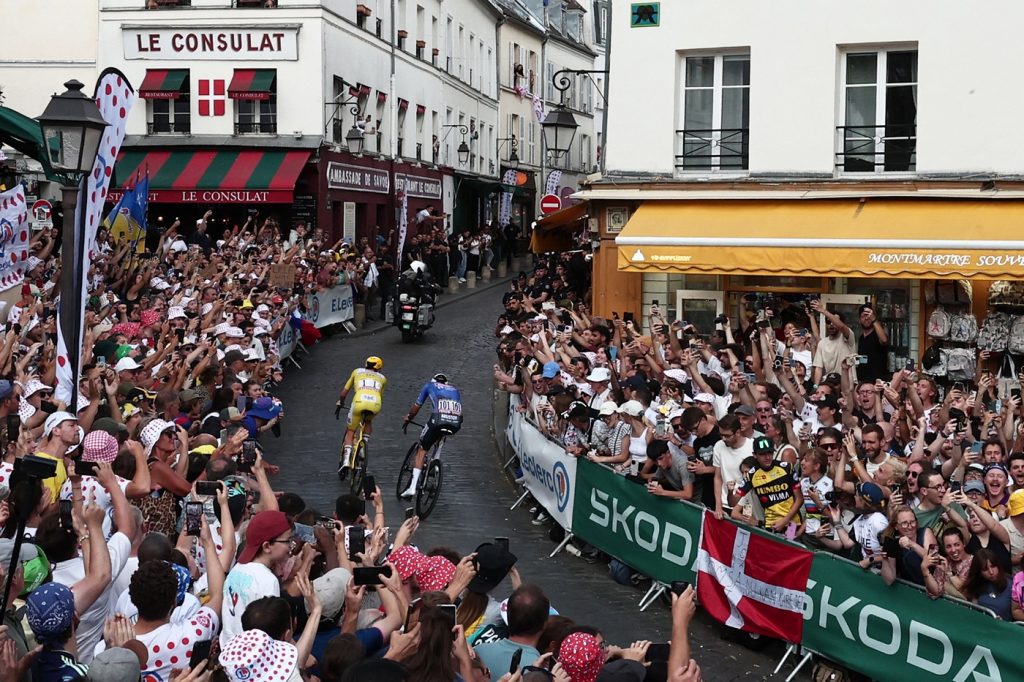
There are already 24 teams involved, with another five ready to join. The group is valued at €500 million and has an ambition that is hard to miss: to bring the Formula One model to professional cycling. It is one of the most significant political and commercial initiatives in the sport’s history. As The Athletic reported last week, most of the men’s and women’s teams in the top divisions acquired stakes in Collective Cycling Group (CCG) at a meeting in Brussels. The aim is to give teams a share of television revenues and help cycling reach a wider audience. At present, appearance fees rarely cover the cost of competing. Teams effectively pay to take part, while riders receive no direct payment from organisers for the value they bring to a race. Unlike in most other sports, television rights revenue goes entirely to the organisers. Prize money is often modest, too, and traditionally shared among all the members of the winning team.
Cycling has another problem: it has no stadiums or arenas, and therefore no ticket revenue of the kind other sports can rely on. Merchandising brings in relatively little. Teams depend almost entirely on sponsors to finance their annual budgets. It is a fragile arrangement, and one that has led to teams disappearing. Even WorldTour teams are never entirely sure they will be around for another season. The WorldTour calendar is an obvious place to start. It currently runs to 168 race days for the men and 77 for the women, making it crowded and difficult to follow. There seems to be some agreement on the need for fewer races, but ones that matter more. One proposal would cut the Giro d’Italia and Vuelta a España, two of the three Grand Tours, from 21 stages to 16. A less radical option would be to give each race a clearer place in the wider season. Cycling has no overall rider ranking that captures the public’s imagination, nor a team championship with any real media profile. The existing points system has done little to change that. Most people remain largely indifferent to it.
That helps explain why so much attention is concentrated on the Tour de France. Once the French race is over, many casual fans lose interest in the rest of the season, whatever the prestige or difficulty of the other events. There is little to connect them, and no common thread to keep audiences engaged. There is also the fact that, unlike in almost every other sport, cycling’s biggest names rarely compete against one another. Tadej Pogačar and Jonas Vingegaard, winners of the last seven editions of the Tour de France, have met in just three stage races since 2022. The scarcity of those encounters is part of what makes their battles at the Tour so compelling. But those behind the proposed changes would like to see them race each other more often. The world’s best riders meeting regularly would give the season more recognisable rivalries and events for fans to look forward to.
The proposals also concern the experience of watching a race. More finishes on urban circuits would allow spectators to see the riders pass several times, while opening up new commercial opportunities. Food outlets, temporary bars and hospitality areas could make a day at the races more of an occasion, appealing both to traditional fans and to those looking for something more exclusive. Some of these circuits could be staged in major cities around the world, from New York and Los Angeles to Bogotá, Beijing and Riyadh. There is a tension here. The aim is to reduce the number of race days, while at the same time opening up new markets and taking events to increasingly distant parts of the world. In effect, the organisers want fewer Tours of Poland and Romandie, and more New York Grand Prixs and Tours of Colombia. The plans could also include events for amateur riders, held on the same weekend and over the same routes as the professionals. It is a model familiar from Formula One, where each race weekend becomes an event in its own right.
Television coverage is another area under consideration. The idea is to give viewers access to more live data on the riders, from heart rate and power output to cadence, as well as allowing them to hear radio communications between team members. More insight into the race could also make the television rights more valuable to organisers. Twelve men’s WorldTour teams and nine women’s WorldTour teams have joined CCG. They are accompanied by two men’s second-division teams, Pinarello-Q36.5 and Tudor Pro Cycling, and the newly formed women’s second-division outfit Decathlon CMA CGM. Red Bull-Bora-Hansgrohe, Netcompany-INEOS and FDJ United-Suez have asked for more time to make up their minds. Sources close to the project, speaking anonymously to The Athletic, believe they are likely to join. Three men’s WorldTour teams, however, have no current intention of signing up: UAE Team Emirates-XRG, Pogačar’s team, Jayco-AlUla and Groupama-FDJ United.
Every team that joins CCG will hold an equal stake in the company. A further five per cent has been reserved for the five founding investors, who have put in a combined €25 million to get the project off the ground. They are linked to the ownership or financial management of Visma-Lease a Bike, Lidl-Trek, EF Education-EasyPost, NSN and Pinarello-Q36. CCG has also received public backing from two major race organisers, despite being controlled by the teams themselves. RCS Sport, which runs the Giro d’Italia, and Flanders Classics, organiser of the Tour of Flanders, have both voiced their support. One major name is still missing, though: Amaury Sport Organisation (ASO),