
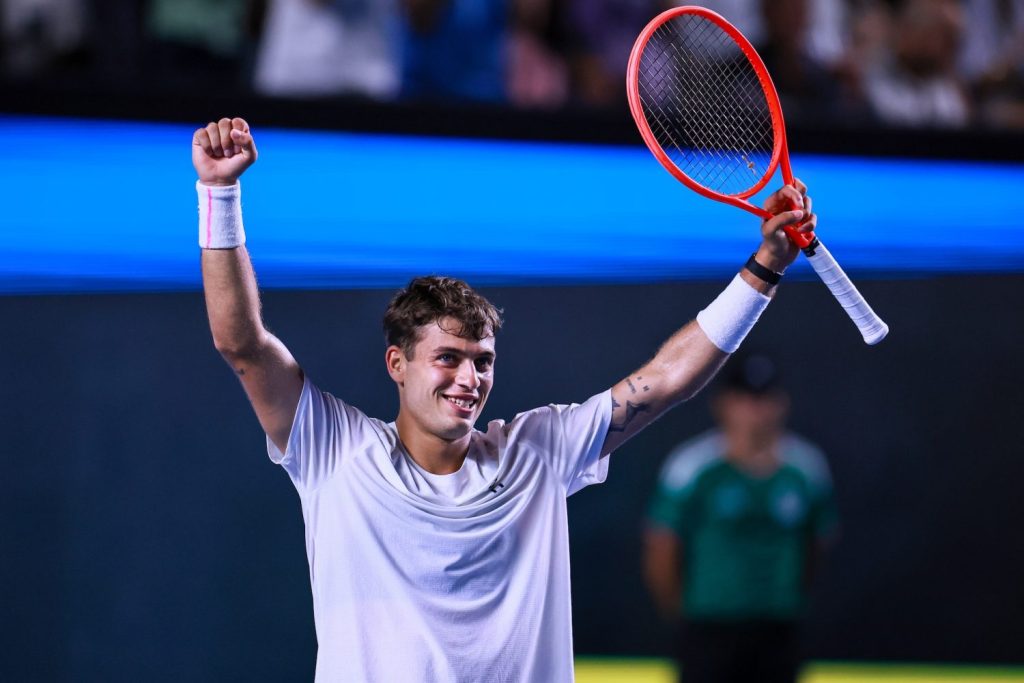
By the end of the season, only eight players remain. It is a ruthless selection, bringing together those who have survived eleven months of travel, matches, injuries and the pressure of defending their ranking. This year, Flavio Cobolli is among them, after a season of peaks and sudden dips: the title in Acapulco, a final at Roland Garros, a quarter-final at Wimbledon, but also a spell when his game seemed to lose some of its spark. At 24, he has earned his place among the best in the world without ever having looked like a prodigy. Perhaps that is part of what makes him interesting.
Cobolli is not Jannik Sinner, whose game is built around almost machine-like precision. Nor is he Berrettini, whose serve and forehand have made grass his natural hunting ground. He doesn’t have Lorenzo Musetti’s effortless elegance, that backhand with something of Caravaggio about it. Cobolli is more grounded, and harder to pin down. His game seems to come together on the fly: adjustments to make, shots to improvise, matches to keep alive until an opening presents itself. He is a player of sudden surges, capable of swinging from frustration to exhilaration and finding something like order in the fight itself. Sometimes, under pressure, his tennis doesn’t unravel so much as catch fire. In 2026, he won the ATP 500 in Acapulco, reached the final at Roland Garros and the quarter-finals at Wimbledon. A season that, not so long ago, would have made him the leading figure in Italian tennis. Now it takes him to the Finals. An achievement in its own right, but within a story that has grown bigger than any one player.
Italy, after all, has eight players in the top 100 and four in the top 30. Alongside Cobolli are Sinner, Musetti and Berrettini, of course, but also Luciano Darderi, Matteo Arnaldi, Mattia Bellucci and Lorenzo Sonego. The range is striking. There is little in their games that suggests a common school. Italy is no longer a nation of baseline grinders, nor a factory for big hitters looking to finish points in two or three shots. These are individual talents, each with their own game, as if they had come out of an artisan’s workshop. Some made it early, others took longer. The system has learned to accommodate very different routes to the top.
For decades, Italian tennis was described as a desert, a long stretch of barren ground after Panatta and Barazzutti, broken only by the occasional player who briefly made his mark. The reality was more complicated. Through the 1990s and early 2000s, Italy struggled to produce players who could compete consistently with the best, but it had a substantial professional base. There were always around twenty Italians in the top 300. The problem was the step up. On average, four or five made the top 100, never enough to establish a sizeable, lasting presence. That remained the case until a few years ago. In 2019, the number rose to eight. Since then, Italian players at the top of the game have become a regular sight.
Part of the story is a particularly gifted generation. Part of it is the result of years of planning. The Federation focused on the conditions that make the transition to professional tennis possible. In practical terms, that means giving players the chance to compete regularly, with tournaments close to home, the occasional wild card, and a way to earn ranking points without spending the family budget on flights and hotels. When Angelo Binaghi became president in 2001, Italy hosted around 2,600 tournaments. By 2016, that figure had risen to more than 8,400. The country built a network of Challenger events, the tournaments that allow players to work their way up from the lower reaches of the circuit towards the names they see on television.
The other change came in how young players were supported through the later stages of their development. For years, the federation’s model was heavily centralised, with Tirrenia serving as the main training hub. From 2015, it began moving towards a more decentralised structure, organised by age group, bringing together the work of coaches at local clubs and the technical expertise of the national federation. The idea was to keep tabs on talent without centralising everything. There are around 90 million tennis players worldwide, and only about a hundred competing for the sport’s biggest titles. According to estimates cited by New York Times tennis writer Christopher Clarey, the chances of becoming a professional tennis player are roughly one in two million. In golf, they are one in a million; in football, one in half a million, and so on.
No development programme can make the journey predictable. Tennis is full of junior champions who never fulfil their early promise, and late bloomers who reach their peak years later than anyone expected. Uncertainty is part of the sport. Binaghi has described the FITP’s work as a long process of sowing: “We have been sowing for years, investing in training centres, coaches, junior tournaments, facilities and the entire system.” The organisational work has clearly mattered. But it would be a mistake to give the Federation credit for every individual success, as though Sinner, Cobolli or Darderi had emerged from a production line.
The players themselves make that clear. Darderi has built his game around clay, gradually adding to his repertoire. Arnaldi relies on aggression and his ability to withstand long rallies. Bellucci has made his own way with a left-handed game and an appetite for variation. Behind them are Federico Cinà, Pierluigi Basile, Jacopo Vasamì and Andrea De Marchi. They may or may not become champions, but there is no longer the sense, as there was a few years ago, that the entire future of Italian tennis rests on the shoulders of one teenager.
The contrast with other countries is becoming clearer. France is still looking for the next champion who can return it to the top of the game. Spain continues to produce exceptional players, though much of its development takes place in private academies. Germany has Alexander Zverev, but little coming through behind him. Italy, by contrast, has produced a concentration of talent unlike anything it has seen before. The challenge now is to sustain it, to make sure the next generation can match the current one. Even at the top, momentum doesn’t last forever.
The boom has changed the audience, too. According to a survey by Sport e Finanza conducted with QuestionPro, 42% of Italians now follow tennis regularly, making it the country’s second most popular sport after football. Among those who follow it, 76% say their interest has grown over the past two years. For 59%, the presence of an Italian player is the main reason for choosing a match to watch.
Results have driven that growth, but so has the way tennis has been brought to a wider audience. Television coverage, the attention of newspapers and social media, and the prestige of the ATP Finals have taken the sport beyond the circuit and into everyday life. In Turin, the season-ending tournament has become a fixture in the city’s calendar. For a week, the streets feel different, shop windows fill with racquets and tennis balls, and even those without tickets find ways to be part of it. This year, Sinner is absent. After winning the title twice in a row, he won’t be there to defend it, and the tournament loses its most anticipated Italian player. But his absence no longer leaves the story without a leading figure. Cobolli is ready to take his place. It won’t be the same for everyone. That’s part of the appeal.