
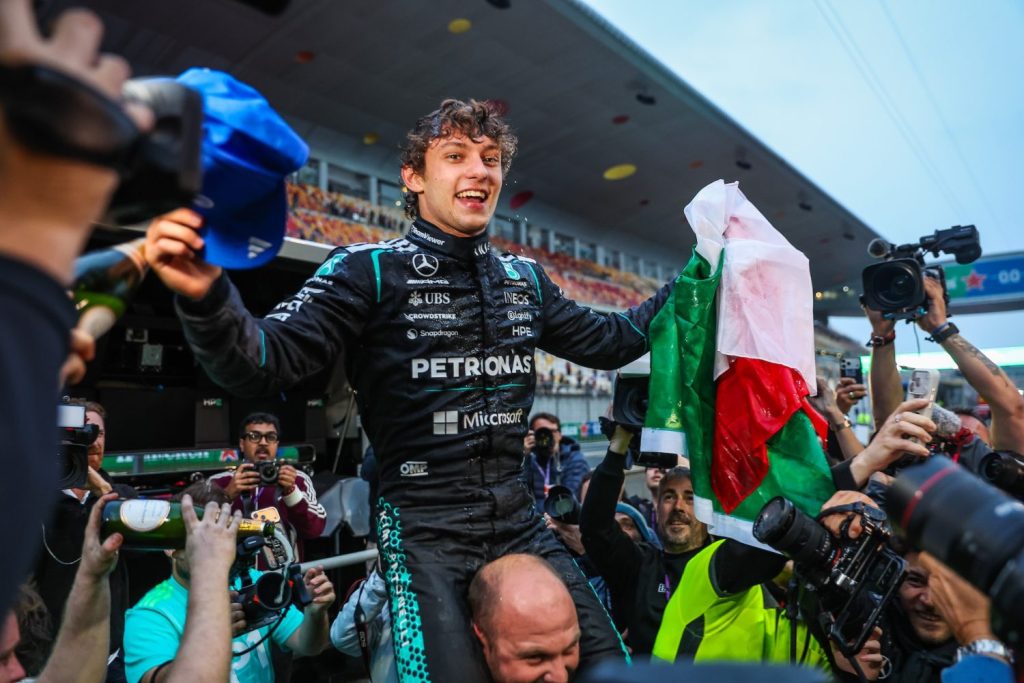
One of the most telling images of Kimi Antonelli’s season had surprisingly little to do with Formula One. It was taken at the Franciacorta circuit, where, just hours after the Italian Grand Prix at Monza, he spent the day karting. Perhaps the most natural way for him to celebrate an extraordinary victory was simply to get back on track, climb into a kart and keep driving. There is something about that image that captures Antonelli perfectly. For all that he is the youngest world champion in Formula One history, Andrea Kimi Antonelli is also a twenty-year-old who lives and breathes motor racing.
Whenever the championship calendar gives him a break, he spends time in the simulator, preparing for races, studying circuits and looking for ways to improve. He joins Mercedes’ young drivers on track, keeps up his involvement in karting and plays an active part in developing the car. He is not the sort of driver who simply gets behind the wheel, waits for instructions from the engineers and does as he is told. Quite the opposite. His instinct to push the limits and keep finding more from the car makes him a valuable presence in the garage, too. He can describe exactly what he feels, where the car is losing time and which changes might make a difference. His curiosity does not stop when a session ends. It is no coincidence that he adapted far better than his team-mate George Russell to the upgrade packages Mercedes introduced after Canada, midway through the season.
Another detail offers a glimpse of the same character. Antonelli is one of those drivers who needs regular reminders to respect track limits. Not because he does not know the rules, but because his instinct is to use every available centimetre, to take the car just that little bit further. Sometimes his engineers have to remind him that five infringements can earn him a penalty. It has become something of a running joke between them, a reminder that, for all his talent, there is still a teenager in the cockpit who occasionally needs telling to take it easy. Not that taking it easy comes naturally to him.
For much of the season, Antonelli insisted that he took things one race at a time. No calculations, no constant checking of the championship standings, no working out how many points he would need to become world champion. The title was not something he spent his days thinking about. At least, not until Monza. Something changed there, in front of the Italian crowd. Starting from the back of the grid and going on to win the Italian Grand Prix was the kind of performance that can change the course of a season, perhaps even a career. It also gave him a new sense of what might be possible. From then on, he began paying a little more attention to the numbers, without losing sight of his usual approach: one Sunday at a time, one corner at a time, one target at a time. Even when the championship became a genuine possibility, his priority remained the same. Driving.
And in the end, he won. At twenty, after a season in which he had prevailed against opponents with considerably more experience, Kimi Antonelli became world champion. His age is part of the story, of course, and the record makes the achievement all the more remarkable. But there is something bigger at stake here: one of the greatest sporting achievements by an Italian in living memory. Before him, only two Italian drivers had won the Formula One world championship: Giuseppe Farina, in 1950, and Alberto Ascari, in 1952 and 1953.
Seventy-three years have passed since Ascari’s second title. Italy has continued to produce racing drivers, though fewer than it once did, but none has managed to bring the world championship back home. Michele Alboreto came close in 1985, fighting for the title until the final five races of the season before falling short. Since then, there have been no realistic opportunities to speak of. Until a young man from Bologna came along and picked up a thread of Italian sporting history that had been left hanging for far too long.
Antonelli’s success has reached well beyond the usual Formula One audience. For a few weeks, Italy found itself following the championship standings, checking qualifying times and discussing strategy, tyres and gaps. It was something Italian sport had not seen for a long time: a champion capable of bringing the country to a standstill, turning every race into a shared national occasion. It was what happened with Alberto Tomba, whose downhill runs once kept millions glued to their television screens; with Pietro Mennea, Marco Pantani climbing the mountains of the Tour de France, and Valentino Rossi on Sunday afternoons. It is happening again with Jannik Sinner, who has brought tennis into everyday conversation, even among people who once knew little about how a match was scored.
Antonelli has become a sporting figure whose appeal extends well beyond the world of motor racing. He is not simply the Italian driver who has won the championship after decades of waiting; he is someone people recognise and cheer for, whether or not they have any particular affection for Mercedes. There is something immediately appealing about his story: a young, smiling driver who seems to have no intention of losing the enjoyment of what he does, even while taking on one of the most difficult and dangerous challenges in sport. He has not built his success on grand statements or bold declarations. He has kept driving, learning, making mistakes and putting them right. When the moment came to show what he could do as a champion, he did so in the way he knows best: by going faster.
Behind that apparent lightness, of course, lie years of work, a family that has supported him throughout, a team like Mercedes that believed in him and an entire organisation that helped build a winning car. Talent alone is never enough, particularly in Formula One. But Antonelli has brought something that cannot easily be taught: an almost instinctive relationship with speed, a desire to be on track even when there is no particular need to be, and an inability to consider the job finished when everyone else has already switched off their computers.
Perhaps that is the secret of his world championship. Kimi has never really needed a reason to get into a car. All he needs is a circuit to tackle, a corner to work out, a lap time to beat. A few minutes after winning the title, he could quite easily have gone karting again. It would have been entirely in character. And that, more than anything, is what makes him special.