
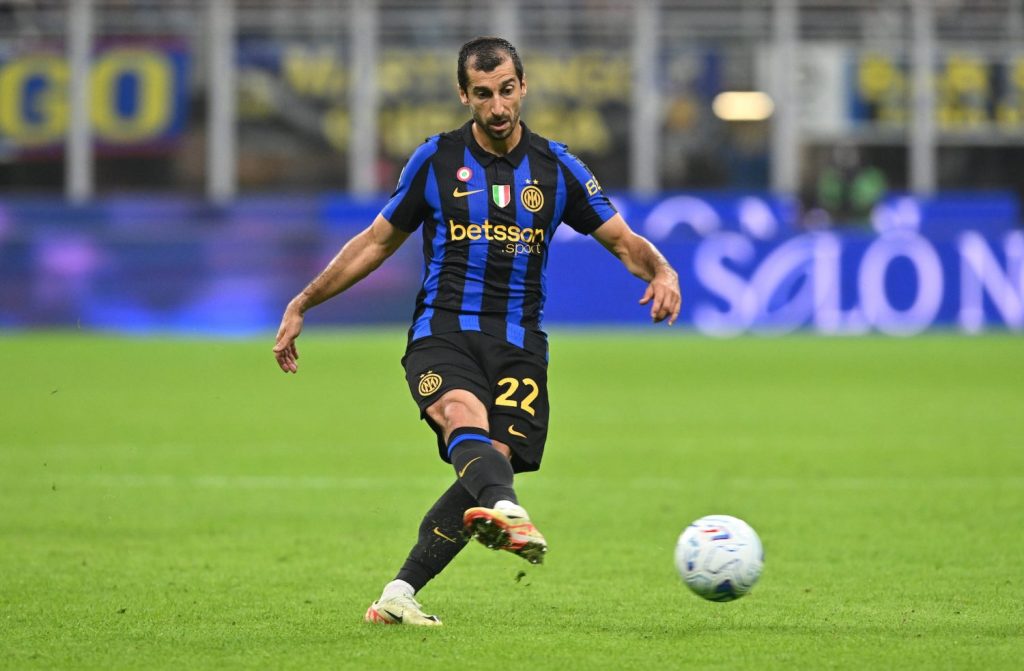
Henrikh Mkhitaryan’s assist for Carlos Augusto’s winner against Shakhtar Donetsk could prove one of Inter’s defining moments of the season. From 33.7 metres out, he sent a left-footed pass onto the Brazilian’s chest with almost surgical precision, barely needing to look at his target. He had already taken in Carlos Augusto’s position and knew where he would be at the end of his run. The rest was execution. The value of the assist went beyond the result it secured. It was a reminder of a quality that time might slow but cannot erase: the ability to read a game a moment before everyone else. Mkhitaryan came on for Bonny in the 75th minute and, two minutes later, produced the pass that decided the match. A brief appearance, enough to change the evening. In the San Siro tunnel after the final whistle, the Armenian brushed aside the praise. “The goal? All credit to Carlos Augusto.” He redirected the attention towards his teammate, as though the finish mattered more than the pass that had made it possible. At 37, even after producing an assist of that quality, Mkhitaryan preferred to talk about the man who had scored.
It was not the first time he had found Carlos Augusto with a pass that seemed to anticipate the action before it took shape. Against Bologna, his ball to the Brazilian helped set up Inter’s goal through Ange-Yoan Bonny. He had found a similar passing lane, delivering the ball almost without looking and allowing the move to unfold before the defence could react. The two assists differed in context and difficulty, but both depended on the same instinct: anticipating the next move before it developed. Against Bologna, Mkhitaryan had given Carlos Augusto the chance to put Bonny through on goal; against Shakhtar, he did almost everything himself, reading the run, judging the weight of the pass and releasing it at precisely the right moment. Carlos Augusto was left with little more to do than control and finish. The difference between a midfielder who plays well and one who makes difficult things look simple often comes down to that fraction of a second.
The statistics backed up what his brief appearance had suggested. Against a Shakhtar side he knew well from his time there between 2010 and 2013, Mkhitaryan completed all nine of his passes. Every long ball he attempted found its target. He won all his aerial duels and three of his four ground duels, while making three defensive contributions. The sample was small, gathered in a matter of minutes, but he had entered the game without needing time to find his bearings. There was also a chance to add his name to the scoresheet. In the 84th minute, Marcus Thuram rolled a ball across the box and Mkhitaryan had room to shoot first time. He hesitated, perhaps looking for a touch or a cleaner angle, allowing the defence to recover and close him down. He kept the move alive, turned and tried to finish with his right foot, coming close to scoring.
Mkhitaryan had not come on simply to keep possession and help Inter see out the game. He was there to influence it, with the freedom of a player who knows he still has something to offer and the responsibility of someone who understands the weight of every possession in a match that has suddenly become more delicate. After Alessandro Bastoni’s dismissal, Inter needed someone capable of turning a difficult situation into an opportunity to strike. Mkhitaryan found one, recognising a route through where others might have seen only distance. His cameo also offered a glimpse of how Cristian Chivu intends to use him. Last summer, Mkhitaryan seriously considered retirement after a season that had forced him to question his future and how much longer he could contribute to the team. Instead, he signed a contract extension until 2027, knowing that his place would have to be earned on the pitch.
Chivu has shown little inclination to treat age as a limitation in itself, and Mkhitaryan is responding with the quality that has always set him apart: an understanding of the game that often puts him a step ahead of those around him. He has already played 185 minutes this season and supplied two assists, making a meaningful contribution to Inter’s rotation. The demands on him have changed. He no longer needs to sustain the intensity of a full 90 minutes every three days or dictate the midfield from the first whistle to the last. Inter can turn to him when possession becomes aimless, when a game needs calming down or when energy alone is no longer enough to control the midfield. He can restore control or come off the bench and produce the pass that changes everything.
In a midfield balancing fresh legs with technical quality and experience, Mkhitaryan offers something different. Younger players bring intensity, acceleration and energy; he brings timing, the split second in which the right pass remains available before the space closes. It is a quality that passing statistics alone cannot capture. It shows in the way he positions his body, the angle at which he receives the ball and the decision he makes before the rest of the pitch has caught up.
Against Shakhtar, that understanding was distilled into a single pass: 33.7 metres, the ball onto Carlos Augusto’s chest, the goal that decided the match. Years of experience across leagues, teams and systems have given Mkhitaryan an instinct for space that remains undiminished. He had considered stopping, but chose to continue at Inter, and Chivu is finding ways to make that decision count. His legs may no longer allow him to dictate a game for 90 minutes. But give him a few minutes, a glimpse of space and a teammate making the right run, and he can still see the pass before it exists.