
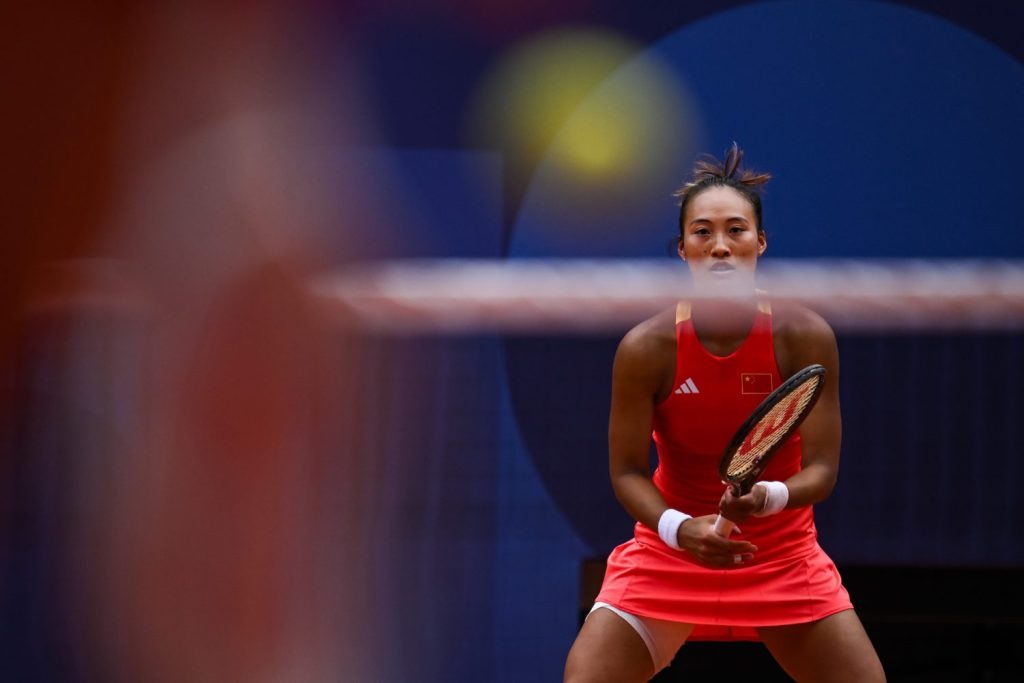
For a sense of just how big tennis has become in China, look no further than Zheng Qinwen’s recent exploits. When the 23-year-old made it from qualifying to the US Open quarter-finals, she topped trending lists across Sina Weibo, Xiaohongshu and Douyin, three of China’s biggest social platforms. It was a similar story when Zheng won gold at the Paris Olympics in 2024, with Chinese media reporting that the live broadcast of the final peaked at a national television audience share of more than 50 per cent. Little wonder Zheng’s attention turned immediately to home when her US Open run came to an end. “I’m always so excited to play in China,” she told reporters in New York. “I’m always more motivated, and also carry some pressure, because I really want to do well there.”
Zheng will be among the clutch of tennis stars heading to China over a seven-week stretch starting in late September. Across that period, the country will host nine tournaments in nine cities, beginning with the Billie Jean King Cup Finals in Shenzhen before the ATP and WTA tours take in Chengdu, Hangzhou, Beijing, Shanghai, Wuhan, Ningbo, Guangzhou and finally Hong Kong—a run that has been dubbed the “China Swing”. Zheng’s success—and before her that of two-time Grand Slam champion Li Na—has helped propel tennis into the national spotlight. Olympic success has played its part too, with Zheng joining Li Ting and Sun Tiantian, women’s doubles gold medallists at Athens 2004, as national sporting heroes.
Those successes have translated into a surge in the number of people picking up a racquet. An estimated 25 million people now play tennis in China, up 27 per cent from 19.7 million in 2021, making it the second-largest tennis-playing nation in the world, behind the United States. Tennis has also found itself well suited to the times. An increasingly affluent Chinese middle class has gravitated towards activities with a certain glamour and international cachet, while the government has thrown its weight behind the sport. Michael Luevano, tournament director of the Rolex Shanghai Masters and a key figure in organising professional tennis in the city since the late 1990s, believes that this combination, alongside sustained investment, has made tennis a sport that “ticks all the boxes” for China. “In our market research, it’s the number one aspirational sport in the country,” he says. “There’s a prestige about it, and its commercial partners recognise that. Plus it’s a game you can play your whole life. It’s a family sport, it’s upwardly mobile, it’s international, it’s a lifestyle—and the government fully supports it across the entire country.”
Today’s success can be traced back to decisions made by the Chinese government in the 1990s: first to establish professional tournaments around the country, then to develop a domestic player base after tennis returned to the Olympics in 1988. “What people didn’t realise then was that the government loved tennis,” says Luevano. “So that’s really the catalyst. State-owned enterprises like ours have brought tournament franchises and that has been the foundation. Getting commercial support was vital, but companies knew it was the way into the Chinese market. Heineken joined us, and took a risk, but they are still with us. Now we have Rolex and we are the number one corporately sponsored event out of all the Masters events.”
Luevano has watched that evolution unfold first-hand. He arrived in Asia to work on the Hong Kong Open in 1994, when the region was still something of a “wild west” for international sports promoters drawn by its vast population, rising prosperity and commercial potential. When he later moved to Shanghai, the challenge was building a local tennis culture. “There was a passion to it, but also a vision that Shanghai would start and the other cities would follow,” he says. “But really, the challenge was educating the local market. We had no local talent. I think our first audience was half made up of students in the People’s Liberation Army, and people were smoking in the front rows. It was an educational process. It took time, but the support of the government and the creativity and the money we spent on educating the public and promoting the sport was pretty significant. Now it’s such a part of the fabric of the city.”
The scale of that transformation is now evident across China. Last year, a report from China’s General Administration of Sport quantified that growth: more than 25 million people playing the game, more than 6,000 players on the National Sports Authority’s books and more than 500,000 unregistered juniors competing in tournaments. The country was also reported to have 53,805 tennis courts—8.12 per cent of all known courts worldwide. Of course, with a population of around 1.4 billion, almost any statistic in China can sound enormous. And while capturing public attention is one thing, holding onto it is another. Sporting fashions come and go. That’s why organisers are increasingly focused not simply on staging matches, but on creating experiences capable of turning spectators into long-term fans. “We are very focused on fan experience,” explains Luevano. “We have constantly worked to create products that inspire the next generation. What people love here is to see, touch and get up close. We’ve created specific practice courts where fans will queue up and stay all day, and activities with the players where they interact with the athletes, like autograph islands. This year we are going out into the Jing’an district and we’re creating off-site experiences.”
Organisers of the China Open in Beijing have similar ambitions, extending the tournament experience far beyond the court. “Our goal is not just to close in on the Grand Slams in terms of scale and prestige, but to build a world-class event with Chinese characteristics, one that defines the new height of Asian tennis and stands shoulder-to-shoulder with the sport’s most iconic tournaments,” Li Xuhua, general manager of China Open Promotion Ltd, told a press conference in April. Li said the plans included expanding the China Open into a month-long series of events across Beijing spanning the Mid-Autumn Festival and National Day holidays, as well as an ITF MT400 tournament open to amateur players. The aim is not simply to grow tennis. Expanding the tournament’s reach, Li said, could help establish Beijing as a major international sports destination—part of a wider government push to use major sporting events to drive tourism and consumption.
Speaking to China Daily after the announcement, Zhang Qing of Key-Solution Sports Consultancy said that standing out now “requires both on-court excellence and off-court commercial innovation”, with a longer calendar, membership programmes and a “sports-plus-consumption” model all helping improve sponsor value and monetisation. Last year, China’s General Administration of Sport released a tennis development blueprint calling for the establishment of “strong tennis provinces” and “100 strong tennis cities”, with the aim of producing 10 players ranked inside the world’s top 100. But it also promoted what it called a “tennis tournament economy”, advocating deeper integration between tournaments and urban development as a means of stimulating local economies. In other words, after decades spent building the sport, China is now looking at what tennis can build around it.
Hong Kong is pursuing a similar formula. Its women’s event has three times been voted WTA 250 Tournament of the Year, in 2018, 2024 and 2025—an accolade organisers attribute at least partly to how much players enjoy visiting the city and experiencing its attractions. Major sporting events have also become a central part of Hong Kong’s tourism push, while a new generation of players is helping raise the sport’s profile locally, led by Coleman Wong, the first Hongkonger to break into the world’s top 100. It was against this backdrop that the Billie Jean King Cup Finals moved to Shenzhen in 2025, bringing the latest edition of a competition that dates back to 1963 to the city. Often described as the “World Cup of Tennis”, it is the premier international team competition in the women’s game. Zheng said the move reflected the “incredible progress of tennis in China” and highlighted how women’s sport continues to thrive in the country. She will be back in Shenzhen for this year’s event as China begins its campaign against Italy, who are chasing a third consecutive title.
Ilana Kloss, chair of Billie Jean King Cup Limited and wife of Billie Jean King, says her first trip to China in the lead-up to last year’s tournament opened her eyes to just how much the landscape had changed. A leading player on the international circuit in the 1970s, Kloss was struck by how young much of the audience in Shenzhen was. In a city synonymous with technology and rapid change, she hopes that this generation can now help shape the future of tennis in China. “If tennis has one issue everywhere else, it’s that the average age of our fans is probably 55 to 60,” she says. “The fact that there’s now a new energy around tennis in China, it was great to see so many young people coming out. We’re big believers that if you can see it, you can be it. So for these young kids to see the very best players in the world live, you really want them to experience that because you just need one, right? And I guarantee you, whether it was Qinwen or Li Na, it all started with watching their heroes play.”