
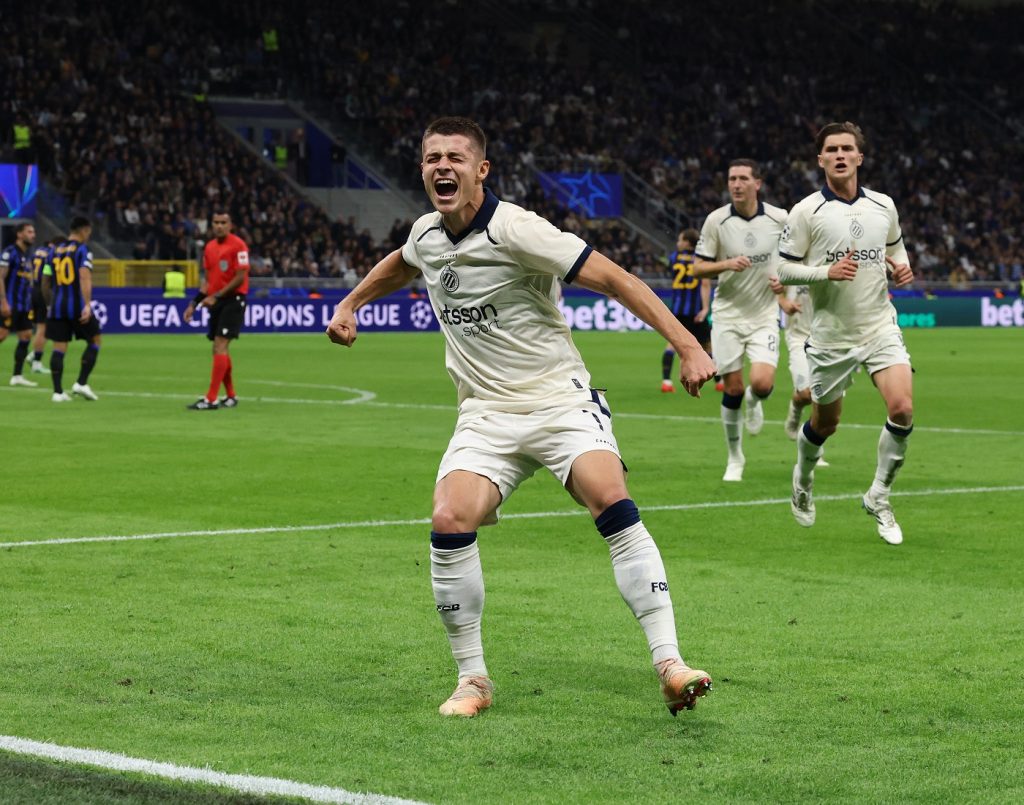
Nicolò Tresoldi took his time walking off the pitch at San Siro. He was in no hurry, having just put three past Inter, secured Club Brugge’s first-ever victory over them at the Meazza, and lived through the most extraordinary night of his career—at least so far. It hardly mattered that whistles rained down from fans waiting for him to disappear into the tunnel: he simply wanted to savour every second, to linger a little longer in his favourite stadium. San Siro is home to Milan, his boyhood club, and facing Inter gave the Italian-German striker the distinct sensation of a derby, even if his history with the Rossoneri is the kind football loves to complicate: a long-distance romance, a trial as a youngster that went nowhere, and the need to start over elsewhere. In Germany, specifically, inside Hannover 96’s youth setup, where he arrived in 2017 as a thirteen-year-old.
When he stepped out at San Siro for Inter–Club Brugge, however, there was no room left for regret. The Belgian side’s centre-forward turned his debut at Italian football’s grandest venue into an immediate statement of intent. First the opening penalty on thirty minutes, then a second on sixty-three, capitalizing on a clumsy mistake by Josep Martínez; finally a third eleven minutes later, nipping ahead of the Nerazzurri defence. Three goals distinct in their dynamics, yet joined by the exact same quality: being in the right place, reading what is about to happen before anyone else, and wasting nothing. Lautaro Martínez tried to reopen the match with a brace, Romeo Vermant grabbed a fourth for Brugge, and Ange-Yoan Bonny pulled another back in stoppage time. But the night already belonged to Tresoldi.
What makes him compelling to watch is that he never gives the impression of an imposing, physical centre-forward. He is an attacker with a balanced frame, lacking the sheer physical presence usually associated with a lone number nine tasked with leading the line by himself. Yet Tresoldi knows how to protect the ball, absorb contact, and win his duels against aggressive defenders. He has no need to physically overwhelm opponents: getting there first, picking the right moment, and using his body intelligently is more than enough. His style is perhaps unflashy, sure, but devastatingly effective. His touches do not demand attention for the sake of it; instead, Tresoldi moves, opens up space, runs in behind, makes himself available, and finishes.
These are qualities that fit seamlessly into Ivan Leko’s setup at Brugge, a side alternating between a 4-2-3-1 and a 4-3-3 that builds numerical advantages out wide through direct wingers and late runs from midfield. In a framework like this, a centre-forward who occupies the box intelligently and converts the work of others is invaluable. Having turned twenty-two less than two months ago, Tresoldi already looks like a forward operating at a high level of maturity, even if calling him a finished product would be premature. The numbers point to concrete progression: after scoring 14 goals in 36 appearances for Hannover, he found in Bruges the right environment to step up again. In this 2026/27 season, prior to his night at San Siro, he had already scored three in his first seven domestic games.
That hat-trick against Inter brings his seasonal tally to six goals across all competitions, demonstrating that he can serve as the focal point for an ambitious side without depending on a single tactical setup. He can lead the line in a front three—his usual role in Belgium—or support an attack alongside a partner, working for the team while creating space for incoming runners. Before choosing football for good, Nicolò played competitive tennis, reaching the Italian Under-12 national setup and sharing courts with players like Luca Nardi and Flavio Cobolli. In an interview with Sportweek, he recalled imagining himself with a playstyle modelled on Carlos Alcaraz: two-handed backhands, drop shots, and constant aggression. Then his family moved to Germany for work, he traded the racket for boots, and joined Hannover’s academy.
Today he speaks four languages and lives abroad, yet maintains a deep connection to the country where he grew up—Gubbio, in the province of Perugia—and to the Milan side he supported as a boy. It is precisely the national team question that makes his story even more intriguing. Born in Cagliari, raised in Umbria, and forged professionally in Germany, Tresoldi has represented German youth setups up to the Under-21s, amassing 16 goals in 26 caps. It is a significant path, which explains why Klopp and the German federation view his eventual call-up to the senior side as a concrete prospect.
The decision, however, is not yet final. In September, Tresoldi explained that he will only make his choice in the summer of 2027, after completing his cycle with the German Under-21s and evaluating both options. Roberto Mancini has also made his move, contacting him to gauge his interest. Italy, in short, remains in the running. And after a hat-trick at San Siro, right under the eyes of a country that so often struggles to recognise its own talent in time, perhaps the moment has come to accelerate. Mancini would do well to push, invite him to Coverciano, and show him that a clear project exists for him too. Tresoldi has already found a way to make his mark in his favourite stadium; now the task is to ensure that when he finally chooses which shirt to wear, Italy isn’t left simply watching.