
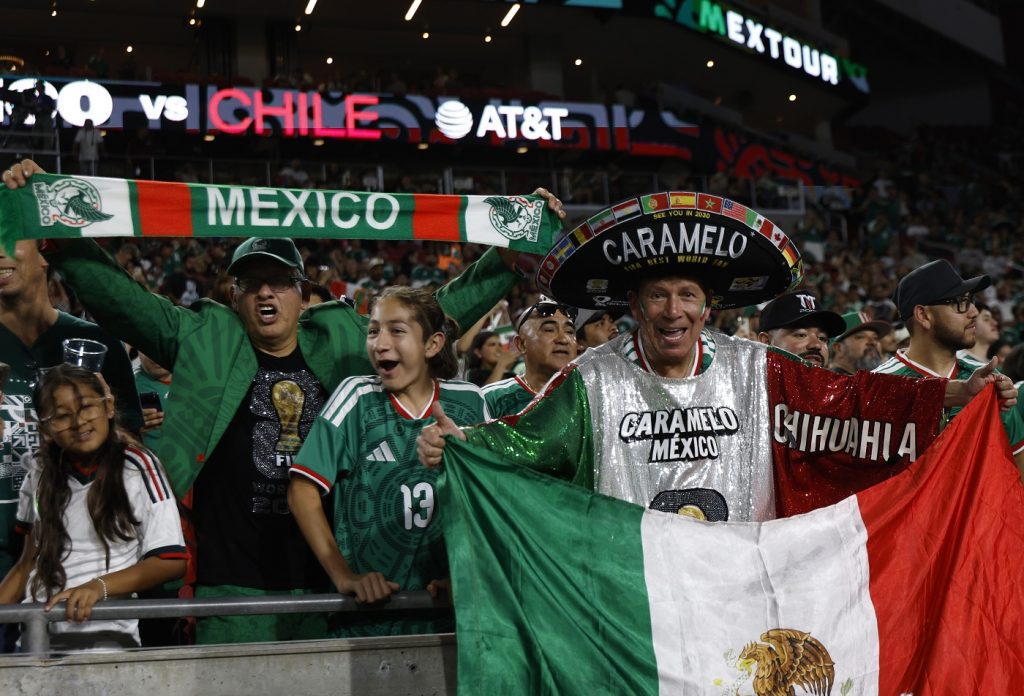
The United States and Mexico are hardly the best of friends, especially in sport, and particularly since Donald Trump returned to the White House. Yet for years now, Mexico’s national team has chosen to play its matches north of the border, beyond El Paso and the wall. The latest came against Chile in Los Angeles: even temperatures that felt like 34°C, with an extreme heat warning in force across Southern California, were not enough to keep more than 56,000 people away from the Los Angeles Memorial Coliseum.
As Forbes reported, the reason is essentially economic. The United States has become a second home for the Mexican national team because it makes financial sense: the stadiums are bigger, ticket prices are higher, and sponsors are willing to pay for access to one of the most passionate — and therefore most valuable, commercially speaking — fan bases in North America. The Chile game was promoted to Mexican supporters with the slogan “Somos locales”: we are the home team. In many parts of the United States, Mexico effectively is. Millions of Mexicans and Mexican-Americans turn up to see the national team, and behind these matches sits a business model that has become essential to the finances of the Mexican Football Federation.
The relationship with the US market dates back to 2003, when Soccer United Marketing, the commercial arm of Major League Soccer, began working with the Mexican federation to organise and promote matches involving the Tricolor. Between then and 2022, tours across the United States drew 4.4 million spectators to 98 games. Around 36 million people of Mexican origin live in the US, giving Mexico a sizeable audience on the other side of the border, one that already knows the team and turns out for it. By 2024, the relationship between the FMF and SUM had generated hundreds of millions of dollars. One report put revenue from the first 12 years of the partnership at almost $400 million, from tickets, merchandise, sponsorships and other activities. These are estimates rather than figures contained in the Mexican federation’s certified public accounts, but they give some sense of the scale of the operation.
The numbers help explain why Mexico keeps returning to the United States. Take El Tri to one of the country’s major stadiums, put them in front of a deeply loyal fan base and sell tens of thousands of tickets. Then there are the sponsorships, concessions, merchandise and media exposure, all adding up to turn an ordinary friendly into a particularly profitable business. There is a downside, of course. Mexico’s frequent friendlies in the United States have also been criticised, with some supporters and observers seeing them as fixtures driven more by commercial demands than sporting ones.
It is a criticism that has followed the team for years. Financially, though, the arrangement is hard to ignore. The United States offers Mexico something the domestic market often cannot: large stadiums full of supporters willing to spend. The games come with an entire commercial operation around them, from sponsors and media to merchandising, and despite the criticism it is difficult to imagine the relationship ending any time soon. In 2015, an agreement between the FMF and SUM guaranteed Mexico $2 million for every match, with a minimum of five friendlies in the United States each year. That was roughly three times what the federation would have earned from playing a friendly at home.
The importance of the American market has only grown since then. When the FMF announced a new six-year agreement with SUM in 2022, its then-president Yon De Luisa said that revenue from US sponsors and SUM-organised tours represented more than a third of the federation’s annual budget. Mexico has also filled stadiums normally associated with American football. In 2024, 85,000 people watched the friendly against Brazil at Texas A&M’s Kyle Field. Across the ten matches Mexico played in the United States that year, average attendance topped 54,000. The opponent does not always have to be one of the biggest names in the game.
That is what makes the model particularly interesting commercially. It is El Tri itself, more than the name of the team on the other side, that brings people through the gates. The Mexican national team is the attraction; the opposition can be secondary. SUM has been central to the arrangement. The company holds exclusive commercial rights in the United States to Mexico’s national teams, including activities connected to the men’s and women’s MexTour. It handles commercialisation, marketing, promotion and event organisation, so the match becomes one part of a much larger commercial proposition. For sponsors, a Mexico game offers access to an enormous and unusually loyal consumer base. That is what makes El Tri so valuable in the American market: the relationship between team and audience is already there, and has been for years. For the federation, meanwhile, the money generated in the United States does not simply finance the senior men’s team. The FMF has said that revenue from the US market also supports its other national-team programmes. The 2022 agreement with SUM expanded the commercial partnership to the women’s national team as well, extending the same commercial model across the Mexican national teams.