
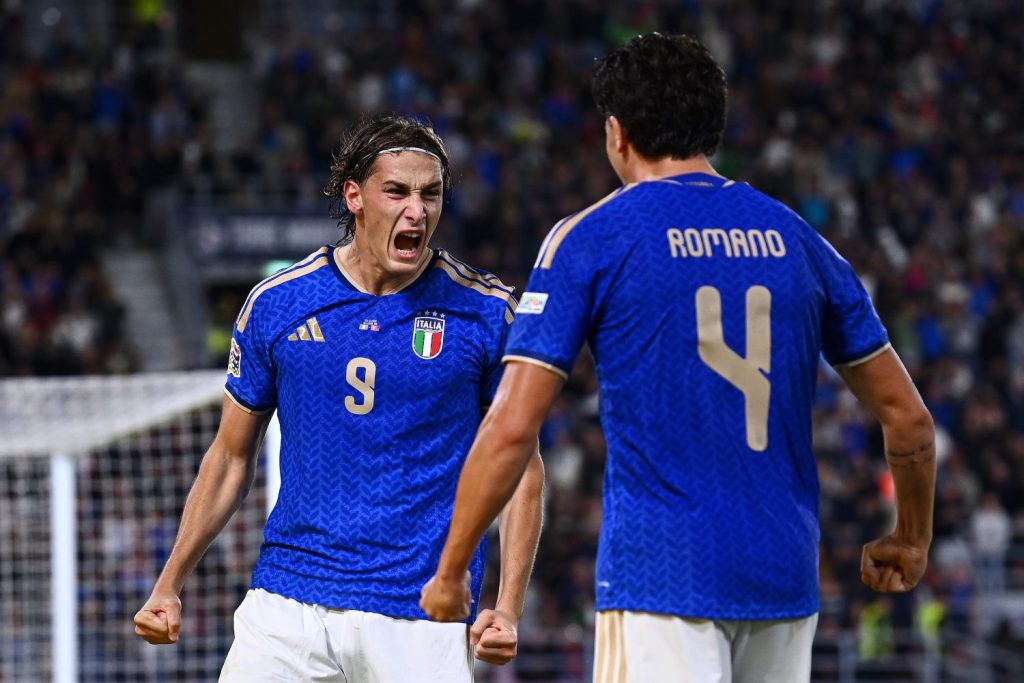
It is true, there is no point denying it: Roberto Mancini’s new Italy won again, 3-1 against Turkey at the Dall’Ara in Bologna, but it was less convincing than the 4-1 a week earlier. There had also been another good performance against France, while in the meantime the coach had changed nine of the eleven starters from the side that drew 1-1 in Paris Saint-Denis. And, last but not least, this was a much-changed group – one that had made a poor start to its Nations League campaign, losing in alarming fashion to Belgium at the Olimpico – playing its fourth game in ten days. A proper tour de force. In short, there is no need to be too fussy. Three points are three points, and second place in the Nations League group is an encouraging sign for what lies ahead.
More encouraging still are the messages coming from within the Azzurri camp, in the names and faces of the new players Mancini has brought in. Some have gone straight into the starting XI, others have been the first men called upon, but all of them have shown what used to be called la stoffa: the talent to play for Italy, and the qualities to suggest they belong there. We are talking about Michael Kayode, Alessandro Romano, Issa Doumbia, Antonio Vergara and Sebastiano Esposito. But also Giorgio Scalvini, Riccardo Calafiori and Francesco Pio Esposito, whom we had already seen in an Italy shirt but who, after this opening stretch of the Nations League, now have to be regarded as part of the core the Azzurri can – indeed must – rebuild around. Alongside the veterans, alongside Donnarumma, Bastoni, Barella, Tonali and Frattesi.
There is nothing particularly bold in saying so. It is simply where Italy are: eight years after beginning his first spell as Italy coach, Roberto Mancini has embarked on a process that resembles, at least in its intentions and basic ideas, the one that led the Azzurri to win Euro 2021. Back then, the veterans were Bonucci, Chiellini, Verratti, Insigne and Immobile, and alongside them came Berardi, Barella, Zaniolo, Di Lorenzo, Tonali, Locatelli, Bastoni and Raspadori, all making their first appearances for Italy. Some of them would go on to become major figures in that European Championship triumph.
Now we are in a completely different world, at the beginning of a completely new cycle and project, but Italy needed fresh impetus; more than that, they needed a jolt, something to bring the national team properly back to life. It has come from players who are still, perhaps certainly, raw and in need of work: Kayode’s instinctive exuberance, Romano’s inconsistency, some naïve decisions from Doumbia, Vergara’s difficulty in managing his energy. There is plenty for Mancini to work on. At the same time, these players have shown the physical capacity and mentality to play aggressive, ambitious football, the kind that demands a great deal of them. They have quality, too, as Kayode showed in Turkey and Vergara at the Dall’Ara, while Romano grew into the game after his poor debut against Belgium. We saw it again in the goals from Calafiori and Esposito after Turkey’s equaliser, the sort of goals that can take the legs out of a side.
That is another point worth noting: a team only recently put together – or at least one that has been changed so radically – could easily have lost its shape after being pegged back at home having taken the lead, could have become stretched and started to come apart, but it did not. Nor should we overlook the fact that, with two wins over Turkey and a draw against France, Italy have secured a place in the top seeding pot for the draw that will determine the groups for the next European Championship qualifiers. It is a small step, certainly, but the mood around this Italy is plainly different from the subdued atmosphere of the second half of the Spalletti era, and from the anxiety that seemed to hang over Gattuso’s team. The credit for this shift belongs, more or less equally, to the players who have already changed the face of the national team and to the coach who identified them, called them up and put them on the pitch.
A little further back, behind Kayode, Calafiori, Scalvini, Doumbia, Romano, Vergara, Sebastiano and Pio Esposito, there are also Samuele Inacio, Ruggeri, Ghilardi and Udogie, followed by the Under-21 players coached by Baldini who tore Poland apart: Ahanor, Bartesaghi, Chiarodia, Reggiani, Pisilli, Ndour, Faticanti, Liberali, Fini, Koleosho, Cisse. Not all of them will become starters for Mancini’s Italy, of course, but the coach now has what he needs to plan and build the future of his national team. And these Nations League matches have shown that he has made a good start, or at least that he is prepared to try.