
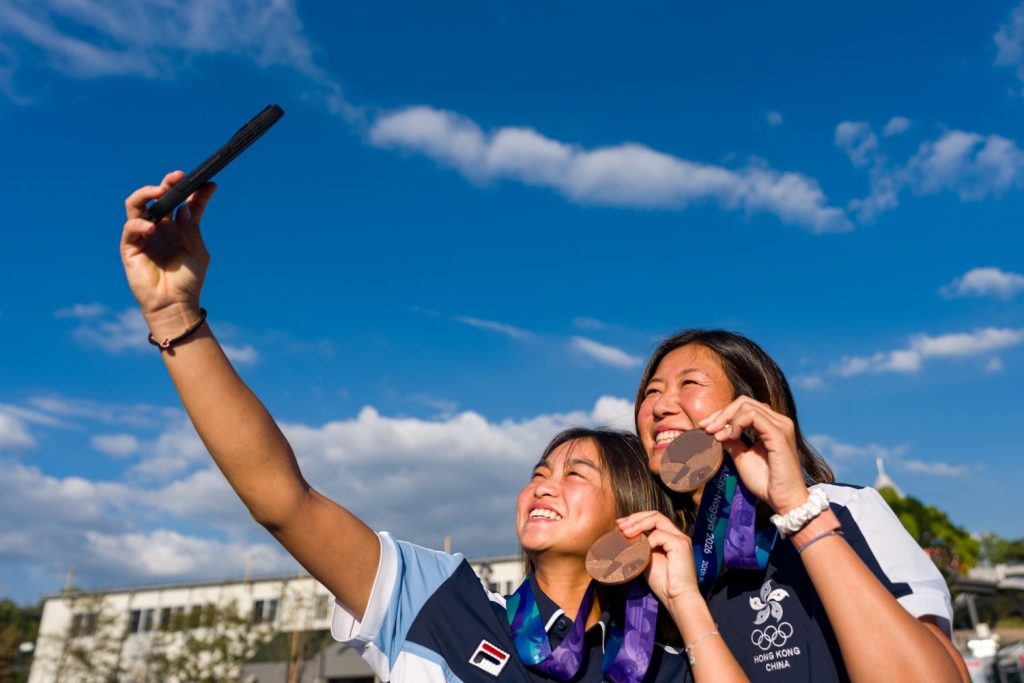
There was a festive air on 4 October at Japan’s Paloma Mizuho Stadium, among the Hong Kong athletes who had taken part in this edition of the Aichi-Nagoya Asian Games. The pictures circulating online told the story well enough: groups gathering for the obligatory photographs, relaxed smiles and, inevitably, the red flags bearing the distinctive Bauhinia blakeana, Hong Kong’s emblematic flower, scattered through every frame. With the Games over, it was not simply a delegation celebrating, but Hong Kong establishing itself as a sporting force on a clear upward trajectory.
After weeks of competition across courts, tatamis and water, the numbers are difficult to ignore: 54 medals in all — eleven gold, 19 silver and 24 bronze — and ninth place in the overall medal table. It is the best result in the history of the Special Administrative Region’s delegation, surpassing the 53 medals won at Hangzhou 2022 and the 46 from Jakarta 2018. But the measure of this campaign goes beyond the tally of gold and bronze, as Wong Po-kee, a senior delegation official, rightly pointed out when speaking to the media before the closing ceremony of the Games.
It is also visible in the generational divide running through the team. On one side, veterans managing the nerves that come with being expected to deliver; on the other, the almost brazen confidence of a younger generation that has grown up without a sense of inferiority towards Asia’s sporting powers. Chief Executive John Lee called it “the spirit of Hong Kong”: in less political terms, a distinctly local form of resilience, the ability to absorb pressure without allowing it to take over.
Look at where the medals came from and it becomes clear that the sporting system of the former colony has changed shape. Sailing and windsurfing remain the historic stronghold — ten medals between them, with the younger athletes naturally dominating the junior categories — but the real shift has happened elsewhere. When Coleman Wong Chak-lam closed out the decisive point in the men’s singles final against Wu Yibing, giving Hong Kong its first-ever Asian Games tennis gold, he said he had “unlocked an achievement”, as though he were clearing a level in a video game. An extreme difficulty setting, cleared without ever losing the composure that great athletes retain once they step onto the court.
It all happened so quickly that he barely had time to check his phone. As he does after every match, he wanted to see whether Rafael Nadal had messaged him. By now it is routine, though there is nothing ordinary about it: his idol has followed and advised him since he was 17, and is now a WhatsApp contact who sends him feedback straight after every match.
Soon afterwards, Leung Yu-hong claimed Hong Kong’s first-ever silver in wushu sanda, at 60kg, while karate delivered authoritative performances in kata and track cycling celebrated a historic podium in the team sprint. From rowing to squash, with the sevens rugby team adding another sign of the squad’s depth, Hong Kong is no longer living off isolated bursts of brilliance and has started to look like a sporting school with a clear sense of purpose.
There is no familiar rhetoric about spontaneous talent behind this success. There is technology, and there is money. Hong Kong’s victories are the direct result of a deliberate political choice: to turn the Hong Kong Sports Institute (HKSI) into an advanced research centre for biomechanics, physiology and data tracking, and to stop treating sport as a secondary part of the city’s public image. The approach was set out in the 2024 Policy Address, alongside increased direct funding for athletes from April 2025 and a broader commitment to covering the costs of international travel.
Michael Cheng, chairman of the Hong Kong China Tennis Association, saw Wong’s gold and the bronze won the previous day by the women’s doubles pairing of Eudice Chong and Cody Wong as proof that “the long-term investments are finally bearing fruit”. Between the concrete of Nagoya’s arenas and the skyline of Victoria Harbour, the sense is that these athletes have done more than string together a series of victories. They have shown a complicated city in perpetual transition a different version of itself: less politics, more hunger; less calculation, more instinct.