
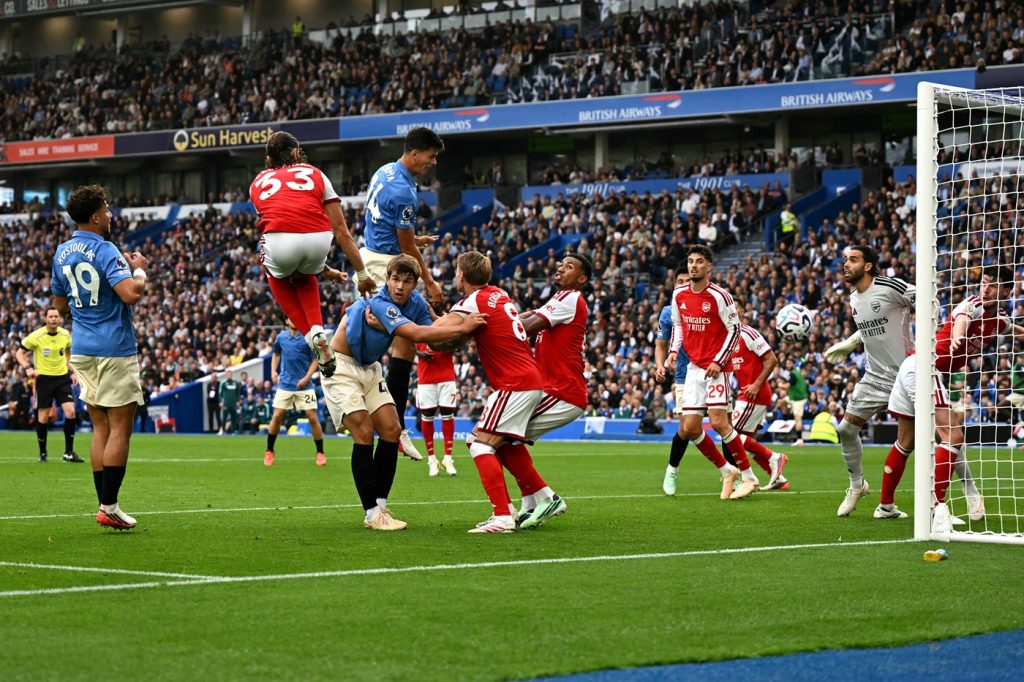
Set pieces, by now, are an obsession in the Premier League. Enough of one for clubs to look outside football for specialists, even as far as mixed martial arts. Brighton did just that, bringing in Christian Eckerlin, an MMA fighter with a background in professional football, to help the Seagulls with the physical side of set pieces. Last season, Brighton asked him to work on dead balls. Eckerlin, 39, had played professionally in Germany before turning to MMA, and brought something to the pitch that English footballers might not have had: an understanding of how to use the body when the ball is in the air, in duels, in contact and when fighting for position.
“I taught them grappling, head control, hip control and how to use their bodies to fend off opponents,” he told the BBC. “The Premier League is more physical, more aggressive, and they don’t know how to use their bodies. Brighton would send me videos to show me how they defended, and they hardly ever used their hips and arms.” The work started in the gym, in the weights room, before moving out onto the pitch. “And it worked. That’s what I did: I opened some doors.” The line could almost stand for Eckerlin’s life, because he has had to open those doors himself more than once. He was a professional footballer from 2005 to 2009 and, at the height of his career, played for Darmstadt in Germany’s third tier. As a boy, though, he had a bigger dream: to wear the shirt of Eintracht Frankfurt, the club he had always supported.
Then football ended, or at least that was what he thought. Eckerlin grew up in Erbach, a small town near Frankfurt, and the ball was “his first passion”. In the youth ranks, he came up against players who would go on to become major figures in German football, among them Bastian Schweinsteiger and Mats Hummels. He played at left-back, although he admits he was never “a technical player”. More of a fighter, he says. At 20, his relationship with football came to an end. After a few disagreements with coaches, he decided to leave. “I’d started getting into a bit of trouble and going out with friends, but the coaches didn’t like me as much anymore. They’d tell me, ‘You can’t do these things.’ I was young, though, and I didn’t have anyone on my side telling me, ‘Calm down and keep going.’ So I said, ‘OK, I’m leaving.’”
Then came MMA. Almost perversely, it was his career as a fighter that eventually took him back to the place he had once imagined as the pinnacle of his football career. In 2024, Eckerlin fought his compatriot Christian Jungwirth at Frankfurt’s Deutsche Bank Park, in front of almost 60,000 people. It was the most-watched MMA event of the year. On Saturday, he will return to the same stadium — the Waldstadion, to those who still call it by its old name — to face Czech fighter David Kozma at Oktagon 94. Almost 60,000 people are expected once again.
At 39, Eckerlin knows there is not much time left. “This could be my last fight,” he says. There is no better place to finish: “There’s no better way to stop than doing it at home, in my own backyard.” Meanwhile, on the other side of the Channel, his old football life keeps crossing his path. Eckerlin knows Brighton manager Fabian Hurzeler through a friend who had played with him in Munich. It was Hurzeler who invited him to England, where he spent three days working with the squad. Everyone, he says, picked up the techniques he had brought over from MMA, although three players in particular seemed to have a natural feel for them. “Danny Welbeck, James Milner and Lewis Dunk had a particular feel for this kind of work.” How much those three days had to do with Brighton’s results is impossible to say, and Eckerlin is the first to make no such claim. Still, there is something circular about his story: a boy who wanted to play in his home stadium, a footballer who walked away from the game, a fighter who returned in front of 60,000 people and, in between, an MMA fighter brought in by a Premier League club to teach its players something he has spent his life learning — how to handle himself in a duel. For Eckerlin, football never really went away. It simply found another way back.