
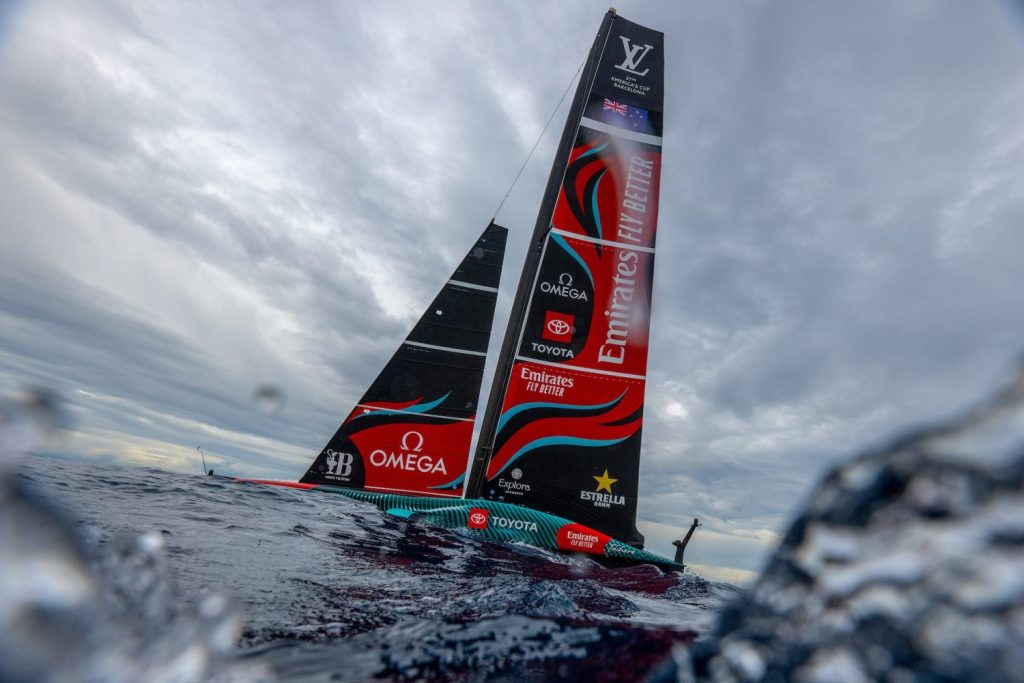
Mount Vesuvius sits low on the horizon to the east of Naples, while Capri closes off the Gulf to the south. Beyond it lie Procida and Ischia, two dark shapes that seem to drift across the water as the light changes, sometimes sharply defined, sometimes almost swallowed by the haze—as though the Gulf decides each day whether to reveal them or keep them hidden. Between them lies the sea: for centuries a busy commercial harbour, constantly crossed by merchant ships. Then tourism transformed it, bringing ferries bound for the islands, enormous cruise ships and yachts moored along the coast. But from September 2026 to July 2027, these waters will host something never seen here before: the AC75, boats just over 20 metres long, capable of skimming across the surface at close to 100 kilometres an hour, their hulls lifted clear of the water by two T-shaped foils. They are the boats of the America’s Cup, the oldest sporting trophy in the world.
Watching them sail bears little resemblance to what we traditionally think of as sailing. Carbon-fibre hulls with flowing lines, two steel arms extending from their sides and ending in slender foils. Once the wind fills the sails, the boat surges forward and lifts clear of the water, reaching speeds that, only a few years ago, would have seemed unimaginable for a sailing boat. The crew hangs between the waves and the sky, suspended above a hull that looks as if it has come from the future—conceived and refined in its early development by Luna Rossa and Emirates Team New Zealand, with OMEGA as technical partner since 1995.
No other sporting trophy has been contested continuously since 1851, yet few competitions have changed so radically, so often. Every edition brings a new version of the sport, driven by new technology. Beneath the boat, though, the constants remain. The wind. The sea. And, above all, time: measured in thousandths of a second, the sliver that separates victory from a race simply sailed well.
“You can’t buy time,” says Grant Dalton, OMEGA ambassador, CEO of Emirates Team New Zealand and a man who has seen the America’s Cup from almost every possible angle—first as a sailor, now leading the most successful team in the Cup over the past twenty years. This is not simply a race against the clock, he says, in which the winner is whoever gets around the course fastest. Time is already being won or lost long before the boats reach the water. “If you design a boat to launch in October and you launch it in November, for example, you’ve already lost a precious month. And in this sport, you never get those 30 days back.”
Everyone in the America’s Cup has the same amount of time. The clock starts for every team at exactly the same moment: the end of the previous edition. Each has the same number of years to prepare for the next one. Almost everything else changes from one cycle to the next—the rules, the boats, even the waters they race on. What matters is who uses that time better: in planning, in thinking, in the smallest details. Emirates Team New Zealand’s record speaks for itself. Three victories in the last three editions, and now a title to defend in Naples. OMEGA will be the Official Timekeeper of the event for the fifth time in its history.
Out on the water, the wind can shift without warning; one unexpected wave can upset the boat’s balance. The sailor at the helm has to read what is coming, to register the change before it becomes obvious. Time matters even more here. There is no chance to correct it, no second attempt. An instant, once gone, stays gone.
There are two sides to the America’s Cup: the defender, the team that won the previous edition, and the challenger, the one crew to emerge from the long selection process among the teams seeking to take the title. “For me, time comes down to precision,” says Diego Botín, the Spanish sailor, one of the best in the world, Olympic gold medallist in the 49er class at Paris 2024 and an OMEGA ambassador. “You have to be precise when the starting gun goes, at the starting line. You have to execute every manoeuvre at exactly the right moment, with the right choreography. Everything is connected. There is very little time to make decisions, and you have to be extremely precise in how you use it.”
Few people know sailing better than Botín, now competing in the America’s Cup with the French team, one of four crews preparing to challenge the New Zealanders, alongside Luna Rossa, the British and the Swiss. Sailing is part of his family history: a father devoted to offshore racing, an uncle who designed boats. But more than technique, he says, what they passed on was “a real passion and the search for a freedom you only find out on the water”, where you are left alone to deal with the invisible. The same feeling took hold when he was a child, on his first Optimist, discovering the thrill of being able to head wherever he wanted. It became an obsession, carrying him to the top step of the Olympic podium in Paris in 2024 and now into the America’s Cup.
Sailing is a sport built on balances that are never quite still, much like the water beneath it. Even the sense of time can shift. On board, seconds stretch and contract without warning, as Peter Burling explains, OMEGA ambassador and the helmsman who led Emirates Team New Zealand to three consecutive victories before moving to Luna Rossa in 2025. Before the start, time is hard and unforgiving. The boat has to cross the line precisely as the clock reaches 0:00: a thousandth of a second early means a penalty; a thousandth late can cost the race. Then it loosens. It becomes tactical, something to be worked with all the way around the course. “You need discipline in the details and, at the same time, a great deal of flexibility,” Burling says. It is in that tension that he finds his connection with the watch brand. “In this sport, time is a crucial factor. It puts limits and deadlines on you all the time, both on and off the water. Sharing OMEGA’s philosophy of time management has taught me how to calculate it and, above all, how to navigate it.”
For Burling, the sea has never been only about competition. Anyone who spends a life on the water learns its strength, its fragility and its secrets. For the New Zealander, that familiarity became something more personal, and then something more urgent: a responsibility to protect the place he calls home. In 2019, that conviction led him and his longtime teammate Blair Tuke to establish Live Ocean, a foundation dedicated to protecting marine ecosystems and actively supported by OMEGA. The realisation came during The Ocean Race, the world’s longest and toughest offshore crewed sailing race, when Burling began to understand how little he actually knew about the immense expanse he had spent years crossing. “It’s time to make the oceans an absolute priority, investing in science and awareness,” he says. The oceans absorb more than 95% of the planet’s excess heat. They cover 70% of the Earth, and yet remain largely out of sight and out of mind. It is something the Luna Rossa sailor can no longer ignore.
For the 38th edition, however, the America’s Cup will leave the open ocean behind. Its home will be the Gulf of Naples—for the first time in Italy. A city where wind, sea and the passage of time have long been woven into its myths and legends, part of the same mystique. Dalton himself chose Naples, for reasons that went beyond favourable sailing conditions. “We did some small regattas there in 2012 and 2013, and it was incredible. The people were fantastic. Usually you hardly remember the regattas—we do so many of them. But those two are unforgettable. Just because of the people, the passion, the warmth.”
Between September 2026 and July 2027, the AC75s will race beneath Vesuvius, between Capri and Ischia. When their hulls rise above the water in front of Italian fans, it will once again come down to time—the same measure, recorded with the same precision—to decide who takes their place in the history of the oldest and most modern competition in the world.