
In 2010, after losing the World Cup final to Spain, Dutch football culture magazine Hard Gras featured Nigel de Jong’s infamous challenge on Xabi Alonso on its cover. The headline read: “The new Dutch school”. They were World Cup runners-up and almost seemed ashamed of it. Bert van Marwijk’s pragmatism, transformed into outright ferocity in the final, had left its mark, much like De Jong’s studs on the chest of the Spanish midfielder. There was, of course, no consensus, either among those inside the game or, even less so, among the wider public. The achievement remained remarkable for a country that had rarely managed to climb so high.
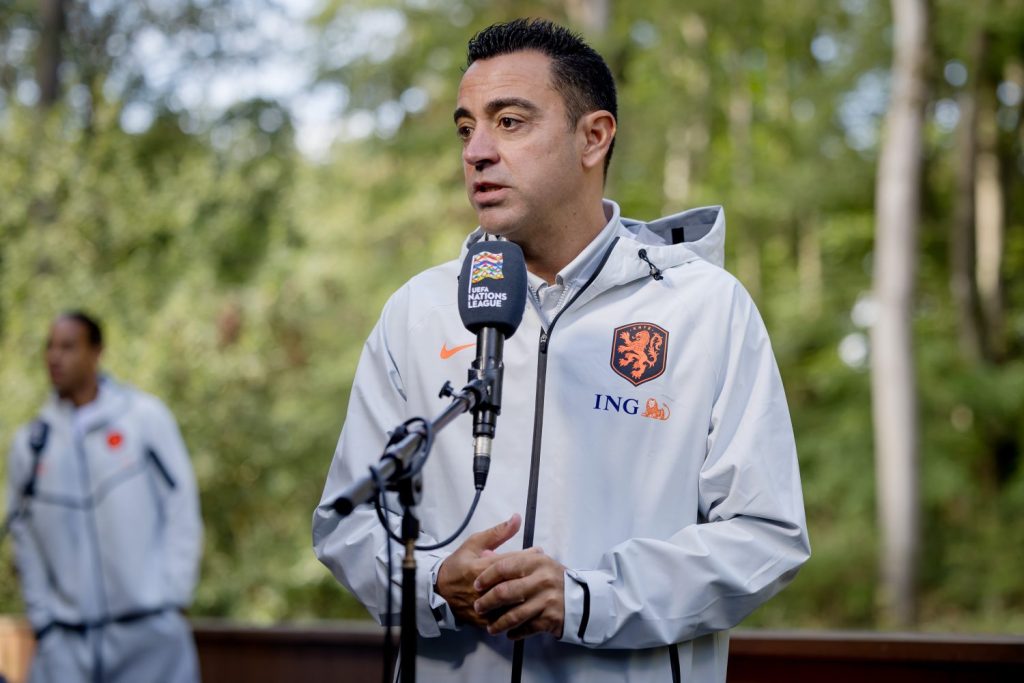
Sixteen years later, it was Nigel de Jong himself, in his role as Director of Top-level Football at the Dutch Football Association (KNVB), who had to choose Ronald Koeman’s successor as Netherlands manager. A curious turn of events: the player who had, against his will, become the symbol of the loss of Dutch football DNA (“Dutch football is a punishment for the eyes and a pain for the heart,” Johan Cruijff declared during the South African World Cup) was now tasked with responding to the increasingly insistent demand to return to the roots. To a football philosophy more in keeping with the history and tradition of the Dutch game. De Jong opted for one of his opponents that 11 July at Johannesburg’s FNB Stadium: Xavi. He too is a symbol, only this time a positive one, of a football revolution whose roots led back to the Netherlands. Because that was where Rijkaard’s Barcelona came from, before becoming Guardiola’s – the man who, according to former Ajax adviser Keje Molenaar, “contains in his mind the place where Cruijff and Van Gaal, lifelong bitter enemies, met”.
In that Spain, Xavi’s Spain, the Netherlands saw what it was no longer. The question of Dutch DNA remained a thorn in the flesh of Oranje football, one every coach who came after Van Marwijk had to live with. And yet the coaches who tried hardest to return to the old principles, Hiddink and Blind, were also the men in charge when the national team collapsed, missing Euro 2016 and the 2018 World Cup. Players dramatically ill-suited to that kind of football brought down a structure that Van Gaal had held together, superbly, with a third-place finish at the 2014 World Cup, where the Netherlands had even lined up with the heretical back three – or back five, depending on the occasion.
It took all of Ronald Koeman’s pragmatism and adaptability to put the national team back on its feet. Tradition was once again set aside in favour of realism, but the thorn remained, ready to throb whenever the results fell short of expectations – which was almost always. After the largely forgettable Frank de Boer interlude, the third act of Van Gaal, which ended with a quarter-final exit at the 2022 World Cup, made the purists wince, while Koeman’s return proved less convincing than his first spell, above all because of a certain inability to make the Netherlands feel like a national team that once again belonged among the elite. During his tenure, the team failed to beat any of the top 25 nations in the FIFA ranking. The summer’s last-16 exit against Morocco, after a match in which the Netherlands had just 29.9 per cent possession, was the epitaph for an adventure that would have ended anyway, at Koeman’s request, after the World Cup. But going out in that fashion reignited the old debate, leaving the KNVB remarkably unprepared. Because Xavi, whatever his image, has united everyone – at least until the first matches begin – and is in fact the third choice.
Faithful to the line, there is no line: one of the best-known songs by CCCP perfectly captures a KNVB that took 43 days to decide Koeman’s successor. De Jong had laid down his conditions: the new coach had to be under 50, have a proven ability to work with young players and possess a strong international CV. It looked like a profile tailor-made for Arne Slot, who turned it down for financial reasons: managing the Netherlands would have meant giving up money still due to him under his Liverpool contract, and it was a lot of money. Counting other people’s money is as common as it is irritating, so we will refrain from any further comment.
The most Cruijffian of the Dutch coaches remained PSV’s Peter Bosz, who was waiting for a call too; but because he did not meet the age requirement, the KNVB did not even consider him. Nor did it consider Erik ten Hag and Van Gaal, both of whom put themselves forward but were never approached by De Jong, and both of whom – Ten Hag above all – took part in a rather unedifying sideshow. Plan B thus became Michael Reiziger, a federation choice in the De la Fuente mould, given his experience with the Under-17s (assistant), Under-21s (manager) and senior national team (assistant), as well as his title-winning spell with Jong Ajax in the second tier. Reiziger, however, lacked international experience and appeal, making him an easy target for a media and social-media campaign centred on his supposedly limited charisma and the consequent, equally supposed, inability to command the attention of the big names. The result? De Jong changed course and slammed the door in Reiziger’s face.
Xavi’s name came from Jordi Cruijff, now at Ajax, who had wanted the Catalan in Amsterdam, only to be turned down for family reasons. The national-team job, however, carries a different workload from a club position, and the Federation was therefore able to resolve the question of its new manager. One mystery remains, though: what vision did De Jong and Marianne van Leeuwen – the director of professional football – present to Xavi, given that no one has been able to discern a clear direction from the Federation in recent years?
In reality, at least as a narrative, Xavi is perfect. Despite being the Netherlands’ first foreign coach since Ernst Happel, he represents less a break than a return to the roots of Dutch football. Technique over physicality, possession, the accordion principle of football described by the Spaniard himself in an interview a few years ago. Xavi spoke of Cruijff’s “accordion”: the idea that a team must remain in constant motion, opening spaces and then closing them again, the ball circulating constantly as players read the game, occupy spaces and create them for their teammates. On paper it sounds simple, almost obvious. That is precisely where the difficulty lies.
It brings us back to one of Cruijff’s most famous sayings: “Playing football is simple, but playing simple football is the hardest thing there is.” The concept requires players to possess not only technique and discipline, but an understanding of space and timing. Xavi has to instil all of this in a group whose composition will change at every international break, which he will have at his disposal only for limited periods, and which includes several players who play a different way at their clubs. It will take time and patience. At least in that respect, De Jong’s choice was beyond reproach. Xavi’s name provides an umbrella capable of shielding the Federation from criticism, should things not work immediately, far more effectively and for longer than Reiziger’s could have done. This is how it works now: when the CVs are equal, or almost equal, the difference is made by the image.
Compared with Slot, there is no contest. Against Reiziger, though, Xavi can at least point to his experience at Barcelona – bittersweet though it was. On the one hand, in his first 50 matches with the Blaugrana, his points-per-game average was lower than those of Ernesto Valverde, Luis Enrique, Rijkaard, Gerardo Martino and even Koeman. On the other, the disastrous circumstances in which he found himself working have to be taken into account: a club in financial collapse, from which it could emerge only because it was Barcelona, and no longer even the protective shield provided by Lionel Messi. The fact that he managed to win the league with a team that, on paper, was inferior to Real Madrid’s can therefore be regarded as a significant achievement.
Xavi also dared to make difficult decisions, such as sidelining Piqué and Jordi Alba. With that managerial approach in mind, there was considerable curiosity surrounding his first Netherlands squad. The expectations were met. There was an emphasis on the young players performing best at the moment, with first call-ups for PSV Eindhoven’s Ruben van Bommel and Feyenoord’s Gjivai Zechiel, while AZ Alkmaar talent Kees Smit, hardly sparkling in this early part of the season, was left at home. No clean sweep: Memphis Depay was left out, having gone to the World Cup only because he was Koeman’s favourite, while Virgil van Dijk remained. Then there were the choices that caught the eye, such as the call-up of Kenneth Taylor, whose real potential Francesco Farioli had shown a couple of seasons ago. For now, then, there is that wind in the sails that Koeman had been missing for some time. The rest, as ever, will be decided on the pitch.