
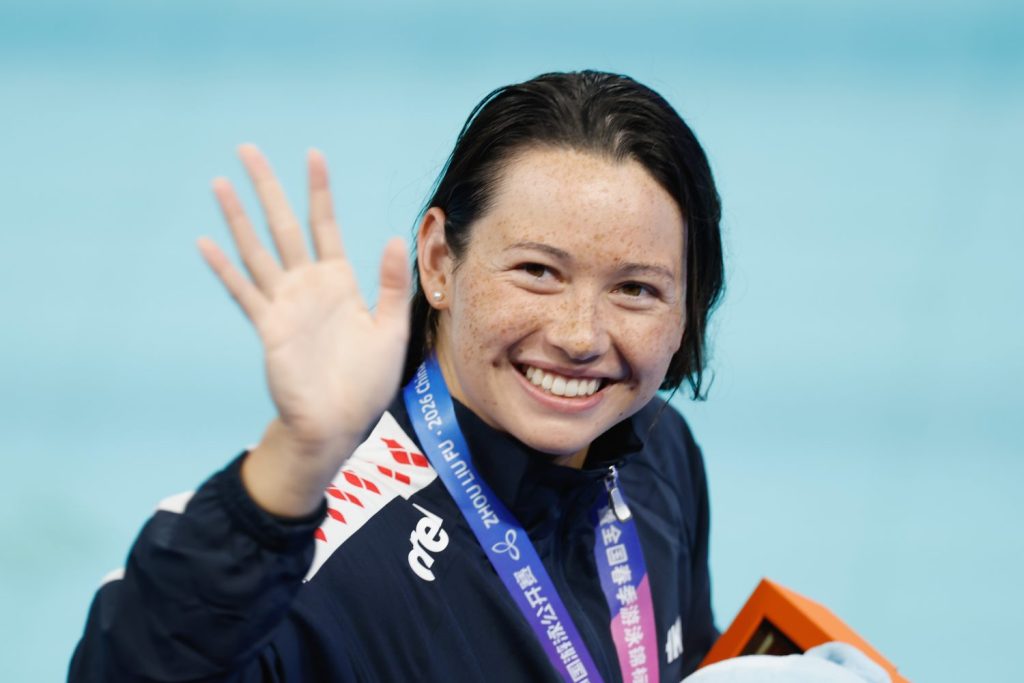
At the Asian Games in Nagoya, as the foam in lane four disappeared, the scoreboard read 52.45, a number that had little to do with the race itself. For Siobhan Haughey, it was the perfect reward for a turn that carried her to gold in the 100 metres freestyle, leaving the Chinese pair of Yu Yiting and Cheng Yujie behind. It was her second individual title in twenty-four hours after the 200, but above all it was a statement that reached well beyond the pool. Defending a continental title in 52.45 goes beyond a simple display of strength: it is physics applied to ageing in elite sport. In swimming, at 28, biology starts to make itself felt. The kick loses some of its explosiveness and seventeen-year-old rivals drive their stroke rates as if fatigue were someone else’s problem. Beating them means compensating for the inevitable biomechanical decline with a tactical awareness that simply does not exist at twenty. This is where Haughey’s story stops being a spreadsheet of times and athletic parameters and crosses paths with the story of Hong Kong. A city-state long accustomed to thinking of itself as a financial centre suddenly finds itself capable of producing Olympic excellence of the highest order, from Haughey to fencer Cheung Ka Long. Raised in local pools before joining Michigan’s NCAA programme, Haughey has become a sporting icon for a place that continues to redefine its identity between East and West. Her four Olympic medals between Tokyo and Paris measure the weight of a community that has found in her an entirely new story.
Then there is the human element, the one performance graphs do not record. “I don’t know how many more opportunities I’ll have to race in front of my parents,” she said afterwards. A simple sentence, except that in 2021, when she won her first Olympic silvers, there was only the surreal silence of an arena emptied by Covid, with her family shut away at home on the other side of the world. Having her mother and father there, five years later, changes the feel of every single stroke. Up close, what strikes you is an almost disarming normality: the constant smile, her YouTube channel, titled Chlorine and Chaos, the recurring joke about wanting to race the men to show what female athletes are made of. The same attitude slips naturally into the language of lifestyle and high fashion. In a shoot for Chanel’s celebrated J12 ceramic watch collection, a timepiece inspired by the America’s Cup sailing boats that Siobhan often likens to the millimetre precision required in the pool, she spoke about her idea of balance: “We often associate being an elite athlete with a rigid kind of perfectionism. Lately, the water has taught me another kind of power: the wisdom of flowing, adapting and allowing yourself to breathe. True resilience isn’t about constant tension, but knowing when to let go and embrace vulnerability.”
With a fourth continental gold to her name and four Hong Kong Sports Stars Awards as Athlete of the Year, whether she is the greatest athlete in the city’s history could be debated forever. It is a bar-room argument, or one for a sociology seminar, and one that seems to interest her very little. When the lights go out and the media noise fades, what remains for Siobhan Haughey is the routine of someone who starts again every morning at five: adjust the cap, climb onto the blocks and enter what she calls Go Go Mode. Go, go, go, without ever looking back.